“Pinocchio” The Musical

Event: “Pinocchio” The Musical by The Singapore Repertory Theatre’s Stage Two
Venue: DBS Arts Centre
Run: 4th Nov – 12th Dec 2010
New musicals with brand new songs are always eagerly anticipated by the two of us (or me at least).
I always make it a point to go catch brand new musicals in town, few as there may be, because it definitely is not easy to come up with music and songs to fill a full-length musical.
This particular musical is written by Jean Tay (“Everything But The Brain”) and directed by Darren Yap (“The 25th Annual Putnam County Spelling Bee”), with original music and songs provided by David Shrubsole.
The evergreen fable of “Pinocchio” seems like a very apt choice of material for a musical adaptation by the SRT’s Stage Two, considering the fact that timing of the production’s run and the way in which it was presented clearly hinted that it was mainly targetted at children.
There are enough intrinsic magical elements in the tale to enchant kids and keep them engrossed, and Darren Yap did justice to that fact by pulling off many special visual stage effects within the musical.
It was definitely the most “magic show” kind of musical which I ever watched, and I say this in the kindest and most positive possible way. (Hey, I’m a big fan of magic, y’know.)
I was certainly impressed with the way they managed to make Pinocchio’s nose grow magically longer every time he told a lie.
If my sense of judgement serves me correctly, his nose grew not just two feet long, but as much as two metres long!
There were many other delightful little magical effects thrown in throughout the musical, not least of which was the beautiful finale at the end when Pinocchio the wooden puppet finally transformed into a real live boy in the most magical possible way.
I particularly also liked the part where Pinocchio sat on the bird that literally flew across from the front to the rear of the theatre, right above our heads.
The songs were a mixed bag that traversed a few genres, but while they were highly functional, few melodies actually stood out for me.
Credit must go to all the cast members for having not only to act and sing, but to also be able to carry out their puppetry duties, which by the looks of things must have required hours and hours of practice, since I do not believe that many of them have had prior expertise in puppetry.
It must have been a huge challenge for the cast members to have to shoulder so many different tasks, but to their credit, they performed remarkably well.
All in all, even though I may have been a few decades older than the intended target audience for “Pinocchio The Musical”, I would shamelessly say that I thoroughly enjoyed myself and was mesmerised by the many magical effects that unfurled before my eyes.
Definitely a wonderful show to bring kids to.
Pinocchio: The Musical

The story of Pinocchio has been one of my more memorable childhood fairytales, especially with Disney’s 1940 version of it. I’m sure many parents have actually made reference to it – don’t lie or your nose will grow long like Pinocchio. The film had some really nice music like “When You Wish Upon A Star“, which has since become the theme song of Disney.
So, how will our SRT musical stage version of Pinocchio be? Book by Jean Tay, Music & Lyrics by David Shrubsole and directed by Darren Yap, this was a family-friendly children’s musical with magic, colours, and puppetry. Yes, puppetry. I’ve not watched a puppet production for really long, with the last probably being Avenue Q. I’ve always been fascinated by puppetry which really tests the storyteller(s) and skill at controlling the puppets. With Pinocchio being a puppet, what more apt than a puppet show? It wasn’t exactly pure puppetry though as there were characters played by humans, but it was nicely mixed.
I enjoyed myself watching the show, and I believe, so did the dozens of kids in the theatre. It’s a refreshing break from the usual serious/adult stuff. Done with an Asian twist with costumes and even a segment with multi-ethnic puppets to add local flavour, the songs were not bad. One memorable song was “Round the Corner” since they reprised it a couple times. The programme didn’t include the song titles, but I think I liked the song sung by Pinocchio when he wished about being a real boy.
Joanna Ampil’s (Blue Fairy) voice was beautiful. Except for Dwayne Tan (from Wild Rice’s Snow White), who was the voice for Pinocchio, and her, the rest of the cast played many parts, as various characters, including puppeteers. They all did pretty well. The cricket, strangely, had a resemblance to Yoda from Star Wars though. Enjoyed the sets and “magical effects” like flight and of course the puppets too.
It’s heartwarming to still go back to these timeless and pure stories of filial piety and teachings of honesty, to be hardworking, and being good in general. It’s hard to find such “innocence” in productions these days, or maybe I should catch more children productions.
The show runs till 12 December, at DBS Arts Centre.
The Water Coolers


Created by: Thomas Michael Allen and Sally Allen
Cast: Peter Brown, Michael Andrew Daly, Amanda Ryan Paige, Rob Marnell, Brooke Wilson
Piano/Musical Director: Cody Stine
We walked into the theatre not knowing what the plot was about, except that it had something to do with the office. And there wasn’t really a plot, but rather, it was a musical revue of life in the office. It was broken up into many segments, mostly exposition of characters in the workplace. Props were quite simple – 3 chairs, 1 desk and a piano. Yes! it was live music from the piano. We saw a good crowd, almost full house, on the opening night.
It was hilarious, even though I probably missed some jokes due to my lack of understanding of some American slangs. I think most of us could relate to the various scenarios and personally, probably know of the characters depicted.
The show started off with the “turn off the phone” reminder, which had 1 player on the phone in the front row as another (on stage) told him to turn it off. Soon, he was on stage and they started the musical revue, followed with the opening number called (surprise!) “The Opening Number”. 🙂 Going into the main programme, it was “Paranoia”, singing “Paranoia! Paranoia!” to the chorus of Handel’s “Hallelujah” from Messiah, where colleagues got paranoid when they faced the insecurity of being “left out” or “dispensable”.
There was also the woes of “The Hottie” in the office, “The Great Pretender” (those that pretend to be very busy but not actually doing much work…sung to the tune of the song of the same name), the irritating “devil’s advocate” (i.e. the saboteur who refuses to accept others’ ideas), etc. They even had a segment on the transformation of work life when “The Palm” was introduced in 1996 (i.e. love addiction to the gadget), which has now evolved to become more a “con” with blackberrys, where we’re too connected (asks for immediate response to work stuff).
I think I liked the parts “P.C.” (politically correct – with reference to dealing with relationships with colleagues of the opposite sex) and the “Helpline”. I thought it was quite ingenious with the former, when they did the evolution-of-man pose when they sang the part on “Evolution of Man”. In the latter, it depicts some people’s fear of calling the helpline because they are afraid of appearing stupid. There was one part where the guy voiced his fears – “they laugh at you!” and a colleague responded with something like “you mean you heard them laughing?”, and he replied “that’s why they put you on hold!”. The “IT cowboy” was quite amusing who becomes like the “saviour”. He explains the problem with a load of technical jargon and the solution to the problem? Restart the computer. Ha!
There’s also an interactive segment with (can you guess?) the cheesy team building exercise that we all learnt to hate in corporate life. 2 of the audience were picked to go on stage to play games and “forfeit”…just like any team building exercise. My friend and I were just talking about how crappy team building exercise can be earlier today! So I was extra amused. Ha! Good thing I wasn’t sitting in front.
There were just too many segments that I can’t recount them all. However, it ended quite sweetly and appropriately, reminding us that despite all the work dilemmas and frustrations, the bottomline of why we work is providing for our loved ones.
My breakdown probably doesn’t make it appear funny, but you can’t describe humour. You need to catch it for yourself.
A Little Night Music by Stephen Sondheim
No, it was not Mozart, but honestly, I went to this musical not really knowing the story. But it’s music by Stephen Sondheim, so one should go, even though the company refused to reveal who were in the cast till really late. The story can be found here.
What did I make of the musical? Let’s start with the good points first. The dialogue was humorous drawing laughs from the audience with its wittiness. Some song highlights included the well-known Send in the Clowns and It Would Have Been Wonderful (I liked the lyrics). A Weekend in the Country was pretty catchy too. The lyrics of the songs were good, quite a few pretty humorous, witty & wry. But I must say the music was rather “complex” (as my friend puts it), with many layers, and can be difficult to sing.
However, the story to me was rather frivolous and as another friend puts it, like a soap opera. The 1st act was a little too “draggy” to lead to the point of conflict. I was a little amused by the ending when Desiree and Frederik finally came together and embraced each other. Somehow, the way that scene was played out seemed a tad “cheesy”. And the way her mother died was pretty abrupt.
My friend was asking me during the show what the role of Desiree’s mother was. I couldn’t think of it then, except that Desiree probably took after the mother and she provided the venue for the weekend fiasco which was the climax of the show. But now, as it suddenly came to mind, I began to wonder if it was similar to the role of Puck in “A Midsummer’s Night Dream” by Shakespeare. And come to think of it, there can be similarities drawn from both stories.
Stephen Sondheim’s “A Little Night Music”

Event: A Little Night Music
Venue: Esplanade Theatre
Run: 9th Nov – 14th Nov 2010
My first ever Sondheim musical, and boy was it an experience.
The thing about Sondheim musicals is that you are constantly being fed with some of the finest and wittiest lyrics in all of Broadway, and it’s hard for the brain not to be stimulated by the constant full-on assault on your senses and your intellect.
But more on that later.
I was there on opening night, and the theatre was in my estimation around 60%-65% filled.
Not too bad for a Sondheim musical, I thought, since Sondheim musicals aren’t exactly the most marketable of shows.
That being said, if there was one particular Sondheim show that would be at least somewhat marketable, I reckon “A Little Night Music” would be it, partly because it contains one of Sondheim’s most commercial hits – “Send in the Clowns”.
For me though, the main draw was my favourite Sondheim song “Every Day A Little Death”, the lyrics from which this blog takes its humble name from.
I wasn’t too thrilled by the entire plot line of the musical, partly because I felt it took too long to get anywhere, and also because it represented a deviation from the classical musical theatre plot form of a main protagonist stating his ambition early on and spending the entire show achieving his objective.
(My friends commented that the first act almost resembled a TV soap opera, which was very true.)
But I guess therein lies the genius of Sondheim, the man who is widely-regarded as one of the most revolutionary and most important figures in musical theatre in the last four decades.
Although the book by Hugh Wheeler had its shining moments, the star of the show would definitely have to be the carefully-crafted lyrics as well as the impossibly-intricate music (which was composed almost entirely in triple time).
Sondheim started out his Broadway career being a lyricist for hit shows such as “Gypsy” and most notably “West Side Story”, so his genius as a supreme lyricist is unquestioned.
However, his musical compositions deserve equal attention as well, because some parts in “A Little Night Music” were so incredibly complex that I just shook my head in disbelief.
One fine example would be the counterpoint constructed in the early trio of songs “Now”, “Later” and “Soon”, which just took my breath away.
You had three different characters singing each of the three songs, revealing their innermost desires and insecurities, and then at the end all three songs come together in the most glorious possible way.
Another example would be the polyphony in “Perpetual Anticipation”.
“Every Day A Little Death”, though not as complex, remains my favourite Sondheim song to date because it so succinctly captures the pain and frustration of a helpless woman whose husband is unfaithful to her.
It’s the perfect marriage (ok, bad pun) of music and lyrics in this song that makes it such a beauty.
One thing that Sondheim has to be given full credit for is his ability to fully dramatise his songs, meaning that he is always cognizant of the fact that the song has to move the story forward.
It’s not like it’s “Oh everyone, here comes a song! So just sit back and relax while I belt out a number…”
In fact, it’s the complete opposite.
I remember hearing a Sondheim interview once where he said that his approach to writing a song in a musical is that by the end of the song, the character or the plot has to have had moved from Point A to Point B.
And all this is evident from “A Little Night Music”.
He adds small details to the music and the lyrics in his songs that allow the actors to sing and act out important plot elements at the same time.
It’s a seamless integration between song and book.
That, in my opinion, is what a true musical song should be all about.
The musical runs at the Esplanade Theatre till 14th November, so I would suggest you get your tickets as soon as possible.
Sondheim musicals don’t come our way very often.
NORA and MusicSG
Besides providing our first-hand perspectives on productions staged locally, I think it’s time we shared some useful Singapore arts resources.
One useful resource would be the National Online Repository of the Arts (or NORA for short) started by the National Library Board of Singapore (NLB). What started as a literary arts online database of works by Singapore writers has now expanded to include works from the performing and visual arts by Singapore artists. You can find excerpts and sometimes, full works of scripts, poetry, dance, music, etc. It’s not comprehensive, but I believe the collection is still growing.

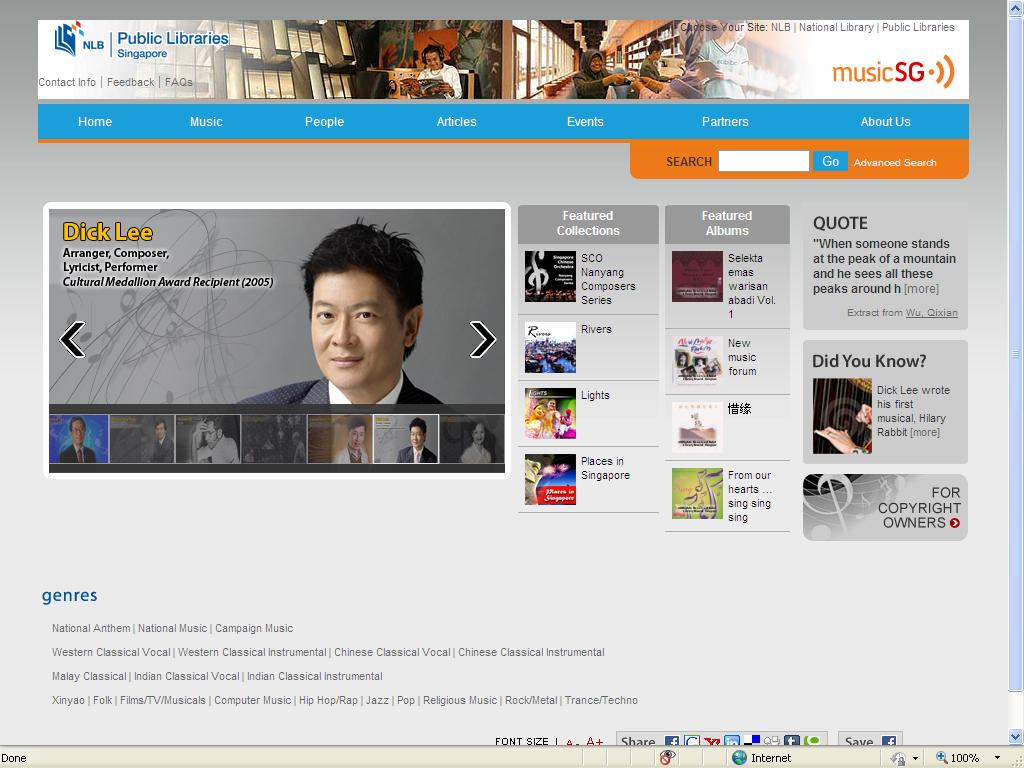
And more recently, NLB also launched MusicSG, which is an online collection of music composed or published by Singaporeans or music composed for Singapore. It includes audio files (some are previews only though) for albums/tracks, scores and also articles on the musicians. There are some soundtracks of Singapore musicals available there.
It’s good to see an effort in archiving these materials.
Suitcases by The Finger Players
Venue: Drama Centre Black Box
Run: 28-30 October, 2010
This was one of the most abstract plays I’ve ever watched. Maybe I’m not exposed enough to such plays, but as it is, it was abstract to me.
Stepping into the venue, one is greeted with a structure of scaffolding all over the stage, with intermittent announcements like a radio with poor reception. Of course, this sets the mood, and as my friend puts it, a little creepy in the dark surroundings of the Black Box.
|

And “creepy” too as it started with the characters entering the space cloaked in white raincoats and painted white faces, in silent movements, dragging in objects in frames that seem to represent ships and planes (I guess that would tie in with the theme of “suitcases” and travellers). As the actors “pottered” around in slow movements, they sort of looked like they were in a chemical plant or something like that, where the things they held were delicate and transported with care. I couldn’t help but be reminded of contemporary dance, though they were not dancing (so you get the idea of abstractness). This I guess, was like the “prelude” to the production.
Well, I couldn’t really make head or tail of the content since speech was almost non-existent. As I went to do some research, this was what one would call “physical theatre” I guess, or maybe movement theatre (something I’ve heard before). So the only thing I could go on was the synopsis to make my own interpretation of the play. Here’s the synopsis:
On a strange yet familiar city, a group of travellers is drifting about, ever-so-ready to fulfil their obligations in life. They exist but their physical beings are unable to fill the void within. A howl is heard from afar, sensual and primitive. The travellers slowly embark on a journey in search of the calling.
suitCASES is a multi-disciplinary performance which attempts to unravel the secrets of our land through an experimental and self-reflective approach.“
The 70-min production was broken into 5 parts (as how I saw it), with the 1st being the prelude as mentioned above. The “prelude” as I call it prepares you for the way the play is played out, with the raincoat featuring often, and of course, suitcases. The raincoats seem to signify an outward shield, always preparing for “rain” but the rain never came. The characters take it off when alone or when they present their selves when their segment comes. The prelude leads you first to the 1st character’s journey, that looked like the desire to find love, comfort and warmth; to fit in. The character is lonely, while everyone else is enjoying themselves (and “bullying”/shunning her). The apt use of balloons probably signifies how uncertain it is for her, as they burst. Near the end though, she finds some gladness as someone and a child sees her and greets her (although the “child” was actually a balloon with a raincoat…it was a bit ghostly). However, I had the impression that this character seemed to be pregnant (or maybe not), so maybe there are some implications here. She leaves the stage with a balloon bobbing in the air from her suitcase, maybe like a glimmer of hope.
The 2nd character appears, a rather jovial one in fact, who performs tricks to entertain people and maybe gain their trust. However, the people, amused at first are cold when he(or she?) reaches out. A story about beings (in the form of puppets covered with “eyeballs”), earth and sky starts to be narrated, and puppets (and suitcases) from his suitcase emerges, even as he reveals a grotesque face on his belly. The story ends, and a final puppet emerges, bringing him joy, as he hugs it and leaves the stage. So this traveller finds what he was looking for and his void is filled.
The 3rd character seemed like someone working very hard to fit into society with the routine work, play, eating, sleep and following the directives from “up” above. My friends thought that maybe it was a little subversive. There was a segment on the “speaker’s corner” that has the character voicing her sentiments (“…我们盲目地跟从…”) which inadvertently causes some “torture” carried out. A half-normal (mannequin-like) and half-boils-filled faced puppet was used as the oppressor in command. The character leaves the stage with her suitcase, in pain and submission.
The last character seemed to be one who was struck with an illness or odour that caused her to be shunned. Experts try to clean her up but to no avail and they abandon her. She reveals a decaying chest area and tries to make it worse, seeming to kill herself. However, she is halted when the other 3 characters appear, and they discovered they each have an infestation on different parts of their body and they connect, and become more relaxed as they find their commonality. They no longer need their raincoats and settle in. Suddenly, what they’ve been shielding comes, as it starts to rain (sound only lah) and they enjoy it.
So there, that’s the production. I’m still pretty clueless.
There were some interesting representations, which included the obvious MBS model hung high at the back. Somehow, it made me think that maybe, there’s reference to the underbelly of the city.
In Conversation With Jose Carreras
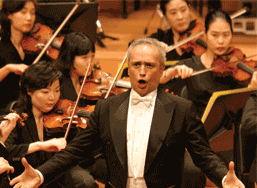
Event: “In Conversation With Jose Carreras” (as part of the Singapore Sun Festival 2010)
Venue: LASALLE College of the Arts, SIA Theatre
Date: 31st October 2010
Of the 3 great Tenors Luciano Pavarotti, Placido Domingo, and Jose Carreras, the one whom I would have most wanted to see in person at least once in my life is Jose Carreras.
If Pavarotti had the effortless range and Domingo had the dramatic voice, then Carreras was the one who had the most beautiful, velvety tone.
Not that I know anything about opera, but I am particularly fond of Mr Carreras because he appears on one of my favourite Broadway recordings of all time, when he participated in the once-controversial and now-legendary 1984 recording of “West Side Story” conducted by Mr Leonard Bernstein himself, and also starring Kiri Te Kanawa.
The DVD documentary of the entire recording was nothing short of fascinating, as it chronicled the many difficult and tense moments faced during the recording process, especially since Mr Carreras wasn’t exactly accustomed to the music of Broadway, and the fact that a number of Bernstein’s songs were rather complex didn’t help matters much.
The most talked-about scene from that documentary has got to be this one (here), when the tensions got so high during a bungled take of “Maria” that things almost threatened to boil over.
The documentary nonetheless revealed a softer and more vulnerable side of the great tenor Mr Carreras which we would seldom get to see when he is in the operatic world.
…
The first thing that struck me as Mr Carreras walked in on stage with moderator Andrew Lim at 3:05pm yesterday afternoon was that he had aged tremendously.
I couldn’t believe that this was the same gentleman that looked the way he looked in the 1984 recordings, since it was only 26 years ago.
Through the entire conversation, Mr Carreras touched on his early years growing up in Barcelona, his operatic beginnings (a great deal of his passion for singing stemmed from watching the movie “The Great Caruso”), his huge adoration of his idol Giuseppe Di Stefano, his successful one-year fight against leukemia, his thoughts on the state of opera today (positive, in case you were wondering), his 3 most revered opera houses (La Scala, Vienna, London…in no particular order), his thoughts on singing in the various languages (Italian and Russian being languages very good for singing), his routine on performance days, his ambitions in life from this point on, etc.
What came across most strongly to me was his immense sense of class, grace, and humility.
Every word that he spoke was measured with a keen sense of warmth, gentleness, and most of all, humility.
He was extremely gracious towards any person whom he spoke about.
This coming from a man who has headlined the world’s greatest opera houses for decades.
It’s hard to imagine that this could have been the same Jose Carreras recording with Bernstein in New York only 26 years earlier…one that was youthful, vibrant, and slightly impulsive.
Nonetheless, the most memorable quote that I personally liked yesterday afternoon was when Mr Carreras said that “technique is at the service of interpretation”, as a response to a question about how an opera singer should reconcile between singing from a technical standpoint and from an emotional standpoint.
And I thought it was very true.
Emotions certainly can get you a certain distance, but if you really want to execute some of the most difficult pieces, then the technique definitely has to be there in order to allow you to execute the way you wish to execute.
At least I’m glad I got to see Jose Carreras up close once in my life.
During the Q&A session, I wanted to ask him to share a bit more about his experience working with Bernstein on the 1984 recording, but due to time constraints and the sheer number of people wanting to ask questions, I could not get my question in.
No matter.
I came away with a newfound respect for one of the greatest tenor voices in our lifetime.
“Cinderel-LAH!” by Wild Rice is Back!

As part of W!ld Rice’s 10th Anniversary festivities, the company will be restaging their ever-popular pantomime “Cinderel-LAH!”.
“Cinderel-LAH!”, their first ever pantomime, was originally staged in 2003, and starred Emma Yong, Neo Swee Lin, Hossan Leong, Sheikh Haikel, Chua Enlai, Lim Kay Siu, and Karen Tan, amongst others.
This restaging retains a number of the original cast members, with a few new additions such as Sebastian Tan, Najip Ali and Gurmit Singh, and is directed by Ivan Heng, with book by Selena Tan and music by Elaine Chan.
“Cinderel-LAH!” still ranks as my favourite W!ld Rice pantomime of all-time, largely due to its excellent songs.
And thus, I am deeply looking forward to catching it again.
I honestly believe that this is composer Elaine Chan’s finest work amongst all her W!ld Rice works.
(I have the whole collection of W!ld Rice CD albums.)
It’s been 7 years and counting, and I’m still enchanted by lovely songs such as “A Waltz To Fall In Love With”, “When I’m Happy”, “What Good Is A Man?”, “Everybody Needs A Little Magic”, and “Around The World”.
I can’t think of any other W!ld Rice musical with as many songs that I loved as this one.
“Cinderel-LAH” runs at the Esplanade Theatre from 25th November onwards.
Be sure to get your tickets (here).
The only way you might be disappointed by this is if you don’t manage to get good seats.
Ma Goes Home
Event: “Ma Goes Home” by Action Theatre
Venue: Action Theatre (The Room Upstairs) @ 42 Waterloo Street
Run: 14th Oct – 24th Oct 2010
Just some quick thoughts on playwright Edgar Liao’s “Ma Goes Home”, which was staged by Action Theatre.
It is directed by Samantha Scott-Blackhall and produced by artistic director Ekachai Uekrongtham.
(I had left for a one-week holiday after catching it at Action Theatre last Friday, and thus my recollections of the play are hazy at best. It didn’t help that I was unable to locate a programme of the play that evening, for some strange reason or other.)
I was looking forward to this one, as I had heard some very good things about it.
“Ma Goes Home” had won Best New Play at “Theatre Idols” earlier this year, and I thought the play’s premise was fascinating as well.
One of the main impetuses for this play was the controversial comments made by a certain minister of ours last year whereby he suggested that Singaporeans consider sending our old folks to nursing homes in JB for reasons of affordability.
Thus, the play depicts an elderly woman who somehow is disallowed from entering the “Singapore” door in the underworld, because of the fact that she was laid to rest in a nursing home in JB.
(The rules of that particular underworld state that a person can only enter her home door if she had been laid to rest in her country of origin.)
As such, Ma gets sent back to the real world in an attempt to convince her son and her not-so-nice daughter-in-law to have her sent back to Singapore to be laid to rest there.
You could easily see the potential in such a premise.
It offers ample room for making a satirical point, as well as illuminate the importance of fillial piety and such.
However, I’m sad to say that the play failed to live up to its promise.
(NB: I was informed that the play had received tremendous reception at the readings, which contrasted deeply with the poor reception from the audience at the full staging last week. I thought it was a fascinating problem – how does a play become a hit at a reading, but fall flat at the full staging? But that is discussion for another day. Fascinating problem, nonetheless.)
The set was interesting, as it was not unlike those T-shaped runways you see at a fashion show, whereby the audience sits on either side of the runway, facing each other.
I felt this was a practical decision, considering the limited confines of The Room Upstairs, and it also allowed the actors to get really up-close with a large majority of the audience.
As for the script, it was evident that Edgar Liao had written a very clever script that was filled with many lines that had great comic potential, but for some strange reason, many of the lines just fell completely flat and failed to generate the merest of reactions.
Of course, there were some which hit the mark, but these were few and far between.
The misses far outnumbered the hits.
As mentioned, I was informed that the lines had received tremendous reception at the readings, so I guess it would make an interesting study for Edgar and the team to analyse why the script just didn’t work when fully-staged.
Was it the delivery? Was it the casting choices? Was it the set design?
It must have been due to something.
I remember looking around me and thinking “Is anyone else getting any of this? Why isn’t anyone laughing? I can literally see the lines just whizzing over our heads.”
Elsewhere, I felt the heavy use of Singlish and excessive swearing could have been toned down, as it got on my nerves after awhile.
I don’t know if it was just me, but I found it hard to empathise with Ma (played by Catherine Sng), and thus, I didn’t find myself being emotionally-invested in the story at all.
It could have been because the character was a tad over-played, and thus I wasn’t so quick to embrace her.
In fact, the more appropriate word to use would be “irked”.
The play made an attempt to flesh out the background stories of the majority of characters through some clever crafting and linkages, thus giving many of the characters further dimension.
I like how even Claude Girardi was given a touching background story of his own, which further enforced the theme of “finding one’s identity” in the play.
That was a nice touch.
The link between Theresa and the drunken woman was also a clever device, albeit slightly predictable.
However, it seemed to me like the play tried to spend too much time on too many characters in the story, and thus lost its focus of the main protagonist, whom I assume is Ma.
In conclusion, I would have to be honest and say that I didn’t enjoy the play very much.
It’s a pity I didn’t attend “Theatre Idols”, because if I had, my impression of the play may have been different, knowing well the full comic potential of the play based on the readings.

 Buttons In The Bread