Hansen & Gretel

Event: “Hansel & Gretel” presented by Players Theatre, as part of Gateway Theatre’s Opening Festival
Venue: Gateway Theatre
Run: 30 June – 2 July, 7 – 9 July 2017
Directed by: Carina Hales
Cast: Lian Sutton (Hansel), Carina Hales (Gretel), Kimberly Chan, James Shubert
Would you believe an ugly crow or a cutesy bunny? What about a talking gingerbread man who entices you to eat him? The house of candy in the middle of the forest?
”Things do not always appear the way they seem to be”
This was the message that reiterated through the play.
One of the main events for Gateway Theatre’s Opening Festival, this familiar Brothers Grimm tale of a pair of siblings who meets a children-eating candy house witch is not new to us. The Players Theatre had also staged this last year.
With a small cast of 4 pax, the actors switched around roles (except for Hansel & Gretel), playing the crow, the father, stepmother, bunnies, gingerbread man and of course the witch. Did I miss out any? Lian was convincing as the brash and silly brother, who does not see beyond what’s in front of him, often leading them into most of their tricky situation. In contrast, Carina endears us to her Gretel, the sensible and kind sister who garners the goodwill of Gingerbread Man, who was crucial in helping the siblings. Kimberley and James displayed versatility with their roles, especially when portraying the non-human characters with different voices, tones and accents. However, I did find their voices a little muffled when they were working the puppets, hence I could not really catch what they were saying at some points.
There was some audience participation when the siblings asked about the next steps they should take, but guess the audience were not as responsive in my crowd. Nevertheless, that didn’t stop the cast from delivering a good performance energetically.
With quick-changing sets and an animated cast, this family-friendly production proved to bring through the message that one should not always perceive things at face value. It applies to adults too, with the example of the father being hoodwinked by his 2nd wife. Good thing was all’s well that ends well and the father reunited with the children, and the woods was no longer a fearful place. Besides that, the kids still get to enjoy candylicious treats courtesy of G-man.
This show is part of Gateway Theatre’s Opening Festival, a new theatre in the heart of Bukit Merah. To find out more about the festival that runs from 7-9 July, check out https://theatre.gateway.sg/.
I also happened to have the privilege to watch the sand art performance of the story of Bukit Merah as part of the official opening ceremony. The story will be told in another manner in Attack of the Swordfish by Act 3 Theatrics.
Coming Soon: “The Effect” by Pangdemonium

Event: “The Effect” presented by Pangdemonium
Venue: Victoria Theatre
Run: 25th Feb – 13th Mar 2016
2016 is Pangdemonium’s “Season of Love”, and they will be kicking things off with the Lucy Prebble play “The Effect”.
Official synopsis:
“Set against the backdrop of a clinical drug trial, this dark and edgy romance revolves around two young volunteers, beautiful psychology student, Connie (Nikki Muller) and charming nomad, Tristan (Linden Furnell).
Sealed off from the real world and monitored by two bickering doctors (Adrian Pang and Tan Kheng Hua), Connie and Tristan find themselves increasingly attracted to each other.
As the doses continue to double, so do their feelings.
Are their emotions real or merely an induced side effect?
Written by Critic’s Circle Award-winning Lucy Prebble (ENRON, The Sugar Syndrome), The Effect breaks down love to all of its composite sensations and questions how much control we really have over what we feel.
This existential and compelling piece has been called “deeply moving, both in its depiction of the giddy wonder of love, and also in its account of the terrifying wasteland of depression itself” by The Daily Telegraph.
A brilliant examination of the human brain via the heart, The Effect explores questions of sanity, the ethical minefield of neuroscience, today’s pill-popping culture and the nature of this thing we call “LOVE”.”
The play stars Linden Furnell, Nikki Muller, Tan Kheng Hua, and Adrian Pang.
Play Duration: Approx. 2hrs (with 15mins interval)
Ticket Purchase: SISTIC Link (here)
Pangdemonium Website: pangdemonium.com
Pangdemonium Facebook Page: www.facebook.com/pangdemonium
Geng Rebut Cabinet
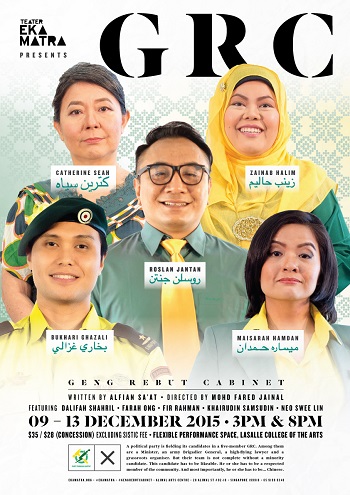 Event: “Geng Rebut Cabinet” by Teater Ekamatra
Venue: Flexible Performance Space @ LASALLE College of the Arts
Run: 9th – 13th Dec 2015
Inside Out
Teater Ekamatra’s latest play “Geng Rebut Cabinet”, written by Alfian Sa’at and directed by Mohd Fared Jainal, is a delightful contradiction of sorts.
It’s a play which tackles the often prickly and sensitive subject of racial dynamics in Singapore, but it is easily one of the most hilarious Alfian Sa’at plays I’ve seen.
It is set in a country which in all likelihood refers to Singapore, but the playwright cleverly turns things on its head by portraying Malays as the majority race, with a GRC of the incumbent ruling party having to field a minority Chinese candidate named Catherine Seah (Neo Swee Lin) as part of the General Elections requirement.
It is election season and tensions are running high, and the five-member Chai-Chee Commonwealth GRC team holds a meeting to discuss campaign strategy, led by its charismatic leader Roslan Jantan (Khairudin Samsudin).
There is the amiable, grassroots-active team secretary Zainab Halim (Dalifah Shahril), the not-uncommonly-seen army general fresh out of the armed forces and parachuted straight into politics Bukhari Ghazali (Fir Rahman), the successful big shot lawyer Maisarah Hamdan (Farah Ong), and of course, the token Chinese minority candidate Catherine Seah, a Chinese teacher.
At the onset, Catherine’s exuberance is regarded as nothing more than mere amusement for the rest of the team, and her eagerness to not only contribute but make a significant impact on the campaign is dismissed as sheer idealism, nothing more.
After all, her role as minority candidate is merely to fulfill the GRC requirement and keep her segment of Chinese voters happy.
However, as the campaign rallies begin and Catherine starts to deviate from the script and champion for equal rights for minorities and at the same time speaking out against majority privilege, the rest of the team realise that they have a crisis on their hands and close ranks to clamp down on this errant minority voice.
“Geng Rebut Cabinet” uses inverted reality to scintillating effect, and the pointed awkwardness of the inversion allows the play to make its points that much more effectively.
A Malay general? Hardly any Chinese fighter pilots in the air force? The Chinese population often struggling to keep up with their counterparts academically?
Its combination of near-absurd humour together with harsh irony make it so compelling, and its two-hour duration seems to fly by in an instant.
The play is also elevated greatly by the strong cast of five, with Neo Swee Lin playing it relatively straight while the rest of the cast, with Khairudin Samsudin in particular, giving riveting, offbeat performances.
Ultimately, Catherine Seah manages to somehow exceed expectations and help her GRC score the second best result in the entire General Election, but just when she thinks she is starting to gain any form of political traction, she ironically gets “silenced” by being designated the role of Speaker of Parliament, the first woman to be given the role, and a minority member at that.
This being election year, Alfian Sa’at manages to recapitulate some of the salient political talking points, such as the redrawing of election boundaries, the way the incumbent party attacks the credibility of the opposition, and the internal workings of the incumbent party political mechanism.
At the same time, he raises many difficult questions about race in Singapore, some of which might not come as too out-of-the-blue if you have been following his Facebook page musings for some time.
In the playwright’s own words: “I have never thought of race as a ‘sensitive topic’. To me, race is sensitive only when we lack a language to talk about it.”
And in “Geng Rebut Cabinet”, he has certainly given us a medium to talk more about it.
Coming Soon: Geng Rebut Cabinet
Event: “Geng Rebut Cabinet” by Teater Ekamatra
Venue: Flexible Performance Space @ LASALLE College of the Arts
Run: 9th – 13th Dec 2015
Opens Tomorrow!
Official Synopsis:
“Teater Ekamatra is proud to present “Geng Rebut Cabinet” (“GRC”), a brand new play written by celebrated playwright Alfian Sa’at, directed by Mohd Fared Jainal.
The play examines what it means to be a minority in a topsy-turvy farcical world where the disempowered are now empowered, where the invisible now have their faces plastered everywhere-especially during the campaign season.
Who defines whether someone is a member of a minority?
Who sets the standards for a ‘model minority’ and a ‘problem minority’?
And are some countries ready for a minority Prime Minister?”
Play Duration: Approx 90 mins
Ticket Purchase: SISTIC Link (here)
Event Facebook Page: www.facebook.com/events/1774518746108851
Teater Ekamatra Facebook Page: www.facebook.com/TeaterEkamatra
The Emperor’s New Clothes
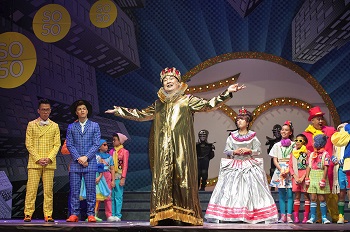 (Photo courtesy of W!ld Rice, by Albert Lim KS)
Event: “The Emperor’s New Clothes” presented by W!ld Rice
Venue: Drama Centre Theatre
Run: 20th Nov – 12th Dec 2015
Underneath Your Clothes
There are few theatre traditions in Singapore quite like the annual W!ld Rice pantomime, and considering this is the 12th pantomime being staged in the company’s 15-year history, it certainly has come a long way.
We’ve seen their takes on classic fables like Cinderella, Aladdin, Beauty & the Beast, Hansel and Gretel, and Jack and the Beanstalk, almost all of which feature full-length original scores, which is an incredibly impressive feat if you think about it.
Last year’s “Monkey Goes West” was memorable for being the first local theatre production being staged at the newly-reopened Victoria Theatre, plus the fact that it drew from the well-known Chinese epic tale instead of the usual Western fare, replete with gorgeous oriental elements.
This year sees W!ld Rice taking on the beloved though somewhat structurally tricky Hans Christian Andersen tale of the vain Emperor who gets duped by two swindlers into believing that they have spun him the world’s finest yarn.
I say structurally tricky because the original version describes how the two swindlers simply waltz into town and begin their grand scheme of deception, sucking up all the money given to them by the exceedingly vain Emperor, and eventually succeeding in presenting the Emperor with his final outfit for the procession, which is nothing more than thin air.
The lack of any discernible dramatic arc, and more importantly, the lack of any particular protagonist(s) in the original story would have made for a rather boring and uneventful pantomime.
While playwright Alfian Sa’at’s challenge last year was in condensing the enormous wealth of content from “Journey to the West” into a two-and-a-half hour musical, playwright Joel Tan’s challenge in “The Emperor’s New Clothes” was to adapt the story into a more conventional musical plot, and he does a great job of it.
Popular artistes Benjamin Kheng and Sezairi play Nathan and Khairul respectively, who, instead of being con men, are in fact the true protagonists of the play – industrious, noble tailors who aspire to become successful fashion designers one day.
Their hands are forced when they are ordered by Emperor Henry Lim Bay Kun (Lim Kay Siu) to design his official outfit for the kingdom’s 50th National Dress Parade, and after discovering the deep dark secrets the Emperor hides in the dungeons deep beneath the castle, they plot to teach the Emperor a lesson he would never forget.
The tale is set in a somewhat dystopian kingdom just before its 50th birthday, where a conceited Emperor rules the roost, having a penchant for throwing journalists into prison, as well as detaining dissenting citizens without trial.
He rules with an iron fist, and does not hesitate to ban anything that detracts from the citizens’ adoration of his being.
Playwright Joel Tan throws in many subtle references which leave no doubt as to what he is referring to (“Operation Plectrum”), while demonstrating fine wordplay in other instances (“treason” vs “the reason”).
The set by Eucien Chia screams Spider-Man, with a skyward perspective of tall, dark, foreboding skyscrapers, while the costumes by Tube Gallery are a riot of gaudy, neon colours.
The score by Julian Wong is a sophisticated mix of sounds, with only a band of three musicians on stage, as almost every actor in the cast eventually plays one or more instruments live on stage.
Of all the musicals I’ve ever been to, this is the one musical which I’ve seen the most actors actually play their various instruments live while performing their roles, and this is reason enough to watch the show.
Who would have known that Lim Kay Siu plays a mean violin, that Seong Hui Xuan and Audrey Luo are equally fluent on the ivories, and that Benjamin Wong is such a charmer on the flute?
In terms of the songs, “Brother From Another Mother” early in the first act is probably the most memorable of the show’s tunes, with Benjamin Kheng and Sezairi establishing their thicker-than-water ties while both on acoustic guitars, with melody and harmonies reminding me a lot of early Simon & Garfunkel.
Dramatically, I felt the showstopper was the song “Perhaps” midway through the second act, which beautifully portrayed the inarticulate tension between the Emperor’s wife (Audrey Luo) and the Emperor himself.
It was lyrically and musically moving, with great delivery by the two actors, and in my opinion this moment itself was worthy enough of the price of admission, although it is a slight pity that the relationship between the Emperor and his wife was not even more fully developed throughout the musical.
This is as strong a supporting cast as you’ll ever find in local theatre, with actors like Seong Hui Xuan, Candice De Rozario, Benjamin Chow, and Andrew Marko all doing a great job with their various roles, while Benjamin Wong truly stood out for me as one of the stars of the show, with outstanding presence and expert musicianship.
While Sezairi’s enthusiasm was infectious even amidst a cast as strong as this, it was Audrey Luo who once again steals the show as Empress Jeanette How, being given a far more substantial role as compared to her last show “Chinglish”, thus allowing her to fully showcase her tremendous comedic chops.
I struggle to think of another actress who could have done a better job than her in this role.
The show bears the familiar trademark of past pantomimes in trying to garner as much audience participation as possible, although I felt that some elements such as the chant which was taught to the audience at the start of the show, as well as the part where the audience was taught to hum to the tune of “Let It Go” came across as somewhat contrived.
In many respects, “The Emperor’s New Clothes” is a testament to how far the W!ld Rice pantomime has come.
It isn’t afraid to take on challenging material, adapt it to a local context, and give it the familiar W!ld Rice treatment, filling every aspect of the show with exceptional talent from the directing, writing, composing, designing and eventually to the performing.
The cliché is so well-worn by now, but it truly is a testament to the magic of theatre when so many talented individuals of various abilities are brought together by a director (Pam Oei) to come up with a show as enjoyable and as spectacular as this.
This is W!ld Rice at its fashionable best.
Coming Soon: The Good, the Bad and the Sholay

Event: “The Good, the Bad and the Sholay” by Checkpoint Theatre
Venue: Esplanade Theatre Studio
Run: 26th – 29th Nov 2015
Opens Thursday!
Official Synopsis:
“In this fast and ever-changing world, what is constant?
The 1975 Bollywood classic Sholay, with its thrilling exploits of outlaw heroes and high-stakes emotion, provides the backdrop for this profoundly humorous coming-of-age story that chronicles Raghav’s journey from boyhood in the small Indian city of Ambala to the metropolis of Singapore.
What do we lose in the name of progress?
And what happens when we finally let go?
The Good, the Bad and the Sholay deftly captures the joys and sorrows of growing up and the changes that come with each stage of life.
First staged in 2011 by Checkpoint Theatre, The Good, the Bad and the Sholay received three nominations at The Straits Times Life! Theatre Awards for Best Original Script, Best Director, and Production of the Year.
Playwright Shiv Tandan joins Huzir Sulaiman in directing this new staging.”
Show Duration: Approx. 90mins (without intermission)
Ticket Purchase: SISTIC Link (here)
Checkpoint Theatre Website: checkpoint-theatre.org
Checkpoint Theatre Facebook Page: www.facebook.com/checkpointtheatre
Peter Brook’s “Battlefield”

Event: Peter Brook’s “Battlefield” presented by the Singapore Repertory Theatre
Venue: Capitol Theatre
Run: 17th – 21st Nov 2015
War and Peace
Legendary director Peter Brook revisits one of his seminal productions, the epic nine-hour staging of “The Mahabharata” 30 years ago, but this time in the form of a condensed 70-minute epilogue focusing on the epic battle at the end of the revered Sanskrit text.
The production first opened in the Théâtre des Bouffes du Nord in Paris, Peter Brook’s long-time theatre home, and made its international premiere here at our Capitol Theatre, after which it will travel to London, Sydney and Tokyo.
While The Mahabharata is a sweeping epic of over 74,000 distinct verses, making it one of the longest poems in the world, “Battlefield”, adapted and directed by both Peter Brook and Marie-Hélène Estienne, tells of the blind King Dhritarashtra, who cedes power to his eldest son Yudhishthira in light of the aftermath of a great war.
The war has been won, but as the family begins to count its cost, it begins to realise that victory seems to bears the bitter taste of defeat.
How much have they really achieved?
And at what cost?
The stage is a startlingly bare one, with nothing more than a few sticks in the background, while musician Toshi Tsuchitori plays a lone drum which serves as soundscape throughout the entire play.
We are introduced to the old King Dhritarashtra (Sean O’Callaghan) and his wife (Carole Karemera), their son Yudhishthira (Jared McNeill), and the wise adviser Krishna (Ery Nzaramba).
Along the way, short fables are intertwined into the proceedings, telling of anecdotes involving a pigeon and falcon, a worm, a mongoose, and the like.
The fables are at times quirky and at times unsettling, adding great colour to the script.
The plot is essentially a very straightforward one, with the bare, stripped-down staging challenging the viewer to focus on the purity of the actors’ delivery of their lines.
Toshi Tsuchitori controls the pacing and tension in the play expertly with the beat of his drum, although I felt the extraordinarily bright “Exit” signs on each side of the Capitol Theatre stage served to diffuse the viewer’s visual focus considerably, thus taking away from the intense nature of the proceedings.
Perhaps the DBS Arts Centre – the spiritual home of the SRT – might have been a better choice of venue for this production, although it definitely would not have been able to accommodate as many people.
While director Brook coaxed out immense performances from the cast of four, Ery Nzaramba managed to stand out for his effervescence and versatility.
“Battlefield” is ultimately a sombre meditation on the atrocities of war and finding inner peace within one’s self in light of the sense of pain and loss.
In many ways it reminds me of “The Spirits Play” staged by The Finger Players just two weeks ago, Kuo Pao Kun’s take on the unbearable horrors of war and the profound impact it has on all the survivors.
“Battlefield” is a true testament to the power of theatre, and it is remarkable what magic can be achieved by just four actors, a solo musician, deft directing, and a powerful script.
Coming Soon: Peter Brook’s “Battlefield”
Event: Peter Brook’s “Battlefield” presented by the Singapore Repertory Theatre
Venue: Capitol Theatre
Run: 17th – 21st Nov 2015
Opens Next Tuesday!
Legendary theatre titan Peter Brook, known for his famous 9-hour “Mahabharata”, has chosen to take the epic battle at the end of this revered piece of literature and make it a stand-alone play.
Peter Brook is probably the most famous director in the world – a true titan of theatre.
30 years ago, he staged a nine hour production of the Indian epic, “The Mahabharata”, which has become one of the seminal works of the 20th century.
Now, at the age of 90, Peter Brook will explore the last chapter of that epic as a stand-alone play.
This new play “Battlefield”, co-commissioned by the SRT, premiered at the Théâtre des Bouffes du Nord in Paris in September 2015, and will make its international premiere at the Capitol Theatre from 17th to 21st November before going on a world tour.
In 2013, SRT in collaboration with Esplanade, brought in “3 Titans of Theatre” – Simon McBurney, Yukio Ninagawa and Peter Brook’s production of “The Suit”.
Show Duration: Approx. 1hr 30mins
Ticket Purchase: SISTIC Link (here)
SRT Website: www.srt.com.sg
SRT Facebook Page: www.facebook.com/singaporerepertorytheatre
Coming Soon: Beauty World (Opens Tomorrow!)

Event: Beauty World
Venue: Victoria Theatre
Run: 13th Nov – 12th Dec 2015
Opens Tomorrow!
Official synopsis:
“This November, legendary duo Dick Lee and Michael Chiang reunite once again for Singapore’s Number One musical, the iconic Beauty World!
This much-beloved musical, which has seen multiple stagings since its debut at the Singapore Arts Festival in 1988, traces the adventures of a small-town girl from Batu Pahat who sets out on a quest to find her father in Singapore.
With a mysterious jade pendant as her only clue, she winds up in a dubious cabaret, where she learns some heartbreaking truths about love and life.
This revival, which features Michael Chiang’s revised script from 2008, will be directed for the first time by Beauty World co-creator and composer Dick Lee.
The production will bring onstage an exciting ensemble of formidable talents from theatre and television.
Top TV star Jeanette Aw provides sensational sizzle as Lulu, the beautiful but vindictive cabaret queen, while Malaysian talent Cheryl Tan brings wide-eyed charm to the role of Ivy Chan, our innocent protagonist.
Adding her touch of class to the mix is seasoned actress Janice Koh, appearing in her first musical as the wise and winsome Mummy.”
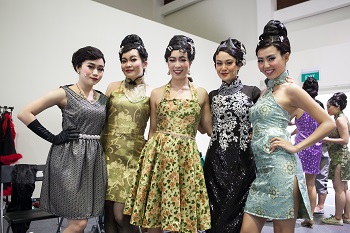
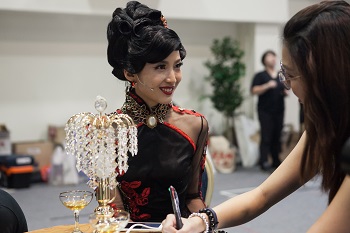
Some pictures from the press preview event:


Show Duration: Approx. 2hr 30mins (with 15min interval)
Ticket Purchase: SISTIC Link (here)
Coming Soon: “Super Happy Land” by Hatch x Gumbo

Event: “Super Happy Land” by Hatch Theatrics & Theatre Group Gumbo
Venue: Malay Heritage Centre
Run: 17th – 19th Dec 2015
Official Synopsis:
“Super Happy Land is the most exclusive location on Earth.
Only a lucky few will get to experience life there – but as everyone knows – you don’t choose Super Happy Land, Super Happy Land chooses you!
And so, five very special individuals from the world over have been handpicked to live there.
And just like the name suggests, everything there makes the inhabitants Super Happy!
They feast like kings –Super Happy Tummy!
They are showered with gifts – Super Happy Heart!
They are pampered like royalty – Super Happy Life!
They are the luckiest people on the planet.
But all good things must come to an end.
Or did it never even begin?”
This is Hatch Theatrics’s final production for the year 2015, and it will be an international collaboration with Theatre Group Gumbo from Osaka.
“Super Happy Land” will be directed by Kayo Tamura and written by Faizal Abdullah for Hatch Theatrics together with Theate Group Gumbo.
It will feature Ryo Nishihara, Hidefumi Oshiro, Kayo Tamura (Osaka, Japan), and Faizal Abdullah, Nur Khairiyah Bte Ramli, Farez Najid, StanxSoap (Singapore).
Be sure to visit Hatch’s crowdfunding page too!
Ticket Price: $25 (Standard) & $20 (Concession) for Regular Price; $20 (Standard) & $15 (Concession) for Early Bird till 1st December 2015
Ticket Purchase: Website Link (here) or email hatchticketing@gmail.com
Hatch Theatrics Crowdfunding Page: hatchtheatrics.wix.com/hatchtheatrics#!crowdfunding/ny0jb
Hatch Theatrics Facebook Page: www.facebook.com/hatch.theatrics.info

 Buttons In The Bread