Murder in San Jose 《圣荷西谋杀案》
 Event: Murder in San Jose 《圣荷西谋杀案》 by Chong Mui-ngam (庄梅岩)
Venue: Esplanade Theatre (滨海艺术中心剧院)
Run: 1 & 2 April 2011
A simply-titled murder story, but a more than mystery sequence of events. Just reading the word “murder” piqued my interest even as I read that it has been performed to rave reviews in Hong Kong. Murder in San Jose was specially commissioned for the 2009-2011 Hong Kong Arts Festivals, and counting this run in Singapore, it has been staged more than 30 times. Furthermore, the script had won “Best Script Award” at the Hong Kong Drama Awards.
Initially, I was afraid I wouldn’t be able to follow the show that well since it was in Cantonese, even though it has English and Chinese surtitles. But it turned out manageable.
This isn’t a whodunnit mystery. Rather, it has been categorised as a psychological thriller, although it didn’t feel that way till the end. As it is, it was a sequence of events from what seemed like a marriage-on-rocks drama that led to a more sinister truth. Someone was murdered in the ending, but it wasn’t as simple as that.
In an interesting prelude, characters went about their daily routines before the official curtains up while the audience were still entering (well, the curtains were already up). It was apparent that the man was just doing everything on his own, even having dinner. So we were prepped for the scenes to follow even as that scene faded out with the start of Act 1 proper.
Set in an isolated suburb in San Jose, Ling (Alice Lau/刘雅丽) had been staying there with her husband, Tang (Tang Wai-kit/邓伟杰) for some years now and expecting their first child. Her childhood friend, Sammi (Kearen Pang/彭秀慧) comes for a visit. Things ain’t so pretty as Sammi observes, with Ling being her controlling self full of rules, and Tang, the frustrated husband who’s dominated by Ling even as he tries to be an online entrepreneur. Sammi is unwittingly embroiled in the struggle between the couple which soon spirals into a showdown as a result of Ling’s sabotage on a possible business deal for Tang. Then it comes out. The murder.
Tang is not really Tang, but a bartender Ling met. They tricked the real Tang into moving to this secluded spot and conspired to kill him, and the bartender took the identity of Tang. The fake “Tang” had to however not try to leave the country or he might be exposed. However, “Tang” can’t stand Ling anymore. He asks Sammi to kill Ling as it’ll either be her or Ling. If Ling dies, Sammi can take her place. Sammi is petrified, should she choose between her own survival or live as someone else? The scene blacks out as the pregnant Ling sits on a chair, with Sammi raising a baseball bat. So who died?
At the end, Sammi is not seen again, and Ling and “Tang” seem to return to their couple life.
Hope I managed to describe the twist effectively. When the truth came to light, it made me realise how some of the things said earlier (even the humour) took on a double meaning now. The script was well-written and the actors played their parts well. Even though there was no intermission, the plot was fully engaging, and the 2 hours didn’t feel long at all. It kept us moving along with the story perpetually, “driving” us through it all. I think this was one of the better plays I’ve watched so far this year.
The only question I had was how come it was Ling and “Tang” (still don’t know his real name) who remained in the end? What happened to Sammi? If I assume she’s dead, how did she die? She was the one holding the bat. Did “Tang” change his mind? Did Sammi back out? Was she really dead? Then how come the prelude had a figure that might be her (or not?).
Maybe as my friend said, it was better Sammi died. I think she would be too soft-hearted to live with killing the pregnant Ling.
Looks like I might need to review the script to see if I can shed any light on this, which fortunately, has been published (in Chinese & English) and was being sold at the venue. Maybe it’ll serve as good reference in future. 🙂
Winners of the 11th Life! Theatre Awards
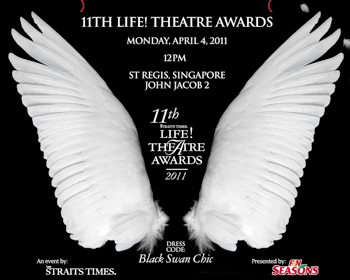
These are the full results for today’s 11th Life! Theatre Awards 2011 held at the St Regis, hosted by the brilliant and effervescent Karen Tan.
The event was organised by The Straits Times and presented by F&N Seasons.
I am eternally grateful to Dr Seet for the invite.
Please pardon me if I had made any mistakes in the list below.
You should probably be able to read about the results in Life! in a few days time.
Warmest congratulations to all the winners!
The full list of winners is as follows:
PRODUCTION OF THE YEAR
December Rains
Model Citizens
A Cage Goes In Search Of A Bird – Winner
The Full Monty
Liao Zhai Rocks!
BEST DIRECTOR
Alvin Tan (Model Citizens) – Winner
Christina Sergeant (Metamorphoses)
Tracie Pang (The Full Monty)
Kuo Jian Hong and Wu Xi (Liao Zhai Rocks!)
Goh Boon Teck (December Rains)
BEST ORIGINAL SCRIPT
Charged by Chong Tze Chien – Winner
Model Citizens by Haresh Sharma
Liao Zhai Rocks! by Wu Xi
White Soliloquy by Goh Boon Teck
wo(men) by Faith Ng
BEST ACTOR
Adrian Pang (The Full Monty)
Oliver Chong (Invisibility/Breathing)
Subin Subaiah (Rafta, Rafta)
Nelson Chia (White Soliloquy) – Winner
Jonathan Lim (Chestnuts 3D: Fried Monty Aka Nightmare On Glee Street)
BEST ACTRESS
Margaret Chan (Emily Of Emerald Hill)
Daisy Irani (Rafta, Rafta)
Neo Swee Lin (wo(men))
Karen Tan (Model Citizens)
Siti Khalijah (Model Citizens) – Winner
BEST SUPPORTING ACTOR
Yazid Jalil (Charged)
Andy Hockley (The Full Monty)
Jeffrey Low (December Rains) – Winner
Xu Bin (Liao Zhai Rocks!)
BEST SUPPORTING ACTRESS
Denise Tan (The Full Monty)
Lok Meng Chue (wo(men)) – Winner
Aidli Alin Mosbit (Charged)
Serene Chen (Charged)
Judee Tan (Chestnuts 3D)
BEST ENSEMBLE
Jo Kukathas, Lim Kay Siu, Najib Soiman, Neo Swee Lin, Jean Ng, Noorlinah Mohamed, Nora Samosir, Peter Sau, Siti Khalijah and Karen Tan (The Performance by Cake Theatrical Productions) – Winner
Nelson Chia, Oliver Chong,Koh Wan Ching and Timothy Nga (A Cage Goes In Search Of A Bird by A Group Of People)
Najib Soiman, Neo Swee Lin, Rodney Oliveiro, Siti Khalijah and Ian Tan (Those Who Can’t, Teach by The Necessary Stage)
Tay Kong Hui, Goh Seok Ai, Doreen Toh and Tan Beng Tian (The Coffin Is Too Big For The Hole by Drama Box)
Rei Poh, Patricia Toh, Zachary Ho, Edith Podesta, Renee Chua and Serene Pang (Home Boxes by Paper Monkey Theatre)
BEST SET DESIGN
Wong Chee Wai (wo(men))
Eucien Chia (December Rains) – Winner
Ken-hin Teo (Boeing Boeing)
Philip Engleheart (The Full Monty)
Lim Wei Ling (suitCASES)
BEST COSTUME DESIGN
Moe Kassim (Liao Zhai Rocks!) – Winner
Lai Chan (December Rains)
Tube Gallery (Maha Moggallana)
Frederick Lee (Boeing Boeing)
BEST LIGHTING DESIGN
Andy Lim (The Magnanimous Cuckold)
Adrian Tan (A Cage Goes In Search Of A Bird)
Dorothy Png (December Rains)
Lim Woan Wen (suitCASES) – Winner
Lim Yu-Beng (Liao Zhai Rocks!)
BEST SOUND DESIGN
Darren Ng (suitCASES)
Philip Tan (Invisibility/Breathing)
Darren Ng (Blackbird) – Winner
Jeffrey Yue (The Coffin Is Too Big For The Hole)
BEST ORIGINAL SCORE (NEW CATEGORY)
Liao Zhai Rocks! (Music and lyrics by Eric Ng & Xiaohan)
December Rains (Music and lyrics by Liang Wern Fook & Jimmy Ye) – Winner
Cinderel-LAH! (Music and lyrics by Selena Tan & Elaine Chan)
Fried Rice Paradise (Music and lyrics by Dick Lee)
Maha Moggallana (Music and lyrics by Goh Boon Teck & Benny Wong)
H is for Hantu
Not unfamiliar to the supernatural and comedy, Jonathan Lim marries these 2 in his latest (re-run) of H is for Hantu.(“Hantu” is the malay word for “ghost”)
The story tells of how a kampung is set to be phased out by HDB to build more flats. However, unbeknownst to HDB, there are actually 2 kampungs (1 for the hantus, which was essentially a piece of forest behind the “living” kampung). Sazali, a boy who wants to preserve the kampung, tries to rally the kampung folks to support him, but to no avail, so he turns to his hantu friends (yes, he sees dead people) who tries to convince the HDB officer (Angie) handling the relocation otherwise. However, they discover she’s being haunted by a child ghost and he wants to help her (in the hope of her helping them). It turns out she used to live in the kampung and the child ghost was her best friend who’s been using her to search for something they buried together. Angie had also been fighting for good packages for the kampung folks as the HDB project must still go own. Eventually, they do get to preserve the forest part where the hantus lived with the help of environmentalists (through Angie’s help). So all’s well that ends well.
Besides the less than perfect recorded music (it sounded a bit noisy with static and some glitches) and the rather mixed genre of songs which was a bit distracting, I found it enjoyable, though a tad long. Maybe because I expected a 90-minute musical (from sistic’s info) but it turned out to be 2 hours (excluding the delay and intermission). No particular song really stood out for me, but I probably took more notice of the pontianak’s theme since it’s totally based on what is known of it, like the parts with “hitting the nail on the head”, “frangipani fragrance”, etc. Think Jo Tan did well in that role as a less than scary pontianak, Cik Pon.
It started off with Sazali telling stories but it progressed differently, although there were still narratives along the way. The references were funny in a “natural” way that worked. I think the wayang kulit performance was rather well done for something like this and they managed to inject Singapore references into it with humour. It gave a contrast of what we used to value and the modern lifestyle. The warm, traditional “storytelling” that drew people, in the cold face of technology (“multimedia presentation” as Angie said). The puppets were pretty impressive too, especially with the massive Hantu Galah (tall ghost).
And what’s a show about ghosts without a scary moment? Maybe the “hantus” portrayed from the beginning were not scary and the story was getting “comfortable”. But the turn the turning point happened shortly before the interval when Angie suddenly appeared like a zombie with a pale small puppet sitting on her shoulder (supposedly the ghost of a little girl). That was super CREEPY! The design of the puppet was such: white blank face, eyes with dark rings (making it look hollow) and dressed in a white dress. Creepy it really was, that it chilled my heart, so much so that I nearly grabbed J’s arm. It took some minutes to get back into the “light-heartedness” of the show again. I must say the “jolt” was pretty successful in producing “tension” and made me wonder about what’s going to happen in the later part of the show (but after the shock, I did consider a few scenarios that might have been expected). It kind of raised my rating of the show a little. Fortunately, the doll used later was less frightening. I think it was the suddenness of the appearance that spooked me. But as agreed with J, it did shift the initial focus of saving the kampung away, even though the ending brought it back again. But I guess it was intended, to create that “twist” to the story.
I would say it ended off in a happy mood, as a musical comedy would, with a medley of songs sung in the show.
H is for Hantu

Event: “H is for Hantu” by Stages
Venue: National Museum Gallery Theatre
Run: 23rd Mar – 3rd Apr 2011
I’d heard great things about this production ever since it completed its first run in 2009 at the Alliance Francaise Theatre.
So it was with great excitement that I attended “H is for Hantu” for the first time with Ilkosa at the National Museum Gallery Theatre (which somehow happens to be one of my favourite theatre venues in Singapore) a few days ago.
I guess you can always be assured of a quality production whenever Jonathan Lim and the gang from Stages are involved in a production.
The first thing that surprised me was the sheer number of teenagers present at the theatre that evening.
In fact, the theatre was so full that many of them had to sit on the floor right at the front, just under the noses of the performers, lending an air of cosiness and intimacy to the show, as if we were all transported back to the kampung days when people huddled around to listen to a ghost story.
Just how producer Terence Tan managed to so successfully attract that many teenagers to the musical is anyone’s guess.
“H is for Hantu” tells the story of a local kampung village and how the protagonist Sazali, a kampung schoolboy, tries to fight for the survival of his kampung.
Along the way we are introduced to colourful hantu ghosts in the form of Cik Pon (Jo Tan), Miss P (Candice de Rozario), and other fantastical creatures such as the Hantu Galah, Hantu Batu, Pocong, and the Banana Tree Spirit.
If you had to name just one thing about the show which impressed the most, it would have to have been hands-down the puppets by puppet designer Frankie Malachi.
“H is for Hantu” boasts of some of the most incredibly exhilarating and imaginative puppets I’ve ever seen.
Just when you were wondering how they were going to pull off the tall giant hantu (was it the “Hantu Galah”?), along comes two sets of puppet props, the first representing the legs only and the second representing the entire upper body, that totally blow your mind away.
The actors that had to perform puppetry duties (Candice de Rozario, Johannes Hadi, Faizal Abdullah) deserve plenty of credit as well.
The Stages team also did a great job in recreating the spooky-kampung-wilderness atmosphere, and I thought the part when Cik Pon first made her entrance amidst the darkness was quite a moment.
I loved the simple yet authentic-looking set, and I thought the little lit train moving back and forth in the distance was a beautiful touch.
Many of the lines were funny, and this is what one has come to expect from the excellent writing of Jonathan Lim.
Music-wise, composer Bang Wenfu did a good job in trying to recreate the feel of traditional kampung music with the right use of musical instruments.
However, for a two-and-a-half-hour musical (by the way, how come the SISTIC website lists the run time as 1hr 30mins?), I thought “Hantu” had relatively few songs as compared to other full length musicals.
I may be wrong, but it seemed to me like there were probably, what, 5 or 6 distinct songs at most?
As such I hesitate to label “Hantu” a “musical” in the true sense of the word, as the songs did not always help move the story along…and I suppose “Hantu” is one of those anomalies that straddles between “musical” and “play”.
Or maybe you could term it as a “play with songs”.
But this is only a trivial matter.
I personally felt that at a run time of 2hr 30mins, “Hantu” did give one the feeling of being rather tedious and drawn-out at times.
Perhaps it could have been because it did not exactly manage to create enough sympathy for the characters, nor a gripping enough storyline.
It started promisingly enough with the village scene and all that, but the main thrust of the story seemed to deviate along the way – from what initially looked like a kampung schoolboy’s quest to save his village, it kind of meandered in the middle and ended up being his quest to solve the mystery of Miss Angie Chia’s past, and her relationship with the little girl ghost.
I felt it a tad strange that two of the characters that were introduced in the opening scene, namely the PE teacher and the village girl (who seemed to have a thing going for the PE teacher), never reappeared throughout the musical.
And Cik Mariam seemed under-utilised as well.
Nonetheless, I doubt the issues I had with the story would have dampened the audience’s spirits in any way, because judging by the response, it seems as if Stages has done it once again by putting up a delightful production that not only tells a uniquely local story, but also manages to successfully suspend our disbelief and turn us all into children once again, sitting by the feet of a master storyteller, watching the magic and myths unfurl before our eyes.
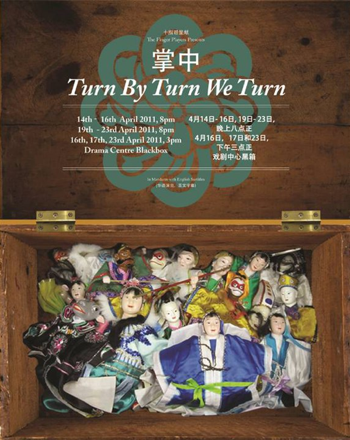
Event: “Turn By Turn We Turn” by The Finger Players
Venue: Drama Centre Black Box
Run: 14th Apr – 23rd Apr 2011
If you’ve been to a SISTIC outlet lately, you might have noticed the beautifully printed brochures shaped like a little treasure chest (see above), which pertains to The Finger Players’ newest upcoming work “Turn By Turn We Turn”.
We’re very much looking forward to this upcoming production, because it looks really interesting.
According to the official synopsis on SISTIC, “Turn By Turn We Turn is a sweeping epic about the lives and fates of members in a traditional Chinese hand puppetry troupe from 1920s China to present day. Holding steadfastly to their craft, traditions, beliefs, and one another in the face of civil and world wars, political strife, changing times and tastes, the puppeteers survive one ordeal after another, testing their mettle and resolve to perform, entertain and preserve the lineage of puppetry.”
And I guess the nature of this story plays nicely into The Finger Players’ strengths, as over the years they have consistently been creating intriguing and fascinating multi-disciplinary theatre works, most notably in the discipline of puppetry.
We at Buttons in the Bread are grateful to director Chong Tze Chien for granting us a short interview, so that we could gain a bit more insight into “Turn By Turn We Turn”.
Tze Chien is, of course, nominated in this year’s Life! Theatre Awards (Best Original Script) for “Charged”, a play which I sorely regret having been unable to catch when it played last December.
And The Finger Players are, of course, responsible for the marvellous work of art that is “Poop”, a multi-disciplinary tour de force that played to critical acclaim both in 2009 and 2010.
Q: What interesting bits can you tell us about this play? Anything in particular that we can look forward to?
Tze Chien: Audiences can look forward to an emotional epic that spans 80 years in the life of a master and his puppetry troupe. Via this story, the play charts the development and eventual demise of traditional hand puppetry in China. For this play, the ensemble underwent traditional hand puppetry training from 2 masters of this art form since September last year. Li Bofen and his son Li Yi Hsin are quite possibly the last surviving leaders in their centuries-old family troupe. The finger players is indebted to Li Bofen because he taught both Beng Tian and Kian Sin (the co-founders of Finger Players) in the 90’s. When Beng Tian returned from China after her training with Master Li, she started the company with Kian Sin. In its early years, the company’s repertoire consisted of traditional hand puppetry until the turn of the century when the company evolved into a multi-disciplinary contemporary theatre that we are today. So with this play the company is revisiting its roots as well as pay homage to the two masters and generations of puppeteers who had fought to keep the art form alive in the most challenging circumstances in China’s history (civil war, world wars, communism and cultural revolution etc).
Q: Was there a particular impetus for writing this play?
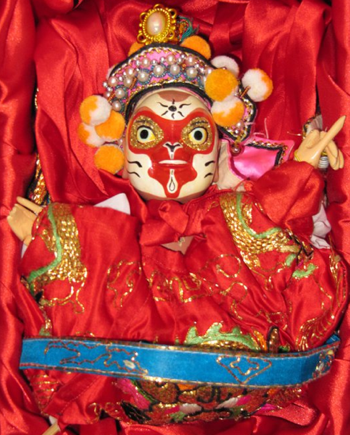
Tze Chien: The impetus for writing this play came from a phone call 2 years ago. A Mr Lim wanted to donate his late father’s hand puppet collection to us as he didn’t know what to do with them. His father was an avid collector of traditional hand puppets and had amassed boxes of these puppets in his lifetime. When we received the delivery at our office we were surprised to find hundreds of these beautiful and exquisite puppets stacked on top of one another in huge boxes. It was both exhilarating and disheartening. We were humbled and honoured to have inherited such a precious gift but it was also heartbreaking as these puppets looked as though they were buried in coffins. I wanted to resurrect them for a performance, using Master Li’s life as the source material for a play.
Q: When was this play written, and how long did it take you to write this play?
Tze Chien: The writing process started in June last year with research: Mainly on China’s modern history and evolution of traditional hand puppetry. In September I interviewed the 2 masters, who came down to Singapore to train the actors. I collected as many anecdotes as possible from them; based on their stories and personal experiences, I created characters and scenarios that reflected the struggles and livelihood in China from the 1920s to present day.

…
“Turn By Turn We Turn” by The Finger runs from 14th April to 23rd April at the Drama Centre Black Box.
Tickets can be purchased (here).
Disney’s “The Lion King”

Event: The Lion King
Venue: Sands Theater at Marina Bay Sands
Run: 3rd Mar – 31st May 2011
A Spectacular Beyond Words
For all the supposed failings of Julie Taymor as director of the beleaguered Spider-man musical, one can never take away from her her crowning achievement that is the Disney musical “The Lion King”, winner of the 1998 Tony Award for Best Musical and Best Direction of a Musical, amongst others.
Indeed, Disney’s “The Lion King” is a majestic spectacle that is beyond compare.
No amount of pre-show hype will be enough to prepare you for what is to be the most astounding and colourful spectacular that will unfurl before your eyes the moment the lights dim and the sound of the African voices begins to glow.
The opening scene itself (“Circle of Life”), possessing all the vibrance and raw energy of the great African wilderness, whereby all the animals big and small slowly paraded onstage in their colourful splendour, was mesmerising enough to immediately make you forget about the $168 hole in your pocket.
Such is the sheer power and magnetism of “The Lion King”.
And the musical went on to impress further, with fanciful stage sets and costumes that were previously unimaginable to the mind.
And it is indeed in the area of sets, and costumes especially, which I thought the musical thoroughly excelled in.
You could see that a lot of painstaking detail had been put into the creation of the beautiful costumes, not to mention the implementation of many a nifty idea here and there.
If there’s one thing “The Lion King” has succeeded in, it is to widen one’s perception on the limitations of what can be portrayed on a theatre stage.
The story of the musical rarely deviated from the cartoon, and to be honest, there was hardly any need to, because the 1994 animated film had in itself a well-contained story of a young lion being banished from his homeland by an evil uncle, and eventually returning home to avenge his father’s death and claim his rightful mandate as ruler of the land.
In terms of songs, I would say that it was the songs from the 1994 film which basically carried the musical, e.g. “Circle of Life”, “Hakuna Matata”, “Can You Feel The Love Tonight”.
The new song numbers did not really make a lasting impression, although there was a lot of indigenous African music sung and played throughout the musical, which obviously lent a great deal of authenticity and gravitas to the proceedings.
The book was well done, and there were many extremely funny lines which I enjoyed, coming mostly from Zazu in the 1st act, and Timon in the 2nd.
In fact, of all the characters in the show, I loved the Timon character the best.
Structure-wise, the biggest gripe that my fellow companion and I had was that the 1st act seemed to end on the wrong note.
One would have thought that the most appropriate point to end off the 1st act would be immediately after Mufasa dies, because that is usually the way musicals are traditionally supposed to end off their 1st act (see “West Side Story” whereby the 1st act ends with both Riff and Bernardo lying dead on the floor) as it leaves the audience with a huge sense of suspense and makes them want to stay on for the 2nd act.
However, for some strange reason the musical went one scene further and ended off after the “Hakuna Matata” scene, whereby Simba meets Timon and Pumbaa and they sing the saccherinely-optimistic number before the curtains come down.
Strange.
But that is perhaps the only negative point we could force ourselves to come up with, because “The Lion King” is quite simply the most visually-impressive musical that I’ve ever had the privilege of witnessing.
The ticket price may be steeper than your average musical, but this is hardly your average musical.
A must-watch for the whole family, if not for the story or songs, at least for the sheer spectacle of it all.
Ivan Heng’s Emily of Emerald Hill
This is way overdue, and with Jeremy already summing it up pretty well earlier, a brief stake in impressions is only what I have. It’s been a while, so things are a bit hazy now…
One man, a monologue and Esplanade Theatre. How would that play out? Ivan Heng reprises his role as Emily of Emerald Hill, of which was how I’ve heard about him and the play really, though I never got to catch that performance. Initially I was puzzled at how a monologue would fit into the size of the Esplanade Theatre, but as it was, he pulled it off, not just with the sets which were pretty huge for a play like this, but with his stage presence.
As true to what I expected, it was a much lighter, and rather entertaining version of Margaret Chan’s interpretation last year at the Singapore Arts Festival. It was rather funny when he actually ‘directed’ the audience as they became his calefare for scenes. One being, I believe, an impromptu one when a person arrived late for the show. It was an opportune timing since she (Emily) was conducting a class (they probably let her in at this point)? Of course, there were still those serious, poignant parts that warranted a stir of the emotions which Ivan brought out in his role.
Well, having watched Margaret Chan’s version, it isn’t surprising that I would unintentionally, or intentionally, compare this performance with that. While Margaret’s Emily was one of subtlety in her manoeuvrings within the household, Ivan’s Emily was, as Jeremy puts it, a little more brash. But Ivan’s portrayal pushed the story along quickly (there were lesser /fast-forwarded scenes) while Margaret’s portrayal gave us time for pensive thought and tunnel into her psyche. It was quite a feat with Ivan clearly running through the lines at a rapid speed for the fast-forwarded portion.
Both thespians were equally adept in their different interpretations, but if I really had to decide between the 2 Emilys, I would say Margaret brought out the inner strength and dare I say “fragility” of Emily more than Ivan, as I kept my focus on what made Emily this way. But then again, I tend to go for the “pensive” side of things. A commendable performance nonetheless by Ivan.
I’m looking forward to Ivan’s next one-man show by Huzir Sulaiman The Weight of Silk On Skin, which I glimpsed in the programme. Wonder when’s that.
《我爱阿爱》 I Love A-Ai
什么是爱?是付出?是接受?是放手?只是一种感觉吗?
一个简单无曲折的故事,却在编剧和导演巧妙的揣摩下变得有趣、不乏味。他们以幽默温馨的写实家庭剧,让人反思着人与人之间的感情对觉,人性、人心的触动。社会真的使人变得冷酷无情吗?
故事环绕在一位身患绝症的老人爱上家里的女佣的故事,而且更搞大她的肚子。他坚决与女佣阿爱结婚,却遭到孩子们的怀疑与不满。是真爱吗?他的儿女有的相信,有的不相信。在这“搏斗”中,家中的人员也渐渐巡回旧时爱的感觉,也让人勇敢地去面对爱,开拓新恋情。这部戏也让人看到亲情的可贵。好像已经很久没看有关一个温馨家庭的故事了。现在大多数都是以 dysfunctional families 为主题, 所以这部剧能让人感动的一处也是这点。经过这场风波后,这家人也因此更加亲近。平凡的故事里有苦,有甜。奇怪的一处(也许没那么奇怪),这部剧的男人似乎都比较追求爱,但女人却在面对社会的实际性忘了那感觉。为什么是这样?但人毕竟是人,也一定能找回所压抑的情感。没感觉的人那里算是人?
演员剧组方面都挑选的很好。每个人都很自然,之间的默契也佳。看到了一些很久没看到的演员如云昌凑,也让我第一次看到许优美(Janice Koh) 演华语剧。
道具方面也挺费心思的,尤其是那旋转式舞台。我正想象他们是否使用了人力 mill technology 来推动它。哈!就像旧式的舞台。应该是机械化了啦。
这是一部不错的话剧。我喜欢。
“I Love A-AI”《我爱阿爱》
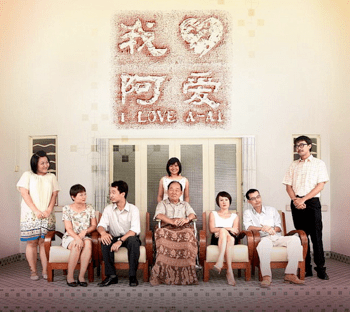
Event: “I LOVE A-AI”《我爱阿爱》by The Theatre Practice
Venue: Drama Centre Theatre
Run: 17th Mar – 3rd Apr 2011
I usually take in Chinese plays only once or twice a year, not because I have anything against Chinese plays, but because for me the experience isn’t too different from watching a tennis match – my head turns left-right-left-right at least a few hundred times throughout the entire play in order to read the English surtitles on the screens.
That being said, I thought “I Love A-Ai” was one of the more enjoyable plays I’ve watched in awhile, regardless of language.
Thankfully, apart from being a good workout on the neck, the play was no less of a workout on the mind and the soul.
(However, once again I have to comment that the turnout for Chinese plays doesn’t seem very encouraging, not especially when you compare them to English plays.)
Anyhow, I thought “I Love A-Ai” was a very well-written play, and credit to Hong Kong playwright Raymond To for coming up with such a solid script which pierced right through to the heart on not a few occasions.
I liked how the play did not beat around the bush and introduced the main conflict right from the start – that the 70-year-old grandfather announces to his family that he has decided to marry his maid A-Ai, and that she is carrying his child.
So right from the start the battle lines are drawn, sides are taken, and we are immediately aware of what the bone of contention is going be.
I liked how the playwright gave ample room to explore the multiple inter-personal relationships within the play, such as how Wu Li Chun (Janice Koh) and her husband had their long scene in the garden whereby they examined their marriage from the inside out, how Wu Li De (Rei Poh) managed to go through the whole courtship process with Zeng Ru Jie (Catherine Wong), how the two ladies Wu Li Chun and her sister-in-law had this major confrontational scene with A-Ai (Katherine Tang) in the dining room, and so on.
It seemed as if the playwright left no loose ends untied, and as a result of that I felt a certain sense of satisfaction at the conclusion of the play.
That is not to say that the play did not have its sense of gravity.
I felt it raised many piercing issues, such as how we living in the modern Singapore society have subconsciously become so cold, heartless and discriminating that when we hear of someone being engaged to a lady from China, we immediately assume that she is in it for the money and nothing else.
We are quick to conclude that there can be no love involved whenever someone marries another person from a foreign land, but many a times we fail to see that it might be we ourselves who have forgotten how to love.
I thought the confrontation scene between the two women and A-Ai was particularly chilling in the way it brought out all the unspoken hypocrisy and vile that is present in so many of us today.
Sometimes it takes a simple girl from a foreign land to show us the true meaning of patience, respect and love.
My favourite part was when A-Ai said to the two highly-suspicious women something like “If I was really in it for the money, don’t you think I could have just spoken a few words into his (i.e. grandfather’s) ear?”
The revolving stage was very well used throughout the play, although it must have cost quite a bomb to install.
One (minor) issue I had with the play was that it seemed to suggest that it was set in the present (hence the reference to “Lady Gaga”), although one wonders why the Tamagotchi toy was referenced incessantly throughout the play, when the last anyone had seen or heard from a Tamagotchi toy was at least ten years ago.
But I’m just splitting hairs here.
Also, the play started and ended with Wu Li De being lost in his magical world of Andrea Bocelli music, and while the glorious music of Andrea Bocelli was heavily featured in the play, one has to wonder about two things – i) Was the Wu Li De character a pivotal enough character in the play such that it had to start and end with him? and ii) Was the choice of Andrea Bocelli music necessarily an appropriate one, considering it represented a rather stark contrast in cultures and context? Could a more relevant choice of music have been used instead?
Lastly, don’t expect too many twists in the plot for this one.
It is pretty much a straightforward exposition of the frailties and complexities of family relationships.
Albeit done in a very well-crafted and enjoyable fashion.
11th Life! Theatre Awards 2011

The nominees for the 11th Life! Theatre Awards (to be held on 4th April at the St. Regis) were announced in the Straits Times last Thursday.
The full article can be read (here).
In the same way we usually try and predict the Oscar winners, let’s do a bit of predicting for some of the categories in the Life! Theatre Awards as well.
2010 was indeed a bumper year for musicals.
In fact, the “musicals” angle was the main headline in Adeline Chia’s piece.
Off-hand I can think the following musicals that were staged last year – Fried Rice Paradise, The Full Monty, December Rains, Liao Zhai Rocks!, Cinderel-LAH!, and Maha Moggallana.
And probably as a result of the abundance of musicals last year, there is a new category called “Best Original Score” with the following nominees:
– Liao Zhai Rocks!
– December Rains
– Cinderel-LAH! (pick)
– Fried Rice Paradise
– Maha Moggallana
If I’m not mistaken, only Maha Moggallana and Liao Zhai Rocks! are brand new musicals, whereas the rest are restagings albeit with revamped songs and new arrangements.
I had not had the luxury of watching all 5 nominees, but I have always been partial to the songs from Cinderel-LAH! (music by Elaine Chan and lyrics by Selena Tan) after watching both stagings of it, so I’m hoping it wins.
“Production of the Year”
– December Rains
– Model Citizens (pick)
– A Cage Goes In Search Of A Bird
– The Full Monty
– Liao Zhai Rocks!
I know that it is never easy to narrow one year’s worth of productions down to a list of just 5 of the best candidates, and a list of “best productions” is always going to be open for debate.
However, I do wish that a few other productions (which I really enjoyed) were included in the list.
These include Blackbird (by the Singapore Repertory Theatre), Those Who Can’t, Teach (by The Necessary Stage), and Poop (by The Finger Players).
Anyway, from the list above I’d go with Model Citizens because I thought it scored well on almost all fronts.
“Best Director”
Alvin Tan (Model Citizens) (pick)
Christina Sergeant (Metamorphoses)
Tracie Pang (The Full Monty)
Kuo Jian Hong and Wu Xi (Liao Zhai Rocks!)
Goh Boon Teck (December Rains)
I am glad that Christina Sergeant was awarded a nomination for the relatively obscure production Metamorphoses (by COLLAB Theatre Ensemble), because I thought she did a pretty good job on it, although I am uncertain if it will be enough to win “Best Director” honours.
I also wished that Chong Tze Chien would have been included in the nominees for directing Poop, which I thought was a fascinating piece of work.
Having watched all the above productions except for “December Rains”, I would go with Alvin Tan for Model Citizens, simply because I felt that Model Citizens was the overall best production (see above) and that the director was instrumental in making it as such.
“Best Actress”
– Margaret Chan (Emily Of Emerald Hill) (pick)
– Daisy Irani (Rafta, Rafta)
– Neo Swee Lin (wo(men))
– Karen Tan (Model Citizens)
– Siti Khalijah (Model Citizens) (pick)
To me, this is between Margaret Chan and Siti Khalijah, and it is difficult to pick between the two.
Let’s just call this a push.
That being said, I felt that Judee Tan (“Chestnuts 3D”) and Emma Yong (“Blackbird”) should have been given honourable mentions in this category as well.
…
Looking forward to attending the 11th Life! Theatre Awards!
It would be an exhilarating experience I’m sure, as it is the first time I’ve had the privilege of attending this event.

 Buttons In The Bread