To Whom It May Concern
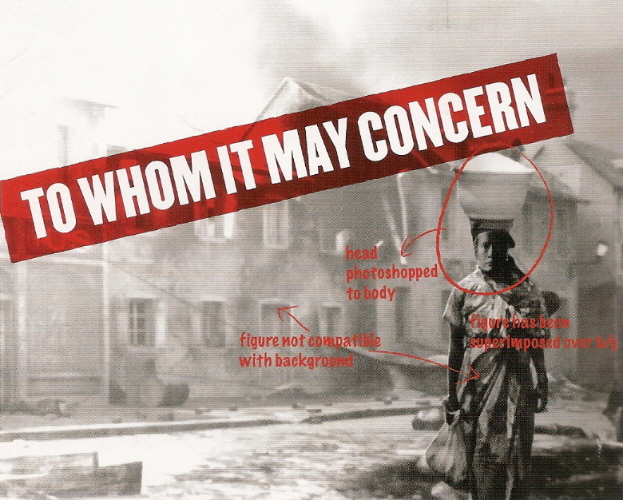
Event: “To Whom It May Concern“ by The Finger Players
Series/Festival: Esplanade’s “The Studios” series
Playwright/Director: Chong Tze Chien
Cast: Karen Tan
Run: 1st Sept – 4th Sept 2011
I feel that monologues aren’t the easiest plays to write or act in, and they don’t come by that often on our stages, maybe because it is quite taxing on the actor, and if not done well, could prove boring and undramatic. The relationship between the actor and the script is very tight. It is an exchange, as well, with the audience, who are fully focused on that one character. However, we did see a number of monologues this year, the last good one being the recent Weight of Silk on Skin.
Citing a departure from the conventional monologue, Tze Chien’s first monologue isn’t focused on the narrative exposition of a single character’s inner most thoughts and nature to an audience (well, at least not in the conventional way), but rather, the protagonist was one character who was three. In his own words, he wanted something that would prompt us not to take the narrative at face value, by creating an unreliable narrator. What is the truth and what is not? When is Lily saying the truth, when she’s not? I believe the main contention here was whether Beck (Rebecca) was real or not. Judith, was from the start, a scammer, so it may not be as crucial if she were real or not, but she would be in a sense “real” if Beck was real. And if Beck were real, then Lily will be speaking the truth. So that was what we were left to discern on our own along the way.
I guess the turning point came when Lily could no longer keep up with the masquerade and all her characters melded together. Maybe she started out with good intentions, but it got out of hand. Was she schizophrenic/mental? Yes and no. She seemed fully aware at the end of what she had been doing.
As it is, what was written is as crucial as to how good the actor/actress brings it across. Karen Tan must be one of the most sought after (and hardest working, as Jeremy puts it), stage actresses in Singapore because wow! I’ve been seeing Karen Tan a lot these days. And I believe it’s because she is one of our more versatile actresses on stage, whether as a comedian or in a serious role. She has not failed to play each character with all her best, and I see she puts in a lot of hard work into it. And switching between the characters for this play required much stamina and tenacity, which she did magnificently.
About the sets, the whitewashed look of chairs, stage and dressing were impressive enough when I entered the venue. A clever use of space, props and cues to enact the play. The chairs were also the premise/starting point for the playwright, as he thought of a likely ignored/forgotten figure, the one who arranges chairs before an event. How much do we really know about this person? Or people like that? And the white would represent a contrast of the truth. The sets designer was incidentally Tze Chien.
For one thing, I believe Tze Chien’s strength is where he is able to direct his plays to holistically bring the whole theatre experience together. And as playwright and director, I believe the play has been well-executed, thanks also to Karen Tan. Interestingly, as pointed out during the post-show dialogue, the script was actually ambiguous in the direction; a whole new play would have taken place if they had chosen for Lily to be speaking the truth from the beginning.
The Hossan Leong Show (Episode 3)
 Event: The Hossan Leong Show (Episode 3)
Venue: Drama Centre Theatre
Run: 8th Sept – 25th Sept 2011
Firstly, we would like to say that we are flattered that the “Hossan Leong Show” marketing team had decided to use one of our quotes from last year’s review for their promotional material for this production.
This is the third episode of the “Hossan Leong Show” in as many years, and it has fast established itself as one of the most well-known theatrical comedy franchises in the local scene, considering our beloved Dim Sum Dollies have been rather dormant for quite some time now.
(Selena, Emma, Pam, where are you?? We miss you.)
George Chan directs and choreographs, and the writing duties are shared by Mr Miyagi (Benjamin Lee), Edmund Shern, and Hirzi Zulkiflie.
Familiar faces in the cast include Chua Enlai, Judee Tan, and DJ Shigeki Ito.
The main point of note is that Siti Khalijah, who also happens to have had won the Best Actress award in this year’s Life! Theatre Awards, joins the cast for the first time.
Truth be told, even though this is the “Hossan Leong Show”, I think that it is the twin pillars of Chua Enlai and Judee Tan that truly carry the show and make it what it is.
Siti, while immensely talented, might perhaps be an unfamiliar face to most people who had not seen “Gemuk Girls” or “Model Citizens” or “Those Who Can’t, Teach”, and thus, it felt as if the audience was slightly apprehensive towards her and hence, she did not receive the lion’s share of the laughs.
Comedy is as much about familiarity as it is about humour, and it might perhaps take a bit more time before we all finally get warmed up to Siti the comedian.
While Hossan is the regular ACS boy that we’ve all grown so familiar and comfortable with by now, it is Judee Tan and Chua Enlai who let their hair down and truly flaunt their boundless reserves of zany comedic talent.
Judee Tan had indeed struck comedic gold when she conceived the “TCM” character in last year’s show, and milks the same character to the fullest effect once again this year, much to the sheer delight of the audience.
I commented on Twitter earlier that watching Judee Tan play “TCM” is always worth the price of admission alone.
It is that good, folks.
However, the “Bibik Lily Lim” character played by Hossan still makes an appearance once again though it felt as if it had already overstayed its welcome last year.
Somehow, for some reason the “Bibik Lim” character doesn’t seem to resonate too well with the audience any longer, and the creative team might want re-evaluate the necessity of including this character in future installments.
Hossan’s opening monologue was highly entertaining, although the rest of the scenes in the show could perhaps been described as hit and miss.
It was hard to decipher the point of the whole IRAS skit (why IRAS?), although it has to be said that it was still the most entertaining portion of the show, thanks in no small part to the brilliance of Judee’s portrayal of TCM, while playing off the equally competent Enlai.
As for the “So You Think You Can Tahan?” skit, while the premise was entertaining, it didn’t exactly feel as if the skit actually managed to break into its stride the whole time.
But don’t get me wrong.
The “Hossan Leong Show (Episode 3)” is still an incredibly entertaining show, with enough fresh and witty lines to keep you tickled no end.
Enough entertainment to leave you with a wide grin on your face as you walk out the theatre.
Kudos to the 3-man writing team for coming up with some truly wonderful new jokes, just when you thought you had heard it all about the General Elections, the four Tans and everything else Singapore.
I’d like to think that the “Hossan Leong Show” is starting to finally find its feet and establish itself as one of the main staples in the local theatrical comedy scene.
It’s certainly got all the tools it needs to conquer new heights, although it could perhaps borrow a page or two from the “Dim Sum Dollies” playbook on how to conceive skit premises that truly hit the mark.
(“The Hossan Leong Show – Episode 3” runs at the Drama Centre Theatre till 25th Sept.)
Event: “Dealer’s Choice” by Pangdemonium!
Venue: Drama Centre Theatre
Run: 29th Sept – 16th Oct 2011
This is Pangdemonium’s third production, after their successful stagings of both “The Full Monty” and “Closer”.
Directed by Tracie Pang, “Dealer’s Choice” promises to be an entertaining comedy, and stars Adrian Pang, Keagan Kang, Daniel Jenkins, Andy Tear, Daniel York and Julian Low.
The script is written by Patrick Marber, and premiered at Londonʼs National Theatre in 1995 and won the Writerʼs Guild Award for Best West End Play and the Evening Standard Award
for Best Comedy.
The play runs for approximately 2 hours (including a 15-minute interval).
For students, you may be pleased to know that there is a Performance Motors “Share the Arts” 2-for-1 student ticket deal. (Please visit this link for more information.)
Lastly, we are very honoured to have been able to do a short interview with Artistic Director Adrian Pang (who also stars in this comedy) to hear about his views on “Dealer’s Choice”:
Q: What made you choose to stage this play? Was there something in particular that resonated with you?
Adrian: We wanted to do a comedy, and at the same time we wanted to make sure that we didn’t do something that’s simply fluffy. Nothing wrong with fluff, but we were looking for a comedy with balls as well – that’s what we like: fluffy balls! Hahaha…The central premise of DEALER’S CHOICE is simple: six guys get together to “talk cock” and then play poker. The “cock” that these guys talk is absolutely hilarious, and with the advent of casinos in Singapore, and more and more people playing poker, the gambling element is also topical and relevant. The poker game in the show is fun, funny and suspenseful – and the best thing is you don’t even have to understand poker to enjoy DEALER’S CHOICE!
Q: Anything interesting that audiences can look forward to in this play?
Adrian: The characters in DEALER’S CHOICE are all wacky and intriguing, the dialogue wonderfully witty and edgy, and it’s such a entertaining exposition of male bonding rituals and the warped mentality of men. It’s a very male, testosterone-driven play, that hilariously reveals how all these men are in actual fact little boys who need a woman in their lives! We saw the original production of DEALER’S CHOICE in London in 1995, and were struck at how funny and entertaining it was, so we are very thrilled to be bringing to our audiences the Singapore premiere of DEALER’S CHOICE:)
Q: How long was the rehearsal process? Were there any difficulties/challenges you faced while rehearsing for this production?
Adrian: Honestly, the most challenging thing during the four week rehearsal process was trying to stay serious. The dialogue really is so funny that it was extremely hard to keep a straight face during rehearsals. Often we would all just crumple in a heap laughing our heads off. It’s going to be just as challenging during performance!
…
Tickers for “Dealer’s Choice” can be purchased at SISTIC (here).
Go get them whilst stocks last!
Fear Of Writing (An Absurd Play)
Event: “Fear of Writing” by TheatreWorks
Venue: TheatreWorks @ 72-13 Mohamed Sultan Road
Run: 1st-3rd Sept & 6th-10th Sept ’11
***Warning: Possible Spoilers Alert!***
Never had I heard so much buzz surrounding a play as I had for this one.
Last week, one particular tweet on Twitter proclaimed it as THE play of the year, and Ilkosa said that she felt her life flash before her (which obviously intrigued me no end).
Yet there were others who weren’t too thrilled by it all.
There was, also, the unfortunate leakage on social media such as The Online Citizen’s Facebook page about a particularly crucial aspect of the play (more on that later), which more or less let the play’s biggest cat out of the bag.
Therefore, I just had to see it for myself.
The moment I arrived at TheatreWorks’ 72-13 premises on Tuesday evening, I could immediately feel the thick sense of anticipation in the air.
This was to be a play like no other, and most of us who were there to attend it were more or less aware of that.
The local theatre cognoscenti was rather well-represented that night, all expectant of the latest offering from Tan Tarn How after a hiatus of about 10 years.
If we thought Chong Tze Chien’s “To Whom It May Concern” challenged us to discern truth from falsehood, then “Fear of Writing” took things a step further.
Our sense of reality was promptly disturbed right at the start when Tan Kheng Hua suddenly stood up from amongst the mingling crowd in the reception area and introduced herself as the “director” of the play, and Janice Koh as the “producer” of the play, which drew what would be the the start of many an incredulous “Huh???” for the rest of the evening.
Didn’t we read that Ong Keng Sen was the rightful director of the play?
Oh wait…what play?
Kheng Hua duly went on to explain that there would be no play that evening, only a “party”, because an MDA license for the play could not be obtained, and that dissatisfied ticket-holders could immediately get their refunds at the door.
Long story short, we were subsequently led into the performance area, where audience members were encouraged to casually sit or stand around to observe the proceedings.
Ilkosa already described it pretty well in her post below that the proceedings almost resembled “performance art” in the way the actresses moved around the entire room and used all conceivable space, and how both live performance and multimedia were seamlessly integrated to form a cohesive work of art.
“Fear of Writing” is not a play itself in the conventional sense.
It is basically an attempt to portray and chronicle Tan Tarn How’s process in attempting to write a play based on political maverick Chee Soon Juan, although we are never introduced to the actual Chee Soon Juan play at all.
The play tries to capture Tarn How’s mental state whilst in the process of writing the play, and the shifting from scene to scene, e.g. news broadcasts, letters to his daughter, conversations with his director, etc. probably represented the conflicted state of mind he was in while trying to write it.
The “cat in the bag” duly arrived at the end of the play, in the form of the MDA officials attempting to halt the proceedings and demanding to take down the particulars of everyone in attendance, amidst much remonstration from Kheng Hua and Janice Koh.
Blame social media, if you will, for the rapid and almost instant dissemination of information nowadays.
I believe that at least half the room was probably already in the know and meekly played along, although I did spot a few members of the audience who were in a genuinely precarious state of disbelief.
I suppose the “fortunate” ones were those who had attended either the 1st Sept or the 2nd Sept performances, since they would have been able to experience the full extent of what it means to feel the “fear” which seems to pervade many aspects of our society today.
If you asked Ilkosa, she would probably be able to relate to you better the deep sense of trembling “fear” she felt at the end of the play, the way the director had fully intended for it to be felt.
One might recall the slightly unfortunate spar on national TV between Ken Kwek (formerly ST journalist, now playwright) and Mr Lee Kuan Yew in 2006, where Ken Kwek unwittingly brought up the issue of “climate of fear” in Singapore, whereby he was immediately shot down by Mr Lee.
We have come a rather long way from those days, if you consider what a landmark year this has been with the singular events of the Presidential Elections, and more importantly, the General Elections.
I have a faint suspicion that “Fear of Writing” would have been even more powerful had it been staged one year ago, when terms such as “opposition party” and “SDP” were still highly taboo words in society.
It’s only been one year, but we are quick to forget how much our social climate has changed after the major political events of this year.
Nonetheless, “Fear of Writing” promises a theatrical experience like no other, and looks us dead in the eye and dares us to confront our fears.
It challenges all of us with the most fundamental of questions: What are you made of? What things in life mean most to you? And are you willing to fight for them?
Fear of Writing

I think it’s safe now. To publish this. It’s been 4 days. (Be forewarned this post contains the spoiler!)
Like a “moving” theatre, the audience was free to sit or move around. The actors too, would move across the space, stand on the platforms where the audience sat and even into the next room. I felt it was something like performance art, with the show consisting of projected interviews with people (about their views of Singapore), interjected with the ‘live’ performance of anecdotes by the actors and a ‘broadcaster’ played by Serene Chen. What was most gripping were the verbalised letters/correspondence between Tan Tarn How and, I believe, his daughter (whom he addresses as “baby”), played out by Tan Kheng Hua. That was how the whole context was intently played out, the thoughts that ran through the writer’s mind, the reason why the ink didn’t meet paper over the years. Even as he purports to write, fear creeps in to dominate, but cleverly concealed as what seemed like the writer’s block. However, he confesses it eventually. It was especially ‘raw’ and emotional with the knowledge that the person he was writing to had died in a tragic hit-and-run accident in London last year.
To start from the beginning, the premise of the play was about the playwright’s intent to write a play about CSJ, but that posed some difficulties due to its “sensitivity”. So eventually, he wrote ‘a’ play, not ‘the’ play about CSJ, but a play about overcoming the biggest obstacle in his writing – fear. The audience was brought through the thought processes from the inception to production of the play. It was surprisingly engaging. Kudos to the director and actors.
At a certain point, only when we were well into the play, we were introduced to ‘the smell’. Quite faintly but suddenly. It was, as I perceive, the smell of fear. Fear paralyses us and if you could say it, we might become “dead meat”. Another aspect of what the ‘smell’ of rotting flesh could refer to, in my opinion, was how unwittingly, most of us have become like “zombies”, just going about our lives indifferently. Strangely, as an afterthought while considering this aspect, I thought of Stepford Wives. Everything seems perfect and beautiful, people are nice, but there is that underlying “decay” and unreality. Only the ‘living’ smell it.
*SPOILER ALERT*
And as we were given the time to ponder this over, we were rudely interrupted by The Raid. MDA officials among the audience stood up and halted the show, apparently gathering evidence of our transgressions. The audience was confused and I believe, many of us weren’t sure if it was part of the play or not. But the officials were pretty serious and the cast too. It slowly seemed more real as we were informed of the statutes and possibility of us being participant to a possible crime. We were even told to queue up for them to take down our particulars. It reached as far as to the point when someone from the audience finally stood up and decided to walk out in defense of the situation. And then lights went out. Ah! so it was part of the play after all.
I felt it was powerful, which says something, considering how placid I can be. I nearly felt my life flash before me, or rather I saw a possible future of “destitution”. Okay, I exaggerate, but the ISA did flash across my mind. This track of thought was probably suggested in view of the tone of the play and the recent elections. However, despite the fear and worry, it was kind of heart pumping in another way. We were suddenly thrown into a possible life-changing moment and each of us clueless and innocent, maybe, in one way or another. How decisive will we be to react? Kudos to Janice Koh and Tan Kheng Hua, and also the “MDA officer Lin” who was ‘seriously’ convincing. Come to think of it, the secretive way she showed her identification should have given the game away. We were given a taste of the apprehension and possible consequences of how the playwright felt and feared might happen. This really was the impact, shaking and waking us up. But he did write this play eventually, casting fear aside. And aptly, the cross-out design of the title would signify no more fear? Interestingly, the programme contents (given at the end) were ‘struck off’. Representative isn’t it?
As a recap of the start, it looked like a natural exclusion exercise was conducted in the beginning when it was announced that the performance was “cancelled” due to the revocation of their licence to perform this play. So it became a closed door private party for invited guests only (us) instead. Those who didn’t want to stay could get their refund and leave. A couple of people did indeed leave and some questioned the legality of the party. Assuming they were not plants, they missed out on a thought-provoking play.
In a way, the play was quite informative, making us aware of certain laws we have. You can take it 2 ways, either making us more cautious by showing us the possible consequences or making us more aware of our rights. Are we thinking for ourselves and what we want? We are after all, all part of Singapore and I believe we love our country enough to care about it and want to make it a better place for everyone, whichever stand we take. Or else why bother?
At this point, it is clear with all these elements, from the use of space to the drawing of our response, we were all part of the stage. In fact, it was our stage as much as the cast were. And so, we are all players. Can theatre cause change? It may be unclear now, but we became more aware. It is a platform.
To Whom It May Concern
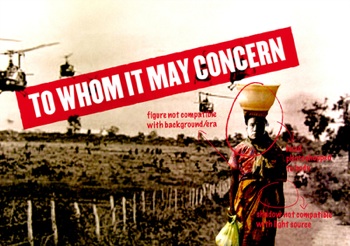
Event: “To Whom It May Concern” by The Finger Players
Venue: Esplanade Theatre Studio
Run: 1st Sept – 4th Sept 2011
“To Whom It May Concern”, a new monologue written and directed by Chong Tze Chien and acted out by Karen Tan, is a quirky little one.
It marks Tze Chien’s first attempt at a monologue, and he has attempted to subvert the genre by portraying the protagonist Lily as an “unreliable narrator” (in his own words), in order to avoid the scenario of the monologue lapsing into the undramatic.
And because the lines separating reality from fantasy are blurred, from the onset we are challenged into deciphering for ourselves which elements are fact and which elements are fiction, just like how one attempts to determine if a certain “Judith Mayo” from Africa is indeed telling the truth about her transfer of wealth or not.
“To Whom” is the fourth and final play in Tze Chien’s new book of plays, and after watching the play I had to go back to read up on the playscript once more just to catch up on all the subtleties in the play that I had missed.
The direction was crisp and clever, and the moment you walk into the Theatre Studio you are greeted with rows upon rows of white chairs all neatly lined up.
(I was kinda reminded of the set during the reading of Claude Girardi and Samantha Scott-Blackhall’s “Twice Removed”, incidentally also featuring Karen Tan, where there were rows and rows of mannequins all neatly lined up on stage as well.)
And as the play progressed, Karen Tan would stick the name labels into the slot in the back of the chairs so as to represent the different characters present in the play.
Hard to describe in detail, but it was all very cleverly conceived.
The only issue I had with the play was that since things started to become more and more fantastical as the play progressed, it was rather difficult for the viewer to stay invested in the proceedings.
I have a faint suspicion that the play started to lose some of its audience by the time it entered its latter half.
In “To Whom”, Karen Tan proves once again that she is worthy of the title of “local theatre’s hardest working actor”.
Not only has she appeared in more productions than anyone else this year (“Family Outing”, “Twice Removed”, “Beauty Kings”, “DNR”, “Model Citizens”) as far as I’m aware, she also gives it her all every time she takes to the stage.
And if the role of “Emily” in Stella Kon’s play is likened to running a marathon, then the physical demands of playing “Lily” plus all the other characters in “To Whom” must be somewhat akin to doing the Ironman, even if the play clocks in at a run time of only about 58 minutes.
“To Whom” may be a play that constantly challenges us to differentiate truth from falsehood, but I think we can be very sure of two things – that Karen Tan has put in a magnificent effort, and that Chong Tze Chien has once again presented us with a cleverly-conceived and directed piece of theatre.
Nadirah
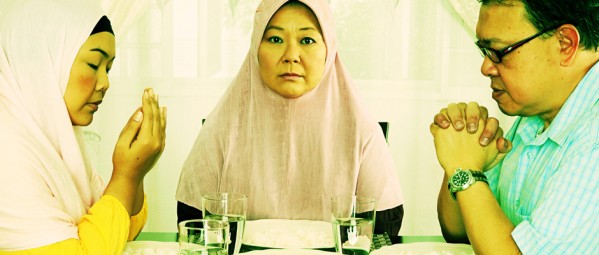
Event: “Nadirah” by Alfian Sa’at (as part of the Man Singapore Theatre Festival)
Run: 17-21 Aug 2011
Venue: Drama Centre Black Box
Directed by: Zizi Azah Abdul Majid
Starring: Neo Swee Lin, Siti Khalijah Zainal, Hatta Said, Shida Mahadi, Tony Quek
Nadirah brings across a myriad of issues, some very real issues. Cross-racial and even more strongly, a cross-religion marriage.
Unexpectedly (to me), it started off with such humour that had me laughing at the amusing dialogue and habits we could relate to played out. I could hear some the Malay audience agreeing and laughing too, e.g. having photo albums in living room and common proverbs and sayings used on children to nag at them. The cast had good rapport/chemistry together keeping us engaged.
But, inevitably, it moved on to more serious ground when the mother (a Muslim convert and divorcee) announced her decision to marry a Christian in a civil marriage where he doesn’t need to convert. This brings tension and struggles with the daughter (Nadirah) who’s a devout Muslim. The daughter is torn between love for her mother and love for her God.
Personally, I kind of sympathised with the mother. Firstly, she wouldn’t have become a Muslim if it weren’t for her ex-husband, who divorced her to marry someone else. I believe she must have had to give up her own family in one way or another. Then in the custody battle, she had to prove she’s a good Muslim because of her daughter so that they can be sure that her daughter will be brought up as a proper Muslim. Finally, after all these years, she finds love and comfort in someone who “saved” her from depression. Someone who dared to love, beating conventions. I was actually surprised (though it sounded quite ridiculously funny) when Nadirah’s senior, Farouk, even thought that because her mother has become a Muslim, she is now Malay and no longer (Peranakan) Chinese. It’s mixing up race and religion. Nadirah and Maznah (her best friend) had to throw up their hands at that too. But I agree with Nadirah that one should choose their faith based on their love of God, not because they fall in love with someone.
And wise words from Maznah, the slightly “renegade” friend who reminded her of the truth “how are you going to love God if you can’t love another human being?” I think Maznah is actually very smart and articulate, and can present pretty good arguments.
Ah, it’s all very complex, this conflict and personal struggles that set us thinking. It’s not something that can be easily resolved. Just as how it ended. I felt that it the issue never really got resolved and the family is still dealing with it, trying to find that balance and compromise.
Family Outing

Event: “Family Outing” by Joel Tan (as part of the Man Singapore Theatre Festival)
Venue: Drama Centre Theatre
Run: 17th Aug – 21st Aug 2011
I guess we should have to first preface this with the fact that “Family Outing” is the first full-length play written by young playwright Joel Tan, who, according to director Glen Goei, started writing this play at the tender age of 22.
I believe Joel is currently 24, and it is not often that a young man can say that he has had his first full-length play staged at the Drama Centre Theatre at age 24.
A highly-admirable start to what might be a bright future ahead for this young local playwright.
But first, the play.
We all know that the play is about the death of young Joseph in the church-going Choo family through a bizarre accident (accidental electrocution by TV), and how on the first year anniversary of his death, a young man named Daniel arrives at the doorstep of the family’s home to reveal that he was Joseph’s lover for five years.
After watching “Nadirah” on Wednesday night and “Family Outing” on Thursday night, I found it extremely difficult to fight the temptation of wanting to draw parallels between the two plays.
To put it bluntly, “Family Outing” might just have been the Christian equivalent of “Nadirah”, where Joseph faced the same predicament Nadirah’s mother faced, albeit in the context of another religion.
But honestly, to try and compare both plays against one another would be doing a disservice to both Joel Tan and Alfian Sa’at, because one should not be so quick to paint the two plays with such broad and insensitive strokes.
“Family Outing” was not without its sparkling moments.
It certainly had its fair share of tender moments, which apparently brought some audience members to tears.
But ultimately, I left the theatre feeling that the play somehow didn’t quite manage hit the sweet spot.
There was something very “Under One Roof” about the beginning, but once Joseph died you realised that you were watching some sort of dark comedy.
The play had an interesting premise, and you felt that it had the potential to be great, but it felt let down by weak characterisation and lines which could have used a bit more fine-tuning.
There were moments where you felt the playwright could have milked the situation for all it was worth, but somehow or other the lines just didn’t deliver.
Karen Tan and Lim Kay Siu, savvy veterans that they are, did well to carry the play on their shoulders, although the characterisation of the mum (Karen Tan) left me with too many unanswered questions – Was she or was she not the devout Christian in the family? If so, why was she so unfamiliar with the Bible? Why did she seem so unfamiliar with the name “Daniel”? Why was she so vulgar in the opening scene? But if not, then why was she so concerned about taking her kids to church every Sunday and so forth?
Because I figured Karen Tan was a central anchoring figure in “Family Outing”, and because I couldn’t get a firm grasp of who she really was, I was thus slightly disoriented and didn’t know whether to empathise with her.
Whereas “Nadirah” managed to successfully bring in the whole dogma of Islam to enhance the religious and cultural dilemma Nadirah and her mother faced, in “Family Outing” it didn’t feel like enough was being done to highlight the external religious factors which brought about the internal emotional struggle which Joseph faced, i.e. religious teaching vs. freedom to love.
Yes, the Cross was prominently hung on stage the entire play, but the whole “devout Christian family” idea perhaps wasn’t explored fully enough.
The choice of music during the play was a curious one, e.g. Enya’s “Sail Away”, Coldplay’s “Viva La Vida”, and Cat Stevens’ “Wild World” (can’t help but notice this song was also used at the end of “Nadirah”), amongst others.
As for the ending of the play, I found it to be rather awkward.
I believe there were two (unintentional) applause points toward the end of the play whereby the audience had applauded thinking that the play had ended: First, when Joseph turns to the audience and proclaims “The End!”, and secondly when he sails away on a slightly bizarre origami paper boat against the backdrop of a starlit sky.
And immediately after that, we go back to the family scene in their living room, and I believe I was not the only audience member to wonder to myself why we were coming back to this scene again.
And shortly after that, the play ended.
I felt that the ending sequence gave the viewer an unnecessary sense of misdirection, and thus made the ending feel rather clumsy.
In musicals the applause points are finely calibrated for maximum effect, and perhaps “Family Outing” could benefit from a slightly more well-constructed ending.
Not that I want to demean Joel Tan’s effort in any way.
As I mentioned, it takes a special talent to be able to have your work noticed and subsequently staged at the Drama Centre Theatre at age 24, and I fully appreciate Joel Tan’s first full-length play for its intriguing premise and its wonderfully tender moments.
Here’s hoping for greater things to come from this young and talented local playwright.
Cooling Off Day

Event: “Cooling Off Day” (as part of the Man Singapore Theatre Festival)
Venue: Drama Centre Theatre
Run: 10th Aug – 14th Aug 2011
It’s only been three months, but it’s funny how the unforgettably rousing events of 7th May and the days leading up to it seem like a somewhat distant memory now.
“Cooling Off Day”, written as a piece of verbatim theatre by playwright Alfian Sa’at, attempts to capture an emotional snapshot of those highly-charged few days leading up to this year’s oft-labelled “watershed” General Elections.
It is a piecing together of 35 different interviews of real men and women in Singapore, over a cross-section of attributes such as age, race and social status, and their thoughts and views on anything vaguely relating to politics in Singapore.
And as such, it is only expected that we would have been treated to a whole mish-mash of ideas and portrayals, on differing levels of intellect.
Lest you suspect that “Cooling Off Day” was overtly one-sided in its political leanings, I am glad to say that I found it to be far more balanced than I had expected it to be.
In fact, the opening scene itself, where Tan Kheng Hua plays a rational young school girl, asked a lot of pertinent questions on why we should simply vote against the ruling party.
The cast of Tan Kheng Hua, Najib Soiman, Neo Swee Lin, Peter Sau, Rodney Oliveiro and Jo Kukathas was highly competent, and Jo Kukathas should perhaps be singled out for her brilliant performances, even though it seemed to me like she might have played slightly fewer roles than the others in the cast.
Najib Soiman proves once again that he is the supreme master of comic caricature, although Peter Sau was quite a riot as well.
Playwright Alfian Sa’at and directors Jo Kukathas and Ivan Heng expressed at the post-show dialogue session that their main challenge in this play was how to select the pertinent interviews from the wealth of material that they had collected, and how they could piece together and arrange the pertinent material into a sequence which made the most sense and had the strongest impact.
I liked that the interviews spanned a variety of topics, such as race, foreign policy, rising cost of living, social media and even Teo Soh Lung’s gut-wrenching account of her experience under ISA detention.
Well-known personalities interviewed include blogger Alex Au, TOC editor Joshua Chiang, SDP candidate Dr Vincent Wijeysingha, and even popular blogger Xiaxue.
One aspect of the play I couldn’t understand was the heavy emphasis on the whole “Easterners vs Westerners of Singapore” dynamic.
I personally didn’t find the topic all too resonant, and was slightly curious as to why it was played out at length.
The unanimous high point of the evening was the last scene of Act 1, where the cast re-enacted the infamous “Bak Chor Mee” parody of 2006, albeit with many 2011 references thrown in…some subtle, others not so subtle.
(I remain incredulous at how many times Singaporeans will burst into laughter every time they see a girl in white stomp her feet on stage and say “I don’t know what to say!” before finally growing tired of it.)
There was no other point in time in “Cooling Off Day” where the energy level in the room rose to a level anywhere near as during the “Bak Chor Mee” scene.
Alfian Sa’at expressed slight dismay (good-naturedly, of course) that the “Bak Chor Mee” scene would have been the highlight of the play, when ironically it was the only scene that was not contributed nor conceived by him, since it was Mr Brown’s creation after all.
I suppose political parody is still one of the most popular forms of theatrical entertainment here in Singapore.
And on a larger-picture level, I suppose politics, especially in a landmark year like this year, is a subject that remains very close to our hearts, even though it may not necessarily be a topic that is always on our lips.
And in “Cooling Off Day”, Alfian Sa’at and W!ld Rice have done remarkably well in capturing the Singapore political zeitgeist of 2011 in as comprehensively a way as can be done within the confines of a 130 minute play.
P.S. Loved the play’s poster design. One of the best theatrical poster designs I’ve seen in awhile. Kudos!
Cooling Off Day
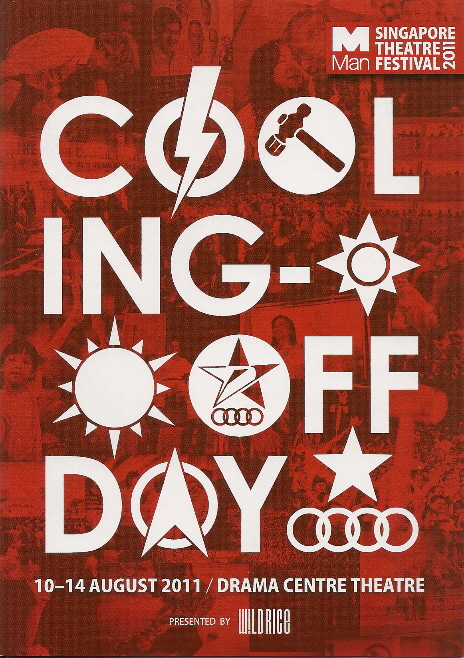
Event: “Cooling Off Day” by Alfian Sa’at (as part of the Man Singapore Theatre Festival)
Run: 10th – 14th Aug 2011
Venue: Drama Centre Theatre
Directed by: Ivan Heng & Jo Kukathas
Starring: Jo Kukathas / Najib Soiman / Neo Swee Lin / Rodney Oliveiro / Peter Sau / Tan Kheng Hua
When I first heard of this play, I wondered. Will it be a pro-PAP or pro-opposition play? Is it focused on the “gunpowder” sentiments of the citizens? But as the show panned out, it was in fact, presented rather objectively. This, I take it to be parallel to the rationale behind Cooling Off Day, which was meant to let our emotions settle down and let us make rational decisions as we weighed our options in perspective.
This was probably my first time watching verbatim theatre. Constructed out of interviews with people before and after the general elections, it was an amalgamation of the opinions of Singaporeans (and PRs?) from both camps; from the regular man-on-the-street, to the popular bloggers (e.g. Mr. Brown, theonlinecitizen, yawningbread) and even politicians. There were a total of 35 scenes, including the familiar Mr Brown podcast of the hawker centre “skit” which still drew laughs even though we’ve heard it before. The “lightning” touch resounded well in the ending of that scene with “Repent!”. There was also another familiar segment about the splitting of Katong area, where Joo Chiat isn’t part of Joo Chiat constituency, etc., which I had read about in an article. I think my favourite scene would be that of Saleh (played by Najib Soiman), the elderly Malay man, especially on the part to prove if Malay candidates were Malay. The Chinese masseuse (played by Peter Sau) was another ‘like’ of mine.
I understand it must be hard to put together the interviews into logical sequence or to frame a kind of theme or something. In terms of structure, we did see the 2nd half of the production moving towards a heavier tone than the 1st, where the interviewees portrayed were sharing on a deeper level. The segments on Teo Soh Lung were probably the more moving portions of the whole show. Honestly, I never knew of the ISA until in recent years when I happened to read some old articles. I was also vaguely reminded of Lim Chin Siong, having coincidentally read of his history at the National Museum the previous day.
There were a couple of hits and misses as some ended a little flat to me, but then again, those could mean something to others like how some of the actors themselves expressed the conflict they had in playing some characters. It could be I’m not really a political person, or people might call me politically insensitive or neutral. But I do believe these are honest accounts so I shan’t comment much on these. Nonetheless, there were a few that ended in an insightful manner, like the scene about the makcik photographed. She ended with something like this – “The question shouldn’t be who’s the makcik photographed, but who’s the photographer? Who’s the chief editor that published it? It is all very political.” 😉 I felt that the West and East comparisons could have been kept to or consolidated into one scene though. I was a little tired that night, so I might have felt the show slightly long towards the end, but generally still ok lah.
To top it off, I liked the way the whole production ended which had the actors, in the midst of Yam Ah Mee’s Club Mix, placing chairs representing the 87 seats of parliament with the whites and 6 opposition seats in red. A fine round up.

 Buttons In The Bread