A Review on “The Art Of Review (by Library@Esplanade)”
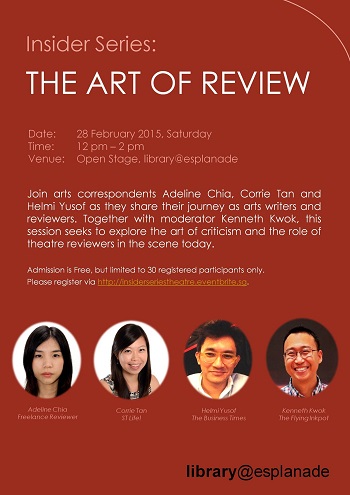 Event: The Art of Review (organised by Library@Esplanade)
Venue: Open Stage, Library@Esplanade
Date: 28th Feb 2015
The Gang’s All Here
I chanced upon the poster for this event a few weeks back through some shared Facebook post, and I was so glad I did.
The event featured, in my opinion, the who’s who of local theatre reviewing – Corrie Tan (ST Life! theatre reviewer), Helmi Yusof (Business Times theatre reviewer), Adeline Chia (former ST Life! theatre reviewer), and was moderated by Kenneth Kwok, co-editor of the venerable online arts journal The Flying Inkpot.
The only notable absence from the esteemed panel was Mayo Martin (theatre reviewer for Today online), who was out of town.
I have always enjoyed reading the theatre reviews by all the above names, although I’ve read the least reviews from Helmi as I hardly come into contact with the Business Times.
I’ve always been a fan of Adeline Chia’s sharp wit and ability to wring out maximum intent from just a few choice words, Corrie Tan for her depth of insight and her meticulousness in crafting her arguments, and Mayo Martin for his ability in bringing across ideas from angles which few other reviewers would think of.
It was thus a reviewer’s wet dream to see Helmi, Corrie and Adeline all in a row up on the Open Stage, flanked by Kenneth, who moderated the 2hr discussion expertly.
Corrie brought up the issue of the lack of a true stalwart of the local theatre reviewing scene, someone the likes of a Michael Billington, Lyn Gardner, or Frank Rich, who has been with the Straits Times long enough to have had accumulated a wealth of experience and insight over the decades, and who commands a reputation and an authority like the aforementioned names.
This is a sentiment that I recall was echoed in Chong Tze Chien’s “Rant and Rave” as well, whereby it seems like the ST theatre correspondents come through a revolving door system where they work their way up to chief arts correspondent only to move on to other pursuits a few years later.
There is thus that lack of continuity and an authoritative voice on all things pertaining to local theatre reviews.
Helmi and Corrie also shared about the limitations they face working for national newspapers – overnight deadlines which do not always afford them the luxury of being able to fully process their thoughts and think through their responses to a show, word limits which make it difficult to flesh out their arguments as lengthily as they would like, and the sheer ordeal of having theatre practitioners call them up and yell at them in protest to a review which they had just published.
Another limitation is also having your work go through an editor, who may or may not frown upon terms which are too technical, for fear of alienating a general readership.
There was the interesting point brought up by Helmi about how, due to the sheer lack of resources in our newspapers, both Corrie and himself often have to do industry pieces (i.e. preview pieces of the show by interviewing the cast and creative teams) as well as review pieces, and this thus raises the question of objectivity, and whether the reviewers can be considered truly independent when they attempt to write a review piece on the production, having sometimes seen a significant part of the rehearsal process as well.
In other larger newspapers overseas, they have the luxury of having writers do industry pieces alone while others focus on just reviewing alone.
Adeline talked about how, regardless of his/her views and persuasions, a reviewer must most importantly be a good writer, and must be one who people enjoy reading.
It is very obvious that everyone has a different opinion with regards to art, and even amongst the three of them they had differing views to various recent shows, but ultimately – and this point was agreed upon by everyone – a reviewer should have his own distinct voice and style, and he/she must make the reader want to read his/her work.
Someone from the floor asked the question of whether the panel of reviewers were mindful of which theatre company they were criticising (if they were to write a bad review), and whether there was a fear of a potential falling out if the theatre company in question happened to be a “big name”.
(Needless to say, as with any discourse pertaining to local theatre reviewing and criticism of theatre companies, the legendary tale of former Life! theatre critic Hong Xinyi and her infamous spat in 2006 with a certain local theatre artistic director would inevitably get its airing once again.)
All panel members mentioned that yes, inevitably it does matter to a certain extent who they are criticising, but Corrie emphasised repeatedly that ultimately, if you were to say negative things about a production, you all the more have to substantiate your argument and give solid reasons why you thought it was bad.
She doesn’t believe in “slamming” any production, knowing far too well how much effort a company puts into each production, and she also mentioned that she tends to be kinder to the smaller productions.
There were many other smaller points discussed during the 2hr dialogue session which I am unable to fully capture, but I truly want to thank Library@Esplanade for organising such an engaging session.
It was quite well-attended, and I saw a number of students diligently taking down notes, as well as other members of the public who clearly had a keen interest in hearing what the esteemed panel had to say.
For me, I was just glad to be able to have had listened to Helmi, Corrie, Adeline and Kenneth expound on many of the questions and thoughts which I’ve always had while running Buttons in the Bread for more than four years, and I am all the more inspired to keep on contributing to the local theatre scene in my own small way through this site.
Great World Cabaret – Let’s Bo Bo Cha Cha!
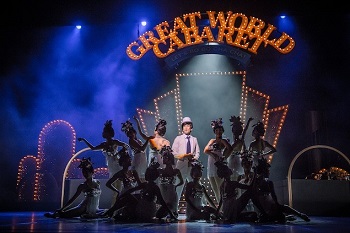 (photo credit: Resorts World Sentosa)
Event: Great World Cabaret – Let’s Bo Bo Cha Cha!
Venue: Resorts World Theatre @ RWS
Run: 19th Feb – 17th Mar 2015
The Ladies, The Music, The Finest…Cabaret, Cha Cha Cha!
The a-go-go era of the 60’s and 70’s remains one of the most colourful and vibrant periods of our cultural past, and naturally lends itself well as the backdrop to many a local musical or revue.
The mere mention of the words “a-go-go” or “cabaret” or “Great World” conjures up heady, nostalgic images of yesteryear, filled with the visual and aural spectacle of bright lights, big bands, sequined dancers, strip-tease artists, stage magicians, vaudeville acts and so on.
The most natural comparisons to reach for would be the classic 1988 Dick Lee and Michael Chiang musical “Beauty World”, as well as Kelvin Tong’s 2011 film “It’s A Great, Great World”, which depicted the past glories of the legendary amusement park called Great World Amusement Park.
And while the settings of all three works are largely similar, they are essentially different art forms as “Beauty World” is a full book musical, “It’s A Great, Great World” is a film, while “Great World Cabaret” is your quintessential 60’s/70’s cabaret show, the likes of which you’d hardly come across anymore in this day and age.
The show, co-produced by Resorts World Sentosa and Dream Academy, starts on an unexpected note, with a dark, creepy set depicting a museum that is nearing closing time.
In comes an elderly security guard (played by Shane Mardjuki), who then starts to reminisce about his glory days as host of the Great World Cabaret and his love affair with his eventual wife Nancy Pereira (Adelene Chua).
And it is through this device by which we are then transported back to the glamourous past, with a drastically different glitzy backdrop and with the colourful cabaret acts each taking turns to make their appearance.
As with most cabaret shows, the acts were a mixed bag of song and dance routines, acrobatic performances, stand-up comedy, and a magic show as well.
The Drunken Sailors act took a rather long while to get going, and didn’t quite seem to give the viewer the payoff it seemed to be building itself up into.
A personal favourite segment of mine was seeing famed illusionist J C Sum up on stage, regaling us initially with one quick dazzling illusion after another, and then with a tender, romantic floating table routine midway through, and finally ending off first with the magical appearance of his lovely assistant (no longer Magic Babe Ning though), and then with an astounding Metamorphosis illusion to top it all off.
It reminded me a lot of a standard three-movement sonata form, where the slower middle movement is usually sandwiched between a faster first movement and an even more emphatic last movement, to give the entire piece greater richness and texture.
The Metamorphosis illusion still remains one of my favourite acts to see live, and no matter how many times you see it, and regardless of whether or not you know how it ends up, it’s still always one of those truly magical feats to see being pulled off live.
While most of the ensemble song and dance routines were visually appealing, it did seem like the mic setups made it difficult to hear the lead singers’ voices clearly, and as such most of the time I had trouble deciphering what the lyrics actually were.
One reason could be that the band seemed to overpower the lead singers’ voices, and the other could be that the sound system just wasn’t set up well enough.
The Siglap Brothers routine, starring familiar theatre faces Caleb Goh and Linden Furnell, fell slightly flat due partly to the difficulty in catching the lyrics being sung, and also simply due to the fact that one expected more from a promising act featuring two actors whom you knew had the ability to do so much more than just belt out a show tune.
Perhaps the absolute crowd-pleaser was the stand-up comedy routine by guest performer of the night Mark Lee, assuming the role of infamous casanova “Valentiko”, who goes on to educate the audience on his quirky secrets to making women fall in love with him.
It was a thoroughly enjoyable routine, and not unlike the turn he did in Dream Academy’s “Happy Ever Laughter” last year as well.
Mark Lee is one of three other guest stars who will each take weekly turns to star in “Great World Cabaret”, with Hossan Leong up next, followed by Sebastian Tan and Judee Tan, all esteemed comedians in their own right.
I know it’s a pretty long run for the show, and that there is such a thing as a production budget, but I’ve often questioned the wisdom of bringing in different guest stars for short periods of time within a show’s run, as this means that the viewer would miss the performances of three other extremely talented comedians (assuming he/she only attends one show in its entire run), and you may get a situation where four different people who’ve watched “Great World Cabaret” may have come out with four different experiences.
And given the prices of the tickets, it might be unlikely that someone would buy tickets a second or third time just to catch another guest comedian perform, since the rest of the show is entirely the same save for that guest slot, and thus it inevitably creates a niggling sense of being left out of a portion of the production especially when you speak to those who have watched the subsequent shows with the other guest comedians.
The Qing Dao Acrobatic Troupe round things off with some truly breath-taking stunts which make you wonder if the laws of gravity do indeed apply to them as they do the rest of humankind.
How on earth they manage to throw their bodies around and balance themselves quite like that is truly beyond me, and has to be seen to be believed.
A cabaret show is essentially a series of entertaining but unrelated acts and requires no storyline to thread the acts together.
However, credit has to be given to the creative team for coming up with the emotional hook of having Shane Mardjuki take a walk down memory lane while reminiscing his past love, and thus, at the end of the show you get some small sense of fulfillment at having also taken the nostalgic journey together with him, even if the love story wasn’t as fully fleshed-out as one would have liked.
Still, “Great World Cabaret” remains an enjoyable romp through the glamourous and glitzy past, and is guaranteed to dazzle with the most gorgeous and glitzy visuals the cabaret world has had to offer.
And in a day and age where cabaret shows are but a thing of the past, this is probably the closest you’ll get to reliving the heady days of the a-go-go era.
The Rishi & Sharul Show
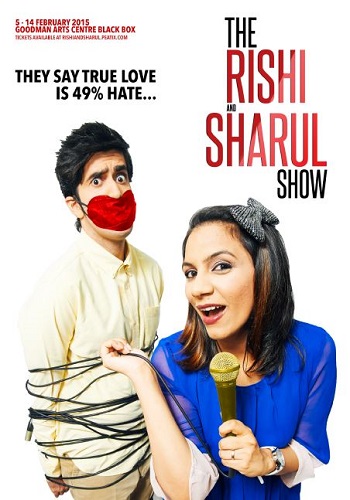 Event: The Rishi & Sharul Show
Venue: Goodman Arts Centre Black Box
Run: 5th – 14th Feb 2015
All You Need is Laugh
You might have seen Rishi Budhrani and Sharul Channa starring in HuM Theatre’s “Rafta Rafta” and “We Are Like This Only!”, but this is they first time the real-life couple are doing a comedy show together.
A number of questions come to mind before attending a show like this: Just how funny are the couple? Do they have enough stand-up material to last a full 80-minute show? What subject matter will the duo focus on?
Having attended opening night, it did seem like the nerves might have gotten the better of the couple, at least for the first few minutes, especially considering there were a number of their close family and friends in attendance.
However, the couple soon got over their jitters and hit their stride, with Sharul coming across as the slightly more composed and natural of the two.
The couple took turns to do solo stand-up routines, sometimes ribbing members of the audience, cracking jokes about gender, ethnicity, relationships and so forth.
They also demonstrated competent improvisational skills, and were often able to think on their feet and come up with impromptu jokes while playing off the audience.
Audience response was both raucous and fantastic, and there was no doubt that those in attendance were being highly entertained by the comedic duo.
The solo routines were interspersed with a number of comedy skits, often broaching the subject of marital relationships, with some pertaining to social commentary as well.
The inherent husband-and-wife chemistry was put to good effect, and you could truly sense the level of warmth and familiarity the two of them had with each other, which added that much more authenticity to the proceedings.
One of my favourite skits was the second one with the couple in the cafe, the husband glued to his iPad and his wife glued to her phone, both suddenly making a serious examination of their own marriage after the husband reads a random survey on Cosmopolitan.
The final skit where they keep rewinding and redoing their choices every time the bell rings was both highly entertaining, and demonstrated great comedic timing as well.
There were hardly dull moments in the 80-minute act, with the duo keeping the energy level consistently high throughout the show, although the “fruit fight” skit did come across as trying to stretch a gag way too far.
It is undeniable that both Rishi and Sharul give every ounce of energy to the show, and viewers who attend it would no doubt be entertained by the comedic prowess and sheer infectious enthusiasm of this hilarious husband-and-wife tag team, who spend most of the time mercilessly poking fun at this love-hate relationship known as “marriage”.
Whoever said love is a funny thing probably never meant it this way.
Circle Mirror Transformation
 (picture courtesy of Pangdemonium!)
Event: Circle Mirror Transformation
Venue: DBS Arts Centre
Run: 29th Jan – 15th Feb 2015
Men in the Mirror
No, the above is not a shot of the cast in rehearsals.
It’s the actual set of Pangdemonium’s first play of the 2015 season entitled “Circle Mirror Transformation”, which is written by Annie Baker and chronicles the exploits of the four members of an acting class in Vermont over the course of six weeks, under the tutelage of the hippie-influenced Marty (played by Neo Swee Lin).
You have Adrian Pang playing the socially-awkward and recently-divorced carpenter Schultz, Nikki Muller playing an attractive but slightly disillusioned former-actress Theresa, Selma Alkaff playing reticent and moody high-school teen Lauren, and Daniel Jenkins playing Marty’s boisterous and eager-beaver husband James.
What starts off as a tentative first lesson eventually leads to a deeper revelation of each person’s personality and life story over the weeks, through a series of seemingly silly and pointless theatre games which Marty puts them through.
As the weeks progress, the members of the class find themselves unwittingly exposing more and more of their innermost emotions, which sometimes lead to less than desirable consequences.
Even the highly-reticent Lauren eventually starts to let her guard down and reveal more of herself to the group, while Schultz and Theresa find themselves being entangled in a rather complex relationship of sorts.
The cast is a fine one, with strong performances all-round, especially from Nikki Muller, who exudes an irresistible charm onstage, and Daniel Jenkins, who makes his role of James totally believable.
Selma Alkaff, who makes her professional debut in this production, looks perfectly comfortable up on stage and hardly seemed out of place when playing off the other four theatre heavyweights.
Where the production falters slightly is in the unconvincing and uneven American accents, which seems to be a recurring theme in Pangdemonium productions.
Also, it felt as it the play was merely a series of sketches and didn’t fully flesh out all its characters as much as I would have liked, and neither did it contain a fulfilling dramatic arc.
It didn’t seem as if the play was building to any discernible climax, and felt more like routine snapshots of an entire six-week course, one week at a time.
And while the play ends on a rather melancholic note, thanks to the sheer energy and calibre of the cast “Circle Mirror Transformation” remains a largely entertaining and exhilarating behind-the-scenes romp through what many real-life thespians go through in order to hone their craft, and shows us that behind the sometimes wacky veneer that we all put on lies a very human desire in all of us, and that is the desire to love and be loved.
Coming Soon: The Rishi & Sharul Show
Event: The Rishi & Sharul Show
Venue: Goodman Arts Centre Black Box
Run: 5th – 14th Feb 2015
Asia’s Funniest Relationship!
From the same team that brought you the sketch comedy show “Rub My Antenna”, “The Rishi & Sharul Show” features a combination of originally written works by fresh Singaporean writers and internationally-acclaimed playwrights, and is a series that tackles issues of love, sex, marriage, family and what all of these mean in Singapore.
Stars real-life comedy couple Rishi Budhrani and Sharul Channa, and directed by Engie Ho.
Go get your tickets soon!
Ticket Price: $35 Standard
Ticket Purchase: Peatix Link (here)
Dim Sum Dollies – The History of Singapore (Part 2)
 (Photo credit: Dream Academy)
Event: Dim Sum Dollies – The History of Singapore (Part 2)
Venue: Esplanade Theatre
Run: 11th – 23rd Dec 2014
Hello Dollies, So Nice To Have You Back Where You Belong
The history of the Dim Sum Dollies, arguably Singapore theatre’s most well-liked cabaret trio, is in itself a highly fascinating one.
It’s hard to believe it, but this is actually the first full-length Dim Sum Dollies stage show since 2008 (which was a rerun), and the first brand new full-length show since 2007.
There were of course the brief cameos featuring newcomer Denise Tan (in place of Emma Yong) in both the 2011 and 2013 editions of Dream Academy’s “Crazy Christmas”, but this Christmas marks the first time the Dollies make their long-awaited grand return to the stage.
In recent years, the Dream Academy Christmas season was traditionally marked by the staging of the “Crazy Christmas” franchise (staged 6 times in the last 7 years), and it was probably wise of Dream to start bringing back the ever-popular Dim Sum Dollies series, considering the “Crazy Christmas” formula was in danger of inching towards its sell-by date.
Which is just as well, because after testing the waters in the previous two cameos, it seems the Dollies have managed to put their struggles and setbacks of the past behind them, and are all raring to go once again.
The formula of their shows is simple enough – rip-roaring skits laced together enormous doses of wackiness, song and dance, and lots of Singapore flavour.
And the Singapore flavour couldn’t have been obvious enough, what with the show taking you on a whirlwind journey through the history of Singapore, from the 60’s right till today.
Any doubts of ring rust were immediately dispelled, with the Dollies demonstrating fine form right off the bat in both their singing chops and comedic timing.
Denise Tan proves every bit up to the task as the new member of the team, and has probably the strongest singing voice of the group, the way Emma did.
The skits tended to dwell more on the political side of Singapore’s history, and oftentimes seemed like a case of “Glee-meets-Online-Citizen”, which isn’t a bad thing really, because there definitely is a large audience out there lapping every bit of it up.
There were the usual jabs at the handing over of a legacy from father to son, the redrawing of GRC boundaries, foreign talent as our national sports heroes, the nationalistic protests at Hong Lim Park, and there were also nostalgic takes on national campaign mascots of the past, and an incredibly detailed rap succinctly summarising the entire 90’s decade (great job on the lyrics for that one).
Revues like this are inevitably hit and miss, and skits such as the “Sunkist Conspiracy” came across as trying too hard to make a point at the expense of humour, and it probably flew over the heads of those who weren’t aware of what the skit was supposed to be referencing.
Nonetheless, humour was in no short supply throughout the show, with the “Lion King” scene featuring the giraffe named Goh (nice “And Tango Makes Three” reference there by the way), and the MRT scene featuring the three Chinese sportswomen, and probably even the “Disco Balls” scene providing some of the more hilarious moments of the evening.
Oh, and how about Pam Oei’s impersonation of a 90’s dial-up modem tone!
Had to be seen to be believed.
Hossan Leong plays off the Dollies brilliantly, and was probably one of the most crucial elements of the show, serving as a perfect counterpoint to the three ladies.
But it is in the music department that “The History of Singapore (Part 2)” truly shines.
Elaine Chan, who composed almost all the songs, submits probably her best score in recent years, and it does seem like she does her best composing work when working together with lyricist Selena.
I do feel the songwriting duo have an inherent chemistry about them that has allowed them to produce some of the best original songs I’ve heard in local theatre, and scores like “Cinderel-LAH!” (the W!ld Rice panto) and other early Dim Sum Dollies soundtracks immediately spring to mind.
For this show, the final song “Together” was immediately a winner in my book, somehow harkening back to the old days with Emma, and other songs like “Sunkist Conspiracy” and “Letting Go” felt equally inspired.
All in all, it seems like the Dim Sum Dollies have picked up right where they left off, and despite a long and sometimes arduous history – just like that of Singapore’s – it seems like they’re back, bigger and better than ever before.
Or as Louis Armstrong would say, “You lookin’ swell, Dollies, I can tell, Dollies, you still blowin’ you still crowin’ you still goin’ strong!”
“Lockdown” by Hatch Theatrics
 (Photo credit: Hatch Theatrics)
Event: “Lockdown” presented by Hatch Theatrics
Venue: The Substation Theatre
Run: 28th – 29th Nov 2014
Hatch Theatrics is a collective of young and talented theatre makers, and they recently staged the psycho-thriller “Lockdown” at the Substation Theatre.
“Lockdown” is a tale set in the counselling room of a typical secondary school, and starts off innocuously enough, with the teacher Miss Nora (played by Shida Mahadi) speaking with a student Izz (Ziyad Bagharib) and trying to mine more information from him with regards to a recent case of attempted theft in the staff room involving Izz and two other students.
Not much is made known to the viewer at this point, and it is only much further down the road that we start to receive more clues to piece the backstory together.
On the chalkboard in the background, we see a number of dates being written on it, and it is soon apparent that the story jumps back and forth in time.
Soon after, two of Izz’s friends – Wan (Farez Najid) and Jason (Andy Yew) – enter the counselling room, and this is when things start to get feisty.
There is obviously tension between Wan, who is the most aggressive of the three, and Izz, who appears to be the most meek of the lot, while Jason prefers to take the role of sidekick to Wan and defers to pretty much everything Wan says and does.
Wan assertively presents one side of the story, while Izz holds firm to his own version of events in such a sincere manner that you are reluctant to doubt him, leaving the viewer with the unenviable task of trying to figure out what the truth actually is.
Things take a turn for the worse when a fire breaks out somewhere in the school compound, and the entire building goes into lockdown mode, whereby all the doors are locked and there isn’t even any phone signal to tap on.
To make matters worse, Miss Nora, who suffers from claustrophobia, starts to hyperventilate, and her situation isn’t helped by Wan and Izz starting to get more and more violent with each other.
As the play progresses, the tension escalates tremendously, leading to an inevitably gruesome and chilling ending.
The performances of the four actors are truly commendable, and all three students made their roles so believable.
It’s hard to choose between Ziyad, Farez and Andy as they all seemed to inhabit their roles so naturally, and even the fight scenes towards the end of the play looked so real you almost wanted to ask them to tone it down a notch for fear of one of them sustaining an injury in the process.
The lines by director and playwright Raimi Safari came across as authentic, although I did find it slightly tricky to follow the storyline as it kept jumping back and forth in time, and the untidy presentation of the facts made it difficult to try and piece the entire backstory together.
The second half of the play was when things started to take a much darker and psychological tone, turning from what initially seemed like a realistic play into a much more edgy and surrealistic one, and while I can see the playwright’s intention in bringing out a number of character issues in the play, such as Jason’s desire to break free from always being told what to do and wanting to be his own man, it did seem like the play was a bit too short in adequately exploring all the issues it wanted to touch on.
“Lockdown” does have its moments, and certainly does seem like it would benefit from further fine-tuning, but in this particular iteration of the play, it is definitely the quality acting of the entire cast which makes the production as riveting and as powerful as it is.
Monkey Goes West
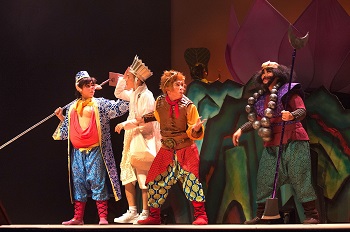 (Photo courtesy of W!LD RICE Ltd. Photo by Albert KS Lim ©)
Event: “Monkey Goes West” by W!ld Rice
Venue: Victoria Theatre
Run: 21st Nov – 13th Dec 2014
West Side Story
As far as W!ld Rice pantomimes go – this is the 11th different one W!ld Rice has staged thus far – “Monkey Goes West” is probably one of the most eagerly-anticipated for a number of reasons.
Firstly, it christens the newly-refurbished Victoria Theatre by being the first local theatre production to be staged at the iconic venue, and I was ever so excited to visit the new “Old Vic” for the first time.
Secondly, “Monkey Goes West” signals a bold departure by W!ld Rice from drawing from the usual well of popular Western fairy tales such as Cinderella, Snow White and the Seven Dwarfs, Hansel and Gretel, and Beauty and the Beast, and choosing to look East instead and adapting one of the most universally-beloved Chinese tales of them all – “Journey to the West”.
Thirdly, this marks funnyman Sebastian Tan’s debut as director for a major theatrical production, and what better way to make a splash than on this year’s annual blockbuster pantomime.
As such, expectations were riding incredibly high and attending this year’s panto seemed even more of an event than compared to the past few years.
The opening scene was enough to take one’s breath away, what with the grand golden pillars of the Heavenly Palace and the unbelievably ornate costumes on all the characters.
The show was certainly a visual treat of the highest order, and it seems no expense was spared in the costumes department.
The score by Elaine Chan was understandably oriental in flavour, and the main musical motif of “Monkey goes West…” certainly does have a habit of staying in the brain throughout the entire show.
“No One Like Mum”, sung by Ah Tang (played by Joshua Lim) was a lovely, delicate number which melded beautifully with the Chinese classic “世上只有妈妈好”, but apart from that, I can’t really say there were any other tunes in the show which truly left a deep impression.
The script by Alfian Sa’at was commendable, considering the numerous challenges involved, one of which was in trying to condense an enormous tome into a two-and-a-half hour musical, and the other being having to find the suitable dramatic arcs in the story to fit a typical book musical.
And while the condensing part was executed well, the challenge of giving the story the requisite rising dramatic arcs proved to be more difficult, and “Monkey Goes West” ended up feeling more episodic than having a fulfilling storyline arc.
Nonetheless, there were the usual brilliant quips which we’ve come to expect from a writer of Alfian Sa’at’s calibre, although the bulk of the laughs came from the usual gag of having a character (Chua Enlai’s in this case) constantly mispronouncing words as something vaguely similar, but which means something completely different.
However, it is in the performances that “Monkey Goes West” truly leaves an indelible mark.
Joshua Lim proves his mettle with a solid portrayal of the straight-laced Ah Tang, and coupled with a fantastic singing voice, shows that he is one of the fast-rising stars in local theatre.
Chua Enlai and Siti Khalijah never fail to bring the goods, and were an absolute riot playing Auntie Fanny/Princess Iron Fan and Guan Yin Ma/Sandy respectively.
Any pantomime with the two involved is truly blessed as they give it that added dimension of hilarity and enjoyment which very few others can.
Nonetheless, it is the relative fresh faces which add the icing on an already marvellous cake – Sugie Phua, usually seen in Chinese theatre productions, with his pitch perfect rendition of the Monkey King with authentic tics and movements and all, and Frances Lee, whom I last saw in Pangdemonium’s “Fat Pig”, playing (ironically) the role of Pigsy with such relish and gratification.
“Monkey Goes West” truly deserves its standing in the annals of W!ld Rice pantomimes as one of the most enjoyable and memorable shows to date, if not for its visual spectacle, then at least for the sheer ambition and vision of the entire team in staging something as grand and as challenging as this.
Full credit to W!ld Rice for daring to dream up something like this, and for managing to bring the dream to fruition in a most delightful and satisfying manner.
The Way We Go
 (Photo courtesy of Checkpoint Theatre. Photo credit: Chong Yew.)
Event: “The Way We Go” presented by Checkpoint Theatre
Venue: SOTA Theatre Studio
Run: 20th – 29th Nov 2014
Lovers And Other Strangers
What started out as a full-length reading entitled “Our Lady of Lourdes” written by playwright Joel Tan at The Arts House last December has now culminated in a full staging entitled “The Way We Go”.
Having attended the playread, it was interesting to see how much further the play had developed under the direction of Claire Wong into the finished product it is today.
“The Way We Go” is a meditative piece telling of two parallel stories – one being that of former school principal Agatha Mao (played by Lydia Look) and how she meets and falls in love with the ever-cynical Edmund Gomez (Patrick Teoh), the cousin of her best friend Violet (Neo Swee Lin), and the other being the much younger love affair between schoolmates Gillian (Chng Xin Xuan) and Lee-Ying (Julie Wee).
It charts the course of the two separate yet seemingly similar love affairs, how they face their respective obstacles along the way, and how one party eventually decides to leave the relationship, leaving the other party grasping for answers.
In many ways “The Way We Go” reminded me of a Schubert Impromptu – lyrical, profound, meditative, not as trivial as say a Chopin Prelude, but yet not as long-drawn-out nor as weighty as a full Beethoven Sonata.
Whereas Huzir Sulaiman gave a strangely likeable sardonic edge to Edmund in the playread last year, Patrick Teoh plays it more direct, portraying Edmund as a largely cynical and unpredictable character with scant redeeming qualities.
Lydia Look steals the show with her robust portrayal of the firm but empathetic school principal who allows herself to fall in love with Edmund, but eventually ending up a broken figure suffering from both a cancer and a shattered heart from having Edmund walk out on her.
The sheer tragedy of seeing her portray a heartbroken cancer patient late in the play was truly heart-wrenching.
Joel Tan once again exhibits his wit and mastery of the language with many an elegant line, while also showing great skill in portraying the nuances and complexities inherent in this thing known as “relationships”.
“The Way We Go” is a delicate journey through life and love, revealing the fears, insecurities, and heartache we all face when entering into relationships, and ultimately makes you want to cherish the ones who really love.
Kudos to Checkpoint Theatre in their efforts to constantly nurture and promote the works on young local playwrights by giving them full proper stagings, and in my opinion, there isn’t a theatre company in Singapore that does a better job of showcasing young playwriting talent than them.
Firefly In The Light
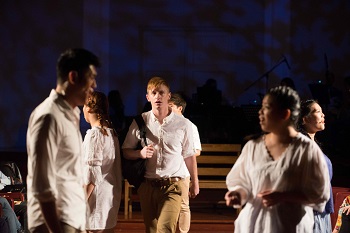
Event: Firefly in the Light
Venue: The Arts House (Chamber)
Date: 15th Nov 2014
Hopes And Dreams
It’s not every day that you find a new original book musical being staged, and it was absolutely exciting to be able to sit in on the premiere of “Firefly in the Light”, a brand new musical conceived almost entirely by one precocious seventeen-year-old named Shayna Toh.
While Tabitha Loh directed the show, it was Shayna who wrote the entire book, lyrics and music to the musical, while also serving as musical director, pianist, band leader and orchestrator as well.
One might be tempted to draw comparisons with Jonathan Larson, who wrote both the book and the songs for “Rent”, and it is indeed hard to grasp how one so young as Shayna could possibly have put so much together in just a span of eight months…all while being a student at Raffles Institution!
“Firefly in the Light” tells the story of the young seventeen-year-old protagonist Wendy (played by Rachel Tay), who aspires to chase her dreams of being a star amidst the bright lights of Los Angeles, where according to her mother, her father had once left his family for in search of dreams of his own.
Meanwhile, an old flame Jake (Linden Furnell) reappears in her life, hoping to rekindle the relationship they once had four years ago.
However, Wendy eventually escapes to Hollywood despite her mother’s violent objections, only to find out that her father – whom she now works for – runs a sleazy nightclub and is both ruthless and violent towards all his girls.
Jake, who blossoms into a singing superstar in his own right, eventually tracks Wendy down in Hollywood, but their supposed reunion does not go according to plan.
The songs are generally in pop-rock style, and there is a good mix of up-tempo, lively numbers as well as the mellow ballads.
There is no doubt that Shayna can write a good tune, and the opening song “Some People Have It All” proves it right off the bat.
The title song proves to be quite a hit as well, and is both catchy and memorable even upon first listening.
But while the lyrics are generally serviceable, it was a pity that the poor acoustics in The Chamber rendered more than half the lyrics undecipherable.
Other contributing factors could have been the drums overpowering the voices, or the less-than-perfect diction of some of the performers, but from where I was sitting I could hardly make out more than half of the lyrics I heard, and I would put it down to the acoustics of the venue, which has never been forgiving as far as I can remember.
The orchestration was inventive enough to keep things interesting, and having been a student of Dr John Sharpley for three years, it is no wonder that Shayna was able to come up with such deft arrangements.
Linden Furnell proves once again that he has got the singing chops, and hit some high notes pretty flawlessly while maintaining great stage presence throughout the show.
Rachel Tay too deserves plaudits for pulling off the lead character Wendy, who is the most emotionally complex of all the characters in the show.
And while the book served its purpose in delivering a full and engaging story, it did seem like there was slight redundancy in characters (one too many schoolmates which didn’t seem all that necessary), plus the fact that characters such as Wendy’s mother and father seemed more like stock characters than anything else.
Also, I felt that the daughter-father bond was far too underdeveloped and should have been focused on, since it would have added a whole new level of depth to the play.
Nonetheless, much credit must be given where it is due, and “Firefly in the Light” remains a truly remarkable effort not just from Shayna alone, but from everyone who was involved in the production.
It never fails to warm the heart to see so much effort being put in by a group of passionate theatre-makers to stage a brand new musical given the limited time and resources they have on hand, and if the musical theatre scene here is ever going to blossom, then this is definitely one way to go about it.

 Buttons In The Bread