“Emily of Emerald Hill” by Wild Rice

Event: “Emily of Emerald Hill” by W!ld Rice (as part of their 10th anniversary celebration)
Venue: Esplanade Theatre
Run: 3rd Mar – 12th Mar 2011
A Faultless Performance
The marketing campaign leading up to this production was hard to miss, when you consider the numerous newspaper ads, taxi ads, media articles, the giant banner outside the Esplanade, and even the viral Facebook music video (set to Madonna’s “Material Girl”) specially shot just to promote this play.
Indeed, a revisit by the brilliant Ivan Heng – “the quintessential thespian” (in the words of Dr K K Seet) – to the iconic role of Emily Gan in “Emily of Emerald Hill” is not an event to gloss over.
I had read that this production had an enormous budget, which would at first seem a bit puzzling since it is after all a play with just one actor involved, but as you sit through the play and see the various sets and multimedia displays unfold seamlessly before your eyes, it’s not difficult to see how the money was spent.
Performing a one-man act lasting two hours in front of a packed Esplanade Theatre is not a scenario for the faint of heart, but if there is any thespian in Singapore who has the big enough personality and talent to pull it off, it would be Ivan Heng.
It was back in 2000 when Ivan played the role at the Raffles Hotel Jubilee Hall, and that production of “Emily” marked the birth of W!ld Rice, a theatre company which has since helped shape the course of local theatre in its own unique way.
And he has chosen to cap off the 10th anniversary celebrations of W!ld Rice beautifully by reprising the beloved role of “Emily”, not unlike the way the stage character brought things full circle by waltzing off at the end to the jazz standard “The Way You Look Tonight”, the very same tune she first waltzed onto the stage with at the beginning.
Indeed, you could probably say that Ivan Heng just could not put a foot wrong throughout the entire performance, even if he tried.
His brash but likeable interpretation of Emily had the entire Esplanade Theatre eating out of the palm of his hand, and his charisma and stage presence went a long way in (dare I say it?) entertaining the largely ticklish audience right from the get-go.
That is not to say that the play is all fluff.
Stella Kon’s revered text tells the slightly tragic story of the once-mighty Peranakan matriarch who experiences two major setbacks in her life – the death of her eldest son and the death of her husband, and how she comes to terms with these incidents.
The multi-layered makeup of the Emily Gan character demands for a gifted thespian to bring out the full complexities of the script, because it is the character itself that makes the play, and Ivan Heng dealt with it adeptly.
One is unlikely to round off a discussion of this latest Ivan Heng production without at least a brief dwelling on the most recent interpretation of this role – Margaret Chan’s reprise during last year’s Singapore Arts Festival at the Victoria Theatre.
Comparisons are inevitable for those who have had the honour of witnessing both interpretations.
While Ivan Heng excelled in certain aspects, Margaret Chan excelled in others.
What I felt made a deep impact on me during Margaret Chan’s performance was the way she portrayed herself trying to win the favour of her mother-in-law.
I thought she play that bit brilliantly and was able to show her full range of acting chops in the way she tried to manipulate her way through family politics and become the most favoured daughter-in-law.
At once she was a domineering matriarch, fully in charge of all domestic affairs in the household, and at once she was a sweet, demure, eager-to-please daugther-in-law by the side of her mother-in-law, at her very beck and call.
But that is a discussion for another day.
For now, full credit goes to Ivan Heng for pulling off an immensely well-received and successful production of “Emily of Emerald Hill”.
W!ld Rice has certainly come a long way, and this is a beautiful way to cap off a fine 10 years of existence.
One can only lick one’s lips in anticipation of the fine offerings from the company in the next 10 years.
Closer

Event: Closer by Pangdemonium! Productions
Venue: DBS Arts Centre
Run: 17 Feb – 6 Mar 2011
I haven’t watched the movie so I can safely say I have an “unbiased” view of the production, although my emotional and analytical faculties might have been impaired by the flu I was having.
The whole plot revolves around truth, how it can hurt and alienate, rather than bring one closer to another. The 4 characters (Larry, Anna, Dan and Alice) intertwine in a series of love and lust affairs and can I say, sometimes of sexual politics? They make up, break up, then make up and break up again. How truth can be used as a weapon of “destruction” in the case of love. As the notes of the programme puts it, “while lies and deception cause damage, the truth, it seems, can make that damage irreparable…truth does not bring any of the characters closer.” Is love a matter of choice?
I didn’t feel that it was draggy (even though it was longer than I expected), and was giving it concentration throughout, which was a good thing. However, I didn’t find it as engaging as I thought it should have been. To give credit, each actor/actress played their parts perfectly well, but when they crossed paths, there was something lacking that didn’t bring out the intensity between characters as I would have imagined the play to be. A lack of chemistry maybe? The show didn’t really reach a climatic point…it seemed to be getting there at points, but then didn’t. As my friend puts it, it came out a little “flat”.
I wasn’t getting any closer to the core of the plot or the character-to-character relationship struggles…or maybe it was meant to be so?
However, I must say that strangely, the final scene gave me a sense of “relief”. At that point, the truth is as truth is, all things released and laid bare. Each character had moved on with their own lives and Alice’s real identity was revealed. No more tension, politics, struggles, etc. Just plain clarity.
On another note, I felt that the only one who could see through or acknowledge the facades of life was Alice (or Jane). She utters the bare truths of life like when at Anna’s exhibition:
“It’s a lie. It’s a bunch of sad strangers photographed beautifully, and all the glittering assholes who appreciate art say it’s beautiful ’cause that’s what they want to see. But the people in the photos are sad, and alone, but the pictures make the world seem beautiful. So the exhibition’s reassuring, which makes it a lie, and everyone loves a big fat lie.”
I think I should go watch the movie since I’ve heard good reviews about it.
Broadway 4 Suakus: You, Me, HDB

Event: Broadway 4 Suakus: You, Me, HDB
Venue: The Hall @ The Arts House
Run: 9th Feb – 20th Feb 2011
In an age where musicals are normally associated with the likes of Lloyd Webber, Boublil & Schönberg, Jonathan Larson and Stephen Schwartz, it is highly gratifying to see a group of local theatre practitioners so fervently spreading the gospel of the older (but no less inferior) Broadway material of the likes of Bock & Harnick, Stephen Sondheim, Rodgers & Hart, and especially Rodgers & Hammerstein.
While the works of contemporary musical writers are wonderful to say the least, one should not ignore the glorious works of the past masters, for whom we would not have Broadway musical theatre today as we know it if not for them.
Indeed, it was the duo of Rodgers & Hammerstein in particular who were instrumental in shaping the course of musical theatre, and one’s journey into the world of Broadway would never be complete without an exploration of their musicals.
Endless thanks, therefore, go to Jonathan Lim and the gang from Stages for presenting a delightful romp into the yesteryear of Broadway music, which somehow manages to score highly both in terms of entertainment value and educational value.
I would have to admit that as I am a huge fan of Rodgers & Hammerstein, most of the material in the show was right up my alley.
It didn’t hurt that “Fiddler on the Roof” is one of my favourite musicals too.
The programme for the show, though simply made via the stapling of some A4 sheets together, was extremely high on educational value as it faithfully chronicled every single song that was to be performed that evening, accompanied with detailed notes and background information on each song.
Apparently, we were told during the show that it was maestro Julian Wong, pianist and co-creator of the show, who was largely responsible for compiling all the juicy bits of information.
I thought it was wonderfully put together, and kudos to the team for taking so much effort into preparing the programme.
The show was mainly a revue, and featured the collective talents of Julian Wong (pianist), Jonathan Lim, Judee Tan, Dwayne Lau and Candice de Rozario.
It’s something like the “Chestnuts” formula if you will, with the good ol’ song-and-dance routines coupled with Jonathan Lim’s witty lines, just that this show was more focussed not so much on satirical comedy, but on the beauty of the songs.
And beautiful they were indeed, from the impeccably written songs of Rodgers & Hart (“Bewitched, Bothered and Bewildered”, “My Funny Valentine”), to the mastery of the musical waltz form of Rodgers & Hammerstein (“I’m In Love With A Wonderful Guy”, “It’s A Grand Night For Singing”, “Edelweiss”).
All four of them sang very well, and their harmonies were faultless.
Not to mention the brilliant arrangement and accompaniment from Julian Wong, which was breathtaking, to say the least.
How good is Julian at the piano?
Well, let’s just say that he plays “Edelweiss” with one hand better than most of us can play it with two!
The comedy in this show was not as outrageous and in-your-face as in “Chestnuts”, and it seemed like quite a few of the lines in this show were hit & miss, either because the crowd was not ready for that kind of humour, or it was just not the right place for those kind of lines.
Nonetheless, Judee Tan was mesmerising once again in her trademark comedic persona that borrows subtly from the Ris Low blueprint.
To me the most magical moment of the evening was when Jonathan and Candice reenacted the scene “Do You Love Me?” from the musical “Fiddler on the Roof”.
It is the scene where Tevye re-examines whether his wife Golde truly loves him, and even though he probes many times, she is unable to give him the definite “yes” that he is looking for (perhaps because it was uncommon in that culture to openly profess one’s love in speech, something like in Singapore I guess), but in the end, she finally admits that she loves him, and Tevye professes that he loves her too.
It is an incredibly beautiful moment that somehow works far better on stage than it does on screen.
That was pure theatre magic right there.
The mash-up of songs from “Miss Saigon” and “Les Miserables” at the end of the show was very well done, both in terms of stage direction and in musical arrangement as well.
I felt that “Broadway 4 Suakus” was successful in achieving its objective of educating us all on the wonders of Broadway music.
It’s almost like attending a “Broadway Musicals Appreciation 101” course, only a hundred times more enjoyable.
There is something new for everyone in the show, and with such a wide and diverse selection of songs presented, you are bound to discover more than a few songs which pique your interest.
The “Broadway 4 Suakus” franchise may only seem to be the little brother of the more wildly-popular “Chestnuts” series at the moment, and understandably so considering this is only its second installment, but in terms of an enriching introductory experience into the world of Broadway, this is as good as it gets.
p.s. One final note to the Stages team (if you’re reading this): I think asking audiences to sign up for the “mailing list” is kinda outdated already, nowadays it’s all about joining the Facebook page! =)
陈洁仪:我的音乐之旅 (Kit Chan: My Musical Journey)
I believe our Singapore songbird warrants a place here, so here it is.

Title : 陈洁仪:我的音乐之旅 = Kit Chan: My Musical Journey
Venue: Esplanade Concert Hall
Run: 12 & 13 February 2011
As part of the Esplanade’s Huayi Festival 2011, Kit Chan performed at 2 sell-out concerts with the Singapore Chinese Orchestra (SCO). I won’t say I’m a fan of hers since I didn’t buy all her albums or keep close tabs on news about her, but I believe she’s one of the best female pop singers from Singapore. The versatility in her voice is admirable and it’s good news she’s getting active again in the arts scene after her 6-year hiatus. Fortunately, they added 1 more show and I managed to secure tickets for that.
As the title of the concert suggests, it brings the audience through her musical journey, structured in movements, starting with her early days, her breakthroughs, her explorations into other things like musicals, turning points of her life, and finally, her comeback.
Opening the show was a prologue, DJ-style with Danny Yeo (杨君伟) seated on the 2nd level of the stage (it was an interesting set-up). Her voice rang out first as she opened with Amazing Grace, and as we searched intently for her appearance, she came out on the gallery on the upper level, joining the choir in that first movement where she sang 3 songs – Amazing Grace, Something Good from “Sound of Music” and Mr. Turner.
I don’t think I’ll go into every song. There were covers, her memorable songs (金曲), and also her own songs. Yup, she writes songs too if you didn’t know. I liked “Mr. Turner” (her 1st composition) which was rather catchy. I believe that’s in one of her albums.
The 2nd movement heard her performing her early hits 《喜欢你》 (Liking You)、《担心》 (Worry)、《拔河》 (Tug of War) and 《心痛》 (Heartache). She was fully warmed up (me too) when she reached 《心痛》, her 成名曲 (breakthrough song) that brought the mood in the concert hall up a notch. On another note, I always felt 《拔河》 was a challenging song to sing, with the “tremolo” portions if I can call them that, and the need to have good control of the voice tones.
The highlight came in the next movement when she re-appeared with 《等了又等》, from Snow.Wolf.Lake (雪·狼·湖). The audience started clapping the moment she opened the song and me? I found myself tearing. This had got to be the best song or climax for the night. I must say, it’s so different when she sings Cantonese songs…they seem to sound more melodious than her Chinese songs. Maybe because the Cantonese dialect has more intonations and she seems to use a different voice when singing them. She went on to sing 《月亮代表我的心》 and 《炫耀》, which saw the first appearance of Jimmy Ye (叶良俊) as guest pianist. Not often would you get to see Jimmy Ye playing on stage, I think.
I wasn’t familiar with the 2 songs from the 4th movement, 《懂得》 and 《东湾土星》, but the last and 5th movement had 《天冷就回来》, which I think is a beautiful heartwarming song by 梁文福 (that also inspired a musical of the same name). And of course, how can she leave without singing 《家》 (“Home”), our 1998 NDP song. She sang the Chinese version.
It didn’t end just yet, and for the encore, she sang one song (only) – “Home” by Michael Buble (yup, not the NDP song, but she did switch to that halfway and back again) which is found in her latest album of cover songs 《重译》. It was quite an apt closing of the concert actually, with lyrics like “I wanna go home” and “let me go home” as she “encouraged” us to be on our way.
Gee, I don’t really know how to rate it…should I give a biased or honest opinion? Well, I felt I would have enjoyed a real 演唱会 with more of her songs and less of a classical concert set-up. Strange seeing everyone sitting prim and proper at a pop (well, almost) concert . I had a “where are the light sticks?” thought and had to control my “sing/hum-along” compulsion. Ha! I think the audience started to loosen up at the encore, which was too short really.
Anyway, the SCO performed a nice interlude with a “mash-up” re-arrangement of her songs after the 2nd movement. Maestro Tsung Yeh (叶聪)is a great conductor.
“命运建筑师之远大前程 (Grand Expectations)” – English review
Title: “Grand Expectations” (part of Esplanade’s Huayi Chinese Festival of Arts 2011)
Director: Edward Lam
Playwright/Creative Director: Sylvia Chang
Venue: Esplanade Theatre
Run: 5 & 6 Feb 2011 (part of Huayi Festival 2011)
(The review in Chinese can be found in the previous post here.)
Synopsis:
Little Devil (David Wang) and Baby (Lee Sinjie) are a pair of actors who specialise in posing as the perfect couple to help their clients in marketing their products. Once lovers, they have a love-hate relationship. Baby wishes to find her own happiness while Little Devil dreams of striking it rich. During one of their stints at a property launch, they meet Moses, the architect.
Moses (Tony Yang) is inspired and inexplicably attracted to Baby, the way she looks pregnant and her uninhibited way of expressing herself, her opinions of home decor, etc. He hires her to be his inspiration for a new project, to play a pregnant “happy wife at home” where she would stay at his house. However, as much as Baby wishes the situation to be real, Moses neglects her whenever he is inspired to work on his design. She is lonely and unhappy, unlike the role she plays. In a turn of events, she discovers she has a hereditary eye disease that slowly renders her blind. She decides to leave Moses once she serves her purpose and also have a last meal with Little Devil. Both Moses and Little Devil finally realise their real feelings for her when she disappears from their lives.
On another note, while seeking treatment for her eyes, Baby meets a doctor (Wang Zhan) who was coincidentally at that fateful launch, and who was also attracted to her then, only that she didn’t notice him then. Unfortunately, now she can’t really see him clearly, but they eventually get married and she has finally found her real happiness, using her heart to see.
_________
First things first, I found the play a tad long. It was 3 hours long. Yes, that’s a long time, but Design for Living was of about the same length and it didn’t feel that long. If I were to compare the two, I enjoyed Design for Living more. Nevertheless, the story picked up in the last half hour, which redeemed it in that aspect.
One interesting style was when I wondered why the playwright revealed the outcome in the beginning (1st scene), i.e. of who she chooses in the end. Eventually, I realised what it meant when during a narrative in the beginning, Baby said that “if I knew this day would come, I would have looked at you more carefully”. Because she became blind.
_________
Thoughts
1)Two men who don’t understand what a woman’s happiness really is.
Little Devil thought that being rich will bring a woman happiness, so he keeps chasing after the “big money”, wanting to be his own boss without being practical first. I believe he wanted to provide for Baby, but she probably wanted a more stable relationship.
Moses thought he could ‘build’ happiness by creating a house that a woman wants. But an empty house is not a home; a perfect house on the outside but emptiness inside is fruitless. A woman needs something real and speaks of a future, to build a home together.
2)Maybe I’m reading too much into things, but was the naming of the character “Baby” on purpose? An overuse of the word that it has become too cliche or meaningless? No longer precious. (Actually, a better translation of the “宝贝” is “Precious”).
3)Baby was always living in a world of “fake” happiness, something short-lived and temporary, that only exists in role-play. So what the eyes see physically isn’t real, only what we see in our hearts is.
4)Sometimes, you can’t see what you see, you can’t hear what you speak; you don’t see what you should have seen and miss it; you speak what you do not mean and don’t know what you say.
“命运建筑师之远大前程 (Grand Expectations)” – 中文评介 (Chinese review)
一首熟悉的歌曲、一首感人的歌曲。。。一首“你的眼睛”(王展演唱)为这场编目于《华艺节》的戏拉开了序幕。显然的,这是一部关于“眼睛”的话剧。人往往被眼前的意象蒙骗了;说看得见,但其实看不见。

故事简介:
小鬼(王耀庆饰)和宝贝(李心洁饰)是一对专门扮演幸福情侣的搭档,在不同的场合替不同的客户演出完美的生活,赚取客人的信任。但曾经是情侣的他们其实并 不幸福。年轻貌美的宝贝一心渴望遇见能带给她幸福的白马王子;小鬼总梦想有朝一日名成利就。两人似乎有一份又爱又恨的情债。在一次发展商推出新屋时,他们 遇见了设计屋子的摩西(杨祐宁饰),一位满怀憧憬的青年建筑师。他看到了宝贝与小鬼的完美搭配。 “怀孕”的宝贝,化身幸福小女人,小鬼俨然是年轻企业家、她体贴的丈夫。两人真真假假的互动,紧扣众人的目光。
摩西深深被宝贝所吸引,他迷上她幸福孕妇的角色,更喜欢她毫无保留的表达方式。于是把宝贝从小鬼身边带走,邀请她在自己的全新设计作品里表演“一个女人的幸福”,并为他带来成功与名望。 只不过这只是一场“幸福”表演吗?宝贝能真的找到她在小鬼那儿所找不到的幸福吗?
摩西在这“幸福”的扮演中达到目的,找到灵感设计了“宝贝的家”。可是,在他冷落宝贝的当时,宝贝的幸福梦想破灭。她也渐渐因先天性的疾病瞎了。她决定在合约圆满后离去,也与小鬼共度了最后一顿晚餐,从此从他们的生命中消失。小鬼和摩西这时才发现宝贝在他们心里的地位。
不过,宝贝在寻医时遇见了王展饰演的眼科医生。原来,在那次的房屋发销场上,他也被宝贝吸引了,也撞见过她几次,只是宝贝没注意。只可惜,宝贝已无法清楚的看着他了。但他们最终也结为夫妇,宝贝也找到了她所渴望的真正幸福。
导演 (Director): 林奕华 (Edward Lam)
编剧/创作总监 (Playwright/Creative Director): 张艾嘉 (Sylvia Chang)
————
让我先讲讲坏的吧。感觉上,这场舞台剧有一点儿长(三个钟头)。对,三个钟头是很长,不过,前年的《华丽上班族之生活与生存》 (Design for Living) 也是差不多一样长,但感觉上不觉得如此。若要我跟那比,我比较喜欢《华丽上班族》。不过,我觉得最后的半个钟的剧情发展,稍微减轻那“长”的感觉,所以也不算差。
最初,我觉得奇怪为什么编剧这么早(第一场) 就把结局说出来(她选了谁)。后来,我在她瞎后才发现戏初的字句“如果知道有这么一天,我就仔细注意/看你了”的含意。
思绪/解剖:
1)两个男人。两个不懂女人所要的幸福是什么的男人。
小鬼以为只要有钱就能带个女人幸福。我相信他想赚大钱是因为他想给宝贝幸福,不过一味要当老板赚大钱是不切实际的。宝贝因此常和他吵架。我相信,她只想要个安稳踏实的感情。
摩西以为幸福是可以塑造的而想建一间能带给女人“幸福”的屋子。可是一个外表美满,但里头空荡荡的屋子是无法带给女人幸福的。女人需要一个充满真正美丽憧憬的未来。
2)我也想过,编剧命名 “宝贝”为“宝贝”是为了点题这名词的滥用吗?哈哈!或许我想太多了。
3)宝贝在戏里一直活在虚构的美满。她与小鬼的“幸福 、完美”搬演证实眼前所看到的其实都是假的,梦幻的。只有心里看到的是真的。
4)在剧中,摩西指出了一个重点。Sometimes, you can’t see what you see, you can’t hear what you speak. 人有时以为看见了,但其实错过了;也有时没听到自己所说的话而口是心非。
_________
(The review in English can be found in the next post here.)
“Something New, Something Old” by FaithWorks

Event: “Something New, Something Old” – A Double-Bill by FaithWorks
Venue: Drama Centre Black Box
Run: 27th Jan – 29th Jan 2011
As part of FaithWorks’ 10th anniversary celebration, they have put up a double-bill entitled “Something New, Something Old”, which runs for 3 nights and features Dora Tan’s “Getting Married With Dad Dead Next Door” and Henry Seow’s “The Bench”, and Ilkosa and I were pleased to have had attended the performance on opening night.
The first play by Dora Tan was a dark comedy, that centres around the curious event of an elder daughter returning home to her family with her British boyfriend just for a few hours in order to go through the formality of having a customary Chinese wedding before flying back off to the UK again…but unbeknownst to them, her father is lying dead in his bedroom.
I thought the play was well-written, as it brought out certain issues, such as how the elder daughter is marrying her British boyfriend just for the sake of escaping from her family in Singapore, and how it parallels with her mother’s predicament of having married her father but yet having little or no love for him.
It was apparent from the play that both the elder daughter and the mother had entered into marriage without really having true love for their partner, and this contrasts ironically with the younger sister, who seemed to have true love for the man that she was seeing for awhile, but the sad thing was that he was a married man.
The play also tried to bring out the issue of modernity and how the young in today’s society tend to be all too quick to forsake their traditional Chinese roots and customs, and be ever-ready to embrace Western culture…although this issue was perhaps not so fully fleshed out in the play.
I liked the clever little twist at the end when it is revealed that the mother knew all along about the father’s death, whereas we the audience thought that she was going to be the last person to know.
(Ilkosa would give a different take though, as she says it was apparent to her from the start that the mother already knew.)
It seems to me that the play was a bit too preoccupied with handling the delicate situation of the father being dead in the next room and how the various family members took turns to individually find out about it, but didn’t dare to let anyone else know that they had found out.
As such, after the mid-way point it felt like the play became more plot-driven than character-driven, and almost turned farce-like in some ways.
But of course, the contrast between the mother’s reaction towards the dead fish as compared to her reaction towards the dead father did serve to highlight how little love she truly had for her husband.
Lastly, I can’t help but wonder if the “grandma” role in the play was all that necessary?
It seemed to me like the grandma did not contribute much to the development of the play at all, and thus I would question if her role was truly necessary.
…
The first thing that struck me about “The Bench” was that it was certainly rather strange, from a structural standpoint.
The main idea of the play is that everything centres around a single park bench, and it chronicles the lives of various groups of people – a homeless man, an unhappy family, a couple in love, a young schoolgirl who can’t find love, a father-daughter relationship, etc.
So one by one, the different groups will come on, have their conversations on the bench, and then walk off.
The happens for one round, whereby all the groups are introduced, and then the next cycle begins…only this time round things start to get a bit more complex and we get to see a bit more conflict being presented.
Ilkosa and I were half-expecting the stories of the various groups to intertwine at some point in the play, but no, the stories remained stand-alone, and after the second cycle, the play ended.
“The Bench” was probably a collection of vignettes with the common motif of a park bench, rather than a play in the real sense of the word.
I thought the individual stories were rather well done.
Joshua Lim certainly stole the show with his excellent comic delivery.
Also, I don’t really know how to put this in a way that it doesn’t sound the least bit offensive, but…I thought the actor who played the homeless man really looked the part.
In conclusion, I certainly thought it was an enjoyable night of theatre, and although I had not previously heard of FaithWorks before, I want to congratulate them on their 10th anniversary and I look forward to catching more of their productions in the near future.
Something New, Something Old
It was a “long” night last night with a double bill by Faithworks.
I found the 1st play “Getting Married with Dad Dead Next Door” a tad draggy, such that I failed to find a strong message coming through to me (or it got blurred out). Jeremy commented that it’s surprising since I’m usually quite perceptive…maybe I was tired…it was a bit long at around 75min (for a double bill). But I did deduce that the mother knew that the father was dead already, right at the beginning of the play. Maybe because I was paying specific attention to what was said and the mannerisms displayed/acted to deduce it, by virtue of knowing already that there’s a dead dad. But this of course, as Jeremy said, meant that there was no element of “suspense” for me. Maybe this might have reduced the appreciation of the play and caused me to feel it was a bit long. I kept wondering when it will finally come to the point where all of them would discover that actually, the rest of the family already knew that the father was dead, which I expected would be the climax of the show. Unfortunately, the climax didn’t last long. Maybe a little shortening of the post-discovery might have brought it to a more impactful close. Generally, in my personal opinion, the play was nicely structured, the way the scenes changed for each set of characters, but probably needs some tightening up.
As for the 2nd play “The Bench“, it wasn’t exactly a play, as in with a main storyline or theme, but more of snippets of happenings around a bench in a park. People come, people go. They did it in a cyclical manner, i.e. about things happening one day at the bench, then another day of happenings starts, with some new characters introduced into the existing characters’ own mini-stories, or more “development” of relationships and about the characters’ lives. I was getting concerned at where this pattern would lead us, and was a little expectant of whether these characters will finally meet at some point (which I think would have brought it to an interesting juncture), but that didn’t happen. The more interesting part came when a geeky guy came out in the 2nd part, providing much comic relief. But it was predictable he would meet the lonely girl and something would develop from there. Both Jeremy and I felt this set-up might have been more suited for film then stage.
Guru of Chai
Just a short review…
I am not a good storyteller, and thus always admire those who can draw audiences when they tell a story, engaging people with what they speak. And Jacob Rajan is such, as the “guru of chai” in this production, with David Ward as the musician.
He tells a story of how a tea (chai) seller’s encounter with a girl abandoned at a train station, and who sings most beautifully, charts the life he would have. A policeman falls for her, but she chooses a poet. Her choice sparks a series of events affecting all around, that leads to tragedies.
I had gone to the show, expecting lots of laughter (which manifested in some of the audience), but I found it hard to laugh a lot myself because behind the jokes made, therein lies poignant words of wisdom and of life’s lesson. And then again, the story wasn’t exactly a happy one. What was interesting was the use of some magic tricks as he told the story, conjuring items out of nowhere, transforming objects to other things.
One particular quote stood out for me:
“Fantasie” – Melvyn Tan Live!
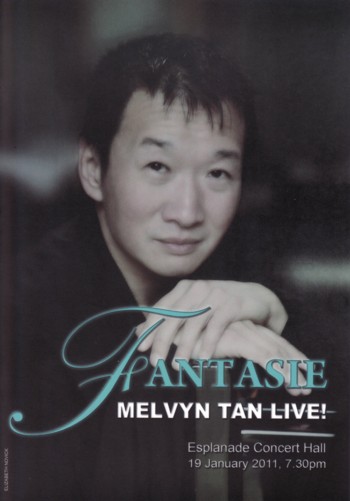
Event: Fantasie – Melvyn Tan Live!
Venue: Esplanade Concert Hall
Date: 19th Jan ’11
A Triumphant Return
The music and arts glitterati descended in droves upon the Esplanade Concert Hall tonight to witness what could possibly have been the most eagerly-anticipated piano recital involving a Singapore-born pianist in recent history.
You could easily make a case that Fantasie – the debut recital of renown pianist Melvyn Tan, was the hottest ticket in town.
One might be tempted to draw smart parallels between Fantasie and the legendary 1986 Horowitz comeback concert in Moscow, and although the magnitude of the two events simply cannot be compared, one should not ignore the cultural and social significance of Melvyn’s homecoming concert as well.
Indeed, much has made of Melvyn’s controversial fine of an undisclosed amount back in 2005 due his defaulting of National Service.
However, tonight was not a time for that.
Tonight was all about a man, a Steinway, and a hall full of expectant listeners.
There was a palpable sense of anticipation in the air minutes before the concert began, and you could tell that this was to be no ordinary recital.
The audience immediately burst into rapturous applause the moment Melvyn walked onto the stage, and his countenance revealed a slight sense of being overwhemled by the response he was being treated to.
The night’s programme consisted of Schumann’s Fantasiestücke, Debussy’s Images (Book 1) and Chopin’s Polonaise-Fantaisie in A-flat Major and Sonata in B minor.
In the Schumann piece, Melvyn demonstrated the lyrical qualities of his playing.
This was further enforced in the impressionistic compositions of Debussy, which required a sense of dreaminess and smoothness of flow, all of which Melvyn displayed to full effect.
Melvyn’s technical chops were on full display in the Chopin pieces, which he duly saved for the second act, and impressed greatly with his lightning-quick octaves in the Polonaise-Fantaisie, and his crisp, delicate running notes in the Sonata.
If I had to characterise Melvyn’s playing, I would say that it is highly refined and possesses an exquisitely delicate touch, and it is in the lyrical and leggiero passages where he truly shines.
It would be somewhat redundant to merely say that Melvyn is technically proficient, as you don’t get to be a concert pianist of such stature without being technically proficient, but I would even go so far as to say that Melvyn is able to coax exceedingly beautiful tones out of the Steinway in a way that few pianists can.
His attention to detail, and to every slight nuance of sound that his fingers create, is what in my opinion makes his playing such a joy to behold.
Melvyn’s fondness for Chopin was yet again apparent in his choice of encore pieces – Chopin’s Etude No. 8 in F Major (Op. 10), Mozart’s Piano Sonata No. 16 K. 545 (2nd Movement), and the Revolutionary Etude (Chopin) to tops things off.
In his introduction to his second encore piece (the Mozart Sonata), Melvyn explained that he had not played this piece since he was 8 years old, and the last time he performed it was in Singapore at the Victoria Theatre, and ended off by saying that even though it is a simple piece, “sometimes the simplest things are the most beautiful.”
After which, he duly sat by the piano and demonstrated to us all just what he meant by that statement…because under the direction of his skillful hands, he played a simple Andante movement so beautifully that it had the power to move one to tears.
I’m not exactly sure how the piece sounded like when Melvyn played it as an 8 year-old, but I was certain that the rendition I heard tonight was a rendition from a true master of the piano.
The final encore piece, Chopin’s familiar Revolutionary Etude, was delivered in a somewhat refined manner, as is consistent with Melvyn’s playing style, though one would have preferred if there was a bit more raw aggression to it.
No matter.
The night ended with thunderous applause and standing ovations in appreciation of one of the finest pianistic talents that has ever originated from our very own island.
The homecoming might have been more than 40 years in the making, but it was definitely well worth the wait.

 Buttons In The Bread