When a Gray Taiwanese Cow Stretched
Just a quick one from the airport.
Having not read the programme booklet, and long forgotten the synopsis given in the festival guide, I was pretty much clueless as what I was about to watch. Only that it was in Japanese with English surtitles.
And Japanese avant garde it was, metaphoric. Despite it being too abstract for me, I must say it was very well executed with excellent choreography and structure. The only problem was that the surtitles were insufficient, especially the mass interludes.
On the other hand, it was like poetry, and the performance was like a recitation of poems, like waves.
Themes I gleaned from the performance were migration and conquest/colonisation. And with the references to history and reminders of World War II, I felt it had fitted in the “I want to remember” theme.
The sets were impressive with giants, boats and housing.
Jeremy asked me how the play made me feel. I didn’t really feel much with the effort to try and interpret and read subtitles, but I did wonder if it was meant to make us feel empathy for the Japanese, especially with reference to WWII. That, made me have mixed feelings.
As an afternote, I referred to the synopsis:
“Writer and director Yukichi Matsumoto and his award-winningcompany Ishinha create an epic story about a “Sea Road” linking up the cultural, social and aesthetic histories of the peoples of the islands bordering the Pacific Rim: from the South Sea islands through Southeast Asia up to Taiwan ending in Japan… Matsumoto wants to create a new form of drama, a drama of the future or ‘tomorrow’ where the company wants to show things or concepts that are difficult or impossible to represent in terms of shapes. He said, “as I studied more about the sea and its people, I came to realize that there were more varied peoples and languages than on the main continent: I thought if I made the sea the main stage I could tell a story of Asia no one has done before.”
He has therefore created a hypothetical Japan current or so called Black Current to link the independent and scattered islands on which various episodes of the people who travel on this “Sea Road” can be represented. They tell their stories one by one – there is no one hero; everyone is a star. It is not the romantic or mythical “Sea Road” in traveler’s tales that he is interested in, but a 20th century visualization with a perspective that is of one standing on the earth and not from photographs or maps that take in a 360 degree view from the sky. The performance shows concepts or things that are impossible to grasp or represent in terms of known concrete shapes or objectifying strategies.”
Thriller Live!
 Event: Thriller Live!
Venue: Grand Theater at Marina Bay Sands
Run: 3rd May – 15th May 2011
Tribute to the King of Pop
Just a few quick thoughts on this:
Some of you might know that I am a huge MJ fan, and have been one ever since my classmate passed me a VHS of “Moonwalker” in school one fine day many years ago.
If you’re an MJ fan as well, there is absolutely no reason why you would not enjoy “Thriller Live!”, unless you are expecting the King of Pop himself to come back from the dead and take to the Grand Theater stage.
One has to note, first and foremost, that this is not a musical in any sense of the word.
It’s not “Mamma Mia!”, and neither is it “We Will Rock You”.
There is no storyline to speak of, just pure unadulterated song and dance.
It’s a tribute concert, plain and simple.
“Thriller Live!” takes you on a chronological journey spanning over four decades to relive the glorious music of Michael Jackson, from his early days with the Jackson 5, all the way to the “Dangerous” era.
If you’re looking for a good night out to dance to MJ’s greatest hits, then this is the place to go.
I was highly impressed with many of the performers, but especially so with the child performer.
His rendition of “Music and Me” at the start (which happens to be one of my favourite MJ songs) was, I dare say, an almost pitch-perfect rendition of the actual MJ recording.
He sounded almost exactly like a young MJ himself!
The overall choreography was breathtaking, and apart from showing insane levels of enthusiasm, it was nice to see that the dancers remained as faithful as they could to MJ’s original choreography, notably in “Thriller”, “Billie Jean”, “Smooth Criminal”, and “Dangerous”.
Setlist wise, I thought they pretty much covered all the essentials and more, although I would have wished for “Human Nature” to have been included as well.
That would have made the setlist absolutely perfect!
And I wished they had done a few more songs from the “Dangerous” album as well, instead of concentrating so much on “Off the Wall”.
“Dirty Diana” was a great addition to the list though.
I hadn’t listened to that song in a long time, and it was great hearing it again.
The high points of the concert, in my opinion, were the renditions of “Man in the Mirror”, “Heal the World”, “Black or White”, “Smooth Criminal”, and “Thriller”.
Overall, “Thriller Live!” features great vocals, incredible dancing, and general feel-goodness as a result of being soaked in two-and-a-half hours worth of MJ music.
The only thing to point out was that the sound quality in the Grand Theater seemed sub-par.
It’s definitely nowhere as good as the sound quality that one would be accustomed to at the Esplanade Theatre.
Gala: Midori (Goh Keng Swee Memorial Concert)
I’ve always loved Russian classical music. I love its exuberance…so soulful, passionate and expressive.
And it was an all Russian programme on 23 April, with works by Rimsky-Korsakov, Tchaikovsky and Rachmaninov.
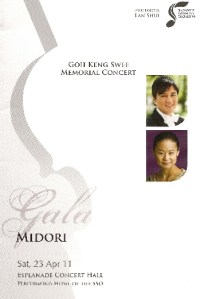
As it was also a Goh Keng Swee Memorial Concert, there was a special addition (Rachmaninov’s Vocalise) to the original programme to dedicate the concert to Dr. Goh, who was instrumental to the formation of the SSO as the founder. It’s been almost a year since he passed on and with that, the concert was opened.
Being Easter weekend, it was not a surprise that the Russian Easter Festival Overture was chosen. These two pieces were a fine lead-up to the feature of the day, Midori’s rendition of Tchaikovsky’s Violin Concerto in D major. I’ve heard a lot about Midori and was very expectant of what I would hear that night. And she did not disappoint.
Known for its technical demands, Midori tackled the concerto with great proficiency. Although I could only see her back view (I was sitting in the Gallery) from where I was, one can’t miss the precision and great control. Every note played had their own power in them and even the soft notes were clear and sharp, yet not overpowering. I literally held my breath whenever she was tackling such notes for fear of breaking the moment (ok, I might be exaggerating). On top of that, she plays with such feeling that it rings in our hearts. I especially loved the soulful second movement Canzonetta (Andante). Only thing was that I wished I could have seen her expression and a clearer view of her playing, and of course, being at the back, some of the sound projection would have been lost.
The encore, if I heard what she said correctly, was the Prelude (and Fugue?) to Sonata No. 1 in G minor by Johann Sebastian Bach (I’m very bad at recognising pieces). Nice.
Midori signing autographs during intermission
The second half of the concert heard the SSO playing Rachmaninov’s Symphony No. 3 in A minor. After the long earlier half (at least an hour), I felt it was a rather long piece for me that night. But I could hear the conflict between Rachmaninov’s nostalgia and bravado, as the programme notes suggested, as each theme was explored by the SSO consistently through the 3 movements. I liked the ending where “…in the end it is the mood of bravado which brings the Symphony to its exciting if slightly ambiguous conclusion”.
And so the concert ended around 10 pm.
881: The Musical
“881” or “八八一” (ba ba yao) tells the story of a pair of getai sisters, Min Min (敏敏) and Yan Yan (雁雁), under the stage name the Papaya Sisters (sounds like ‘881’ in Mandarin). The musical is an adaptation of the film by Royston Tan, of which was a huge success, running for, if I remember correctly, 3 months. However, despite that, I never caught the film as a result of procrastination. Maybe in a good way, this left me without preconceived expectations to compare the musical and film when I stepped into the theatre.
Although it was a bit weird with the 福禄寿 (Fu Lu Shou) deities appearing (who acted like narrators), they provided the comic relief and ‘breaks’ in between. Well, Sebastian Tan leads the trio here, as Lu. Well, being about the getai, I guess one can play with the “supernatural” aspect, like in the closing scene where Min Min’s ghost sings from the moon as she promises. Overall, the show was relatively entertaining, with all the colour, flamboyancy and usual Chinese melodrama. A few poignant moments brought tears to my eyes.
I was expecting the “cat fight” (i.e. the battle of Durians and Papayas) to be more intense though, but the Durian Sisters did succeed in making themselves irritating. The battle ended rather abruptly when Min Min collapsed and the competitors suddenly disappeared, while we were transported to the dying scene. I guess the focus here was on relationships (friendship, “kin”ship and loyalty), so all else was forgotten.
The costumes were simply breathtaking. While the Durian Sisters (actually I think they should be called Soursop since they were called Angmoh Liu Lian) took the European trend, our Papaya Sisters, true to the Singaporean spirit, covered our ethnic groups and landmarks. The merlion costume won the immediate applause of the audience when it appeared, fountain-inclusive! The sets were massive too, transforming the Esplanade stage to a getai for the night, plus the inclusion of other settings.
I believe at least half the songs weren’t originals (some evergreens like “爱神” and “热情的沙漠”), but “一人一半”, the theme song, from the film was one of the more memorable songs. One of the songs that touched me was “不要说放弃” which was reprised a couple times. I felt there were 2 musical styles in the show, one being the getai series while the other were the pop ballads. I think the cast were generally comparable/compatible in their musical capabilities, with no jarring differences in their performance (as compared to December Rains), and each were strong in their own areas. However, I felt that Judee Tan could have been given more opportunity to shine. She didn’t really get any full solo segments, unlike Joanna Dong who had two. But she did end powerfully after a dramatic pause, as she belted out the last line.
I agree with Jeremy that some parts were kind of glossed over, like the love triangle, which they did in a quick narrative manner as a background. If we weren’t paying attention, it would have been missed, even though we know that it was one of the predictable aspects of the show. That method worked fine for the opening scenes when the girls growing up though.
Well, with about a week left, you can still grab your tickets to the razzle dazzle of the colourful world and drama of getai-hood.
“881” The Musical…Getai Meets Musical Theatre

Event: 881 – The Musical (by Toy Factory Productions)
Venue: Esplanade Theatre
Run: 15th Apr – 1st May 2011
Chinese Theatre’s Answer to “Fried Rice Paradise”
The boisterous and colourful world of Getai arrives at the Esplande Theatre in the form of “881 The Musical”, the highly-anticipated theatrical adaptation of the wildly succesful Royston Tan movie from 2007.
Many thanks to Goh Boon Teck and the rest of his team at Toy Factory for bringing us the second grand-scale Mandarin musical in as many years, following the success of last year’s “December Rains”.
If there was a local movie in the past five years that was most suited for translation onto the musical theatre stage, then “881” would definitely have been it.
It was a no-brainer, because one can already imagine the myriad of possibilities available in tackling a story about friendship, loyalty, and love…amidst the backdrop of the Getai world.
First off, I have to state that I’d not seen the Royston Tan movie before, so I am unable to comment on how the musical differs from the movie.
Which is just as well, since it was never my intention to make this a point-by-point comparison between film and musical.
I would rather just view the musical as an entity on its own.
…
Music
There were 5 brand new original songs written for “881 The Musical”, though it is quite evident that the one song which truly stood out was “One Half (一人一半)”, which was the theme song from the film itself.
And such was the strength of the song that it was reprised incessantly throughout the musical.
Even the 4-note motif of the opening notes was enough to rouse up one’s emotions in a way that few other songs in the musical could.
The musical also featured the use of a few classic Hokkien hits, and there was even a rendition of Teresa Teng’s “何日君再来” at one point.
…
Costumes
I am not sure what the entire budget for “881 The Musical” was, but it seems to me like no expense was spared on the sets and props.
And oh, the costumes!
In keeping with the spirit of all that is loud, glitzy and ostentatious about Getai, this musical boasts of some of the most impressive costumes ever seen on a Singapore stage.
The costumes were so amazing that the audience instinctively broke into applause not once, but twice, at two distinct points during the show, in appreciation of the spectacular sights they were treated to.
(Life! Theatre Awards judges might want to just pen down the names “Saksit Pisalasupongs” and “Phisit Jongnarangsin” as outright winners of “Best Costume Design” for next year’s awards, because it’s hard to see how their efforts in “881” could be topped.)
…
Cast
“881 The Musical” is noteworthy for a number of reasons, one of which is that this is Judee Tan’s first lead role in a major theatrical production.
Those who had seen her in the “Chestnuts” series, “Broadway 4 Suakus”, and even “The Hossan Leong Show 2” would be aware of her immense talent, especially as a comic genius, and it is gratifying to see that she has finally had her well-deserved big break, headlining a major musical.
I thought Judee put in a commendable performance, but to those who’ve seen her command an audience like no other in her previous stage appearances, it felt as if she was capable of much more.
Joanna Dong plays the role of Min Min, sworn sister to Judee’s Yan Yan, in what is basically a reprise of her “Joey Tan” character in the recent movie “Forever”, minus the psychosis.
Joanna seems to have had the art of playing the role of sweet, doe-eyed, Miss Goody-Two-Shoes down to a tee.
Both Judee and Joanna sang remarkably well, and while it must be said that both of them look uncannily alike, especially in the photographs, that is about as far as it goes…because it didn’t feel to me like that was a whole lot of chemistry going on between the two of them.
For some reason, the pairing just didn’t feel quite right.
Perhaps it might have been because their characters were too similar.
I wondered if Judee should have played up her character a bit more, making it a bit more rough around the edges, to contrast with Joanna’s saintly character.
Sebastian Tan, playing “Lu” of the Fu-Lu-Shou trio, was easily the crowd favourite thanks to his comic delivery and great tenor voice.
I personally thought that Dennis Chew put in one of the strongest performances, even though his role of Duah Gee was pretty much a one-dimensional one with little room for development.
He showed great acting chops, and had a good voice to boot as well.
Oh, and I loved the whole MJ impersonation thing as well.
Subtle, but well-received.
…
Issues
There were a few issues I had with the musical that I would like to point out.
Firstly, how did a span of two years just flash by under our noses just like that?
I think the idea of two years having elasped between the moment the Papaya Sisters started becoming successful and the moment the Durian Sisters started to appear was lost on most of us in the audience.
I’m sure it’s not just me who was pondering over this, as I also overheard the folks behind me asking this very same question during the intermission.
Secondly, it seemed to me that though the musical provided plenty of visual stimulation, it needed more work in terms of developing the relationships between the characters.
For example, the love triangle between the two sisters and Guan Ying could have been fleshed out more vividly, so that we would have felt much more sadness at the end when Joanna leaves Guan Ying to Judee.
Also, the musical could have shown how the two sisters stuck with each other through thick and thin, forming the tightest of bonds, thus allowing us to empathise even more greatly with their sad scenario at the end.
There could also perhaps have been a song expressing why Getai meant so much to both Judee and Joanna, so that we could better appreciate why they are putting their life’s devotion into the artform.
Thirdly, I thought the musical’s dramatic arc peaked too early, which caused the remaining 20-30 mins of the show to feel somewhat sluggish, as it never did manage to scale the same heights once again.
The high point of the show was undoubtedly the Getai “showdown” midway through the second act between the Papaya and Durian Sisters, where one pair continually one-upped the other by emerging with wildly-extravagant costumes and dances, resulting in the climax of the show, where the audience couldn’t help but applaud with vigour.
That was the absolute high point of the show, which sadly came about 20-30 mins before the ending.
Fourthly, the main thrust of the story seemed unclear.
Was it a pair of sisters’ quest to become successful in the world of Getai?
Was it the fight against their biggest nemesis – the Durian Sisters?
Or was it about losing and cherishing our loved ones?
It seemed unclear at various points in the show, and one wasn’t exactly sure which thrust the story was ultimately trying to bring out.
…
The Chinese Version of “Fried Rice Paradise”?
Comparisons with last year’s “Fried Rice Paradise” inevitably started to creep into my mind the moment I saw how the set and the stylised characters in the first scene resembled the street set in “Fried Rice Paradise”.
And thus I found it hard to shake off the nagging suspicion that “881” might just be the Chinese equivalent to “Fried Rice Paradise”, until the moment the Durian Sisters started squirting soya milk(?) out of their chests…which confirmed everything.
What I mean is that like FRP, “881” panders to the tastes and sensibilities of the masses, and this means that the lines and gags in the show aren’t always done with the utmost taste.
Plus the fact that many of the characters (apart from the leads) were largely one-dimensional stock characters, e.g. Duah Gee, the Durian Sisters, 800, etc.
But one thing I’ll say for “881” is that like FRP, I know for a fact that it has managed to attract people to the Esplanade Theatre who would never have visited the Esplanade, and who would never have watched a musical if not for it.
I’ll cite you an example: On my way out of the Esplanade Theatre last night, I bumped into some distant relatives whom I’d never expected to see in the Esplanade Theatre watching musical theatre…not in a million years.
Such is the pulling power of “881 The Musical”, and you’d have to give Goh Boon Teck and Toy Factory all the credit in the world for staging such a colourful, entertaining and accessible extravanganza that brings the disparate elements of Getai, musical theatre, and non-theatre-going-folk all together under the same roof of the Esplanade Theatre in a way that was previously unimaginable.
And as such, “881 The Musical” deserves high praise.
《掌中》Turn By Turn We Turn
The life/soul of a puppet lies in the palm (and fingers) of the puppeteer (掌中), and when the hands are gone, as the ending scenes says, 艺术没有了艺术家,就不过是一堆破木烂布 (an art, without the artist, will just become a pile of useless wood and rags). And so is the significance of the “chopping of hands”, I believe.
In this tale about Li Bo Yuan, the chief puppeteer, his story is traced by the tale of Sun Wukong (the Monkey God), of which he performs, possibly his favourite character and alter-ego. If you’re familiar with the tale of 《西游记》 (Journey to the West) and Sun Wukong, Tze Chien has masterfully weaved these 2 characters (Bo Yuan & Sun Wukong) seamlessly together in portraying the ups & downs of Bo Yuan as troupe master. Just like Wukong, bursting out of the rock, Bo Yuan had started off, impetuous and reckless, full of 憧憬. Just as Wukong wanted to protect his kingdom, Bo Yuan wanted to protect his troupe and in this way, made decisions that might have seemed treacherous, just for the troupe’s survival. And like how Wukong was subdued and placed under confinement, Bo Yuan decided to let his disciple take over, and let his passion rest and take care of his family. However, the opportunity arose for him to live his passion again, to make a comeback like how Wukong was released from being trapped under a rock with a new mission, coincidentally, a journey to the west. A true master of the art, Bo Yuan lived and breathed it and, at the end of his life, he completes the journey, having done what he could do for the art, though with some regrets, and is released from bondage, just as he and the “souls” of the puppets 升天.
I think this relation was one of the strongest points in the production, not to mention the spell-binding puppetry display of the scenes from 西游记. I’ve always been fascinated by puppets and indeed, when the show is on, no one looks at what goes under (or above for some) as they are focused on what’s happening on the stage. As the opening lines (unspoken) goes, no one bothers actually, for the audience only wants to be entertained. Sad isn’t it? For the struggles and sacrifices of these artists go unnoticed, or misunderstood. But the sweet thing in the story was that Bo Yuan had a wife that supported and understood him all the way. 所为“人生难得一知己,千古知音最难觅”.
However, unlike the immortality of Sun Wukong, humans are not eternal, and without anyone to pass this on to, it will get lost. But then again, immortality of the art (or even legends) will only last if there was someone to tell it. What struck me was the irony of how the troupe survived numerous political upheavals, including the Cultural Revolution, but yet it failed to survive the the modern world of capitalism and commercialism, even bureacracy, only to face the fate of possibly collecting dust in the museum where the true ‘soul’ of the art is buried or thrown away (“丢掉、丢掉!”)
But at least we get to witness it here now, thanks to The Finger Players and their efforts to try to bring it back into awareness under the tutelage of Li Bo Fen and Li Yi Xin. Only a few days left to watch it. Grab your tickets now!
“Turn By Turn We Turn” by The Finger Players
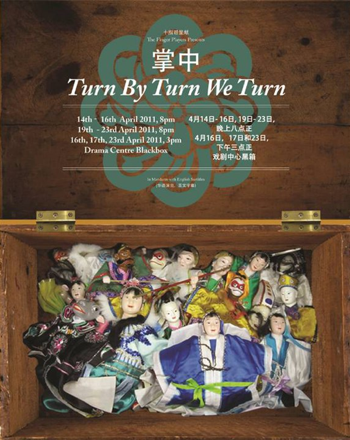
Event: “Turn By Turn We Turn” by The Finger Players
Venue: Drama Centre Black Box
Run: 14th Apr – 23rd Apr 2011
“Master said…in our world, there are two levels: one that is above us, where the gods and deities, heroes and emperors roam. The other is the level below, where we are. All that the audience pays and wants to see is right above our heads. They are not interested in what goes on below.”
And just like that, with these few opening lines, the play “Turn By Turn We Turn” had me at hello.
“Turn” is the latest offering from The Finger Players, and is written and directed by the talented Chong Tze Chien.
The play makes heavy use of Chinese puppetry, and this plays very nicely into the strengths of The Finger Players, as the company has had its roots in traditional hand puppetry since its inception.
“Turn” was written as a result of a surprise gift of a whole collection of hand puppets from the son of a collector two years ago, and most of the beautifully ornate puppets used in the play are from that particular collection.
The source material for the play was largely based on puppet master Li Bo Fen’s personal life experiences and accounts, and it was Master Li and his son Li Yi Xin themselves who were instrumental in training the cast in the fine art of Chinese hand puppetry since September last year.
One can imagine that the training must have been rigorous, because the cast of eight managed to put up a highly-convincing display in hand puppet dexterity throughout the entire performance, as if they had been puppeteers all their lives.
“Turn” attempts to be an epic play that chronicles the life and times of a traditional hand puppetry troupe that spans from 1920s China till the present day…all in 90 minutes.
And while this would sound like a mean feat, you could probably say that Tze Chien just about managed to pull it off.
And it is perhaps due to these very parameters that result in “Turn” being generally very pacey, and not having many moments which felt draggy or long-drawn.
The story often switches back and forth between the stage puppet act and the real-life portrayal of the troupe members, and it is apparent to the viewer early on that the story of the Monkey King being enacted by the puppeteers would closely parallel the circumstances of their lives.
And through the course of China’s 20th century history, the plight of the troupe is portrayed as they go through wars, change of leadership, the Cultural Revolution, and so on.
The part that struck me most was towards the end when Master Li lamented the fact that many of the former troupe members no longer saw the need to retain their puppetry skills, and queried why it was that when they were extremely poor and living from day to day in the old days, they could give their life’s devotion to the troupe and the artform, but ironically, in the modern age of relative abundance, none of them saw the need to preserve the precious artform any more.
And this perfectly captured the essence of many a modern day lament – the sad decay of precious traditions and heritage as a result of modern capitalist ideals.
I felt the directing by Tze Chien was crisp, and I loved the seamless sense of flow throughout the play.
The lighting by Lim Woan Wen (recent Life! Theatre Award winner for a previous Finger Players production “suitCASES”) was deft and served the purposes of the play well.
I thought the cast of eight did a fine job both in acting as well as handling the heavy puppetry demands.
Some of the puppet scenes were simply a joy to behold.
You always have to give extra credit when a cast has to shoulder extra puppetry duties on top of acting (e.g. “H is for Hantu”, “Pinocchio”).
All in all, “Turn” impresses greatly with the way it portrayed such an epic tale in a succinct manner, and the way it presented the Chinese puppetry artform in all its glory.
It is almost impossible to find an opportunity nowadays to witness traditional Chinese hand puppetry performed in such a manner.
Definitely a play to catch.
DNR (Do Not Resuscitate)

Event: DNR
Playwright/Director: Robin Loon
Run: 7-9 April 2011
Actors: Gerald Chew, Karen Tan, Serene Chen
How the story goes: Wen Jiansheng (Gerald Chew) has been faithfully standing by his wife, Li Chenjie (Karen Tan), who has been in a coma for nearly ten years. Enter Ye Ling (Serene Chen), a healthcare professional, newly hired to provide around-the-clock care of Chenjie. Intelligent and strong-willed, Ye Ling slowly makes Jiansheng rethink life, love and the rest of it all. Just as Jiansheng makes a decision to move on, Chenjie wakes up and things return to before, or does it?
Call me dull, but I really don’t know why this was called DNR (can someone enlighten me?). I only know that it means having a living will such that a natural death is allowed, with the omission of action to resuscitate. Well, I don’t see any specific reference to this in the play, except maybe to the comatose Chenjie, who just lies there. But no mention of DNR was given (unless I missed it). Was that why he keeps her this way? I thought it was out of love. Or does it have another meaning? Like with reference to the ending?
When I first read the synopsis/brief on the brochure, I was expecting it to be melodramatic like the 70s Taiwanese dramas, which was what inspired the playwright. However, it didn’t feel really melodramatic, and how would I say…rather “modern” than dramatic nostalgia? Maybe the writer’s intent was with reference to the “drama” of 2 lovers meeting in frustrated circumstances, but can’t get together because of those circumstances, and the longsuffering male protagonist (Jiansheng) takes up his responsibility in the end (with the help of Ye Ling’s “sacrifice” to let go), and things return to what was considered morally right, even though Chenjie has lost her memory. But then again, in an interview with Robin Loon, he said,
“I want it to evoke sentiment, but not sentimentality”
which I guess was close to what was effected. Subtlety.
Interesting that I felt Ye Ling and Chenjie seem to share similarities in their character.
As a “theatre unplugged”, with almost no props, just actors and live piano music, the play was accompanied by a recurring theme of, I think, a tune from some Chinese melodrama, played during transitions. And I think that made us focus on what was at hand, the raw interaction between characters. I guess the recurring theme should remind us of the repetitive and cyclical nature of Taiwanese melodrama. A constant reference was also made to Charlotte Brontë’s Jane Eyre. The characters were almost in similar circumstances, but not quite.
I must commend Karen Tan for her excellent performance as the comatose Chenjie. Her spasms during her “sleep” and her portrayal of someone who just woke up from a long coma was totally convincing to me (not that I know anything about it); the physical weakness and mental handling of that, plus her facial “adjustments” for the role, must have taken much energy and effort to sustain and practise. I find her character, Chenjie, rather witty and humourous, despite the conditions, which made her my favourite character in the show.
I guess one question about the story would be this: what if Chenjie didn’t wake up in that timely manner? What if Jiansheng decided to continue with Ye Ling? Chenjie said she wouldn’t mind if he left her as she couldn’t remember anything about them. What if Ye Ling didn’t make the decision for him? Ok, that’s more than one question.
Coming Soon: “881 – The Musical” by Toy Factory
Event: 881 – The Musical
Venue: Esplanade Theatre
Run: 15th Apr – 1st May 2011
The highly-anticipated “881” musical opens tomorrow at the Esplanade Theatre.
This latest production by Toy Factory stars Joanna Dong and Judee Tan in the lead roles, along with familiar names such as Nat Ho, Sebastian Tan, and Dennis Chew.
Goh Boon Teck and Beatrice Chia-Richmond are credited with directorship roles, and Royston Tan (who made the original “881” film of which this musical is based on) serves as creative consultant.
Benny Wong is the composer/arranger, and Elaine Chan is the musical director.
This is one musical that I am definitely looking forward to!
Tickets can be purchased (here).
The Lion King Musical
Given the excellent description by Jeremy of the musical earlier, I was initially planning to skip my review of this. But here I am, with some brief notes on my part about the show (caught on 8 April).
With much anticipation, backed by the good reviews so far from friends, I stepped into the theatre expecting to be ‘wow’ed by the production.
Indeed, I was exhilarated by the opening when all the animals came trudging down the aisle. It nearly brought tears of excitement into my eyes. I think if I were a child, I would be squealing or speechless with wonder. The sets and costumes were simply fantastic. Giraffes (on stilts), cheetahs, elephants, lions, African birds, antelopes, etc. The African safari all here, on the ‘Sandy’ shores of Singapore. I was particularly intrigued by the lion headgears that could bend at will when the lions were in their lion stance to act like masks, yet rest perfectly on their heads when they were speaking normally. The movements and choreography was excellent too, plus some use of shadow play.
However, maybe I had my expectations too hyped up. It was good, though it didn’t exactly “overwhelm” me. I felt the singing on my night wasn’t so good. Nala seemed to have a somewhat dry throat that night. Nevertheless, I felt that the best singer for that night was the one who played Mufasa. He was as Mufasa should be, strong, wise and mature, yet also loving. I liked Rafiki too. Amusing. The songs weren’t as memorable as I had hoped, except for some of the more familiar songs. Not that they were not good, as I enjoyed the rhythms for the more African-styled songs. They just didn’t stick as well.
As an additional note, it was amusing to note the use of Chinese words like “谢谢” during the show. Well, I guess a lot of times, this happens to cater to the local audience.
So, is it worth the money to watch this? Yes, even if it’s just for the colour and spectacular sights. Oh, I also heard it’s been extended again and will be moving to a bigger theatre.

 Buttons In The Bread