The Weight of Silk on Skin
It was explicit. Graphic even. BUT it was an excellent script.
The discourse was intense and intimate from the outset. Just you and the man, John. A jaded man faced with the torment of his past 25 years, yet with hope of redemption as he runs himself through the story of himself and Anna. A love he never forgot, a love he will meet and seek once again.
An amateur in theatre studies, I was informed by my friend that the format was a traditional form (for a monologue?) where it was set in the premise of preparing for an event. It worked, and in a simulated confined space, we sensed the build-up of emotions to reach a point of final resolution, as he stepped out to face the moment.
Filled with metaphorical allusions, the script was overflowing with descriptive imagery and textual fluency enough to swallow you but yet, for you to devour and savour at the same time. I especially liked the portion about shoes with its allegoric references. I would really like to read the text just to study this aspect. And as intense as it was, it wasn’t all serious as there were more than a few subtle humour picks even though I admit some were lost on me as I wasn’t familiar with the references.
And ah, the man. Ivan was totally praiseworthy in his delivery of the monologue. Monologues are not easy, and it was a challenging script, but he executed it perfectly, bringing out its depth and engaging the audience in a man’s journey of conflict and emotions. It was interesting that there were portions when he stepped into the vacant space towards the back that caused his words to be echoed in the emptiness of that space, especially in parts that seem to emphasize John’s loneliness and desperation. I don’t know if this was intentional or not, but the set up was otherwise minimalistic, with just a chair and a rack of clothes towards the side. And why weight of silk? The remembrance of the sweetness of love, like a caress that clings to you, sheer, but always there.
I remember a quote of which Anna quoted from Rumi: “Your task is not to seek for love, but merely to seek and find all the barriers within yourself that you have built against it.”
I guess love is something you can’t fight nor hold back, even if you have built your own walls to defend against it. But rather, it is something which you should embrace. Do we seek love then fear it?
Even though being more on the conservative side made me feel a little uncomfortable with some of the explicitness, one must recognise that it was a good play especially for its richness. As a friend said, it’s been a while since a good locally-written monologue has been heard and staged. I left the theatre still feeling the intensity of it on me, and maybe (if I may use it), like the weight of silk clinging to me.
The Weight Of Silk On Skin

Event: “The Weight of Silk on Skin” by Checkpoint Theatre (as part of the Man Singapore Theatre Festival)
Venue: Drama Centre Theatre
Run: 3rd Aug – 7th Aug 2011
“The Weight of Silk on Skin” headlines the Man Singapore Theatre Festival, and I was privileged to be able to attend the opening night gala performance two nights ago.
It is an 80-something minute monologue written by playwright Huzir Sulaiman and directed by his wife, Claire Wong.
Expectations for this play naturally ran high, not least because it is Ivan Heng’s second big monologue of the year, although the characters of the matriarchal Emily Gan could hardly be any more different from the red-blooded, sexually-charged persona of this John Au Yong.
“Weight of Silk” is a highly intimate piece whereby John recounts the main lost love of his life Anna, and portrays his anxieties upon his impending meeting with her once again after many years.
Anna is the lover that most of us would know – the perfect partner, the love of our life, the one we want to spend eternity with, the one that no other lover can make us forget.
But sadly, Anna is also the one that we somehow never managed to hold on to.
I think Huzir Sulaiman has not only captured a very real and identifiable sentiment, but has done it in immaculate fashion.
His script is both incredibly lush and layered, and filled with wonderful imagery.
Ivan Heng has to be commended for executing what can be considered a highly demanding script, as it is filled with subtle nuances that requires the delicate portrayal of an upper-class New York-educated Singaporean man who is both self-assured and yet tormented by the spectre of Anna, who unfortunately left him in their New York days through no major fault of his own.
I thoroughly enjoyed “Weight of Silk” for the sheer richness of its script, and I am unable to recall the last time 80 minutes in a theatre watching one single actor ruminate on a relatively bare stage passed by so quickly.
Bravo to the essentially four-person creative team of Claire Wong, Huzir Sulaiman, Ivan Heng and Lim Woan Wen (lighting designer) for pulling off a piece of theatre that, though modest in production values, deeply impresses with its quality and elegance.
Charged

photo credit: Irfan Kasban
“The world is not colour blind.” – LTC Victor de Souza
And so it is, in this racially charged play. Playing the race card, or not.
“Charged” – a word that signifies prosecution, a word that signifies tension. I probably couldn’t identify with the context so well as a woman since I never went through NS, but the setting and premise isn’t the focus. Nevertheless, it was a choiced one. What else would prompt a nationwide prompt into addressing the latent tension that could make or break the peace we have sensitively strove to protect? A daring exposition of the politically incorrect, a verbalisation of things/stereotypes that we know, but never speak. Yes, it might be an exaggeration at points but theatre allows that, exploring the “what-if”s and “what-not”s.
Personally, I was expecting to feel more emotionally charged by the show. It could be due to the setting, or my expectations were highly-raised with the great reviews before. Nevertheless, it was a clever way that it was presented, different accounts by different people; a matter of you say, I say. Which is true? Which is not? Whose side should we take? And Tze Chien writes good lines.
It was still a mystery as to what actually transpired between the two recruits to lead to their deaths and why it happened. Was it a moment of insanity? Was it a racial conflict? Was it a matter of taunt? No one knows. But that just brings home the point that “anything goes” and the truth became not so important anymore. We hear what we want to hear, and we’re charged to make our own conclusions. And in the midst of all that cover-up, I believe the only truthful moment came when both mothers met. It might have started off as a means to pacify the public, and for show, but what mattered most at that point wasn’t about race or politics, but two people seeking and sharing their hearts and a common grief, a mother’s grief.
On the bright side, it makes you realise how difficult it is to keep the peace in a multi-racial society, and we shouldn’t take all these for granted. But then again, all these pent-up expressions… Try as we might, humans tend to be biased one way or another, whether consciously or subconsciously.
Charged
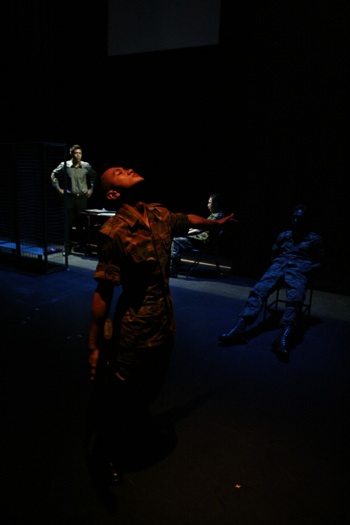 (photo credit: Irfan Kasban)
Event: “Charged” by Teater Ekamatra (as part of the Man Singapore Theatre Festival)
Venue: Drama Centre Blackbox
Run: 3rd Aug – 7th Aug 2011
The original run for “Charged” took place last December at the Drama Centre Black Box, and even though it was a short run, it had received many favourable reviews.
Since then, “Charged” has gone on to win Best Script (Chong Tze Chien) at this year’s Life! Theatre Awards.
I was unfortunately unable to attend last year’s initial staging, and thus I eagerly looked forward to watching it two nights ago.
It so happened that Thursday evening was also the book launch of Tze Chien’s new book of plays, thus before the play began I was able to have a quick chat with the gifted playwright whilst asking him to autograph on the copy of his book of plays that I bought.
I also asked if this year’s staging was any different from the original staging, and he mentioned that small tweaks had been made here and there, but not much.
“Charged” is appealing in many ways because it is a play set in a place which most Singaporean males can probably relate to – an army camp.
(After the play I asked Ilkosa if she could relate to the whole army setting of the play, and she said “not so much”, so I guess this setting is slightly more relevant to those who have served NS.)
The comparisons to Rashomon are inevitable, at least in its approach, whereby various army boys give different accounts to the investigating officer of what they believe was the true story behind Russell’s shooting of Hakim, and subsequently his taking of his own life.
The story essentially revolves around Officer Victor de Souza’s mission of making sense of this seemingly senseless double-death, and along the way we are awakened to the harsh unspeakables of racist sentiments, as well as the fact that the truth is always kept off the record, and that while “race can be used to explain many things, it can also explain away many things” (one of the best lines in the play).
“Charged” is a very powerful piece as it brings to the forefront many of the unspoken thoughts that many Singaporeans may or may not have harboured in their hearts with regards to this very fragile and delicately-poised equilibrium we’ve come to know as “racial harmony”.
It was basically a no-holds-barred barrage of highly-charged sentiments, and hardly anything that should not be said was not said.
Yes, theatre is meant to disturb and challenge and provoke, but I personally wondered if it was necessary to bring out all these racist sentiments wholesale through the altercations between the soldiers on guard duty.
I wondered if there were a more subtle way to bring out these sentiments, rather than by letting the soldiers just blurt all these out in a rather clumsy fashion.
Perhaps a more subtle approach might have been slightly more effective, rather than have everything thrown into our faces lock, stock and barrel.
Having gone through many years of national service myself, I personally wondered if such racial altercations are all that common or realistic in Singapore camps, because I had not personally heard of any such stories before.
Not that I don’t believe that racial differences and varying sentiments don’t exist, just that I didn’t believe that they would ever manifest themselves in such an explosive manner.
It took a leap of faith to throw myself into the plausibility of this scenario.
As such, I had a slight problem in the believability of the play, in that I did not find it likely that something like this would have happened in Singapore.
But that aside, “Charged” is very well-written as it gives ample development to all characters, from Russell and Hakim to Officer de Souza to Zubir to the two mothers.
It was highly-satisfying as we got to see all the different stories being adequately fleshed out.
Tze Chien, once again, provides us with many strong and memorable lines throughout the play.
The acting in the cast did seem slightly uneven though.
Tan Shou Chen was commendable in his portrayal of Corporal Russell, and the mothers of the two dead soldiers, played by Serene Chen and Aidli “Alin” Mosbit, were very convincing as well.
Lastly, just a small point to note that I found it difficult to empathise with either Russell or Hakim, because the fundamental problem was that we were never told the true story and were given three or four different accounts for us to form our own conclusions.
As such, we were not informed of what the real Russell or the real Hakim was, and were unable to decide if we wanted to sympathise with them or not.
But nonetheless, I found myself being riveted by this extremely tense and thought-provoking play from Teater Ekamatra, and it is fantastic to see such challenging new plays being produced.
Into the Woods
Don’t expect singalong melodies or soothing tunes. But, as characteristic of Sondheim musicals, expect bouts of witty lyricism. The poetry was riddleful (if there’s such a word) and it had its own set of rhymes. And in what seem like “chaos” at first as fairytales converge, the musical moved on at a fast pace. The audience was kept engaged in the continuous flow of events, the twists and turns, ups and downs, that there wasn’t a dull moment as we were “pushed” along the story together with the characters as they bustled on stage to fulfil their destinies.
Although I am not that familiar with Sondheim’s musicals/writings, it is known to me that the beauty and genius of his works lay in his lyrics. And there are some clear morals/lessons taught. Be careful what you wish for as it might cause repercussions not just for yourself, but to others. And you have to learn contentment at some point, or else there’ll be unending wishes. And so, what happens when a fairytale ends? Reality. Things we do have ramifications and you’ve got to handle your own problems and decisions, just as how the narrator died in the 2nd Act, leaving the story to be told by the characters themselves. And the funny thing was, all the trouble started with a bag of beans. See how sometimes the most trivia of things (芝麻绿豆) can spark a long-drawn fiasco, all for nothing and back to square one. And don’t we just like to blame everyone else? But good thing at the end, each took responsibility and worked together, growing in maturity and wisdom. There were some sacrifices along the way, but that’s life isn’t it?
One scene felt a little redundant though, and that was the baker’s wife’s affair with one of the princes. If it were to cause the breakup of the prince and Cinderella, or the irony of the baker’s supposition of the prince’s philandering ways to Cinderella, I felt it wasn’t totally necessary or fitted well. But maybe there’s a moral behind that? Don’t get distracted and tarry, or you might just lose your life, literally.
Performed as Dream Academy’s tribute to Broadway musicals and a homecoming for some of the cast and director, the production saw a strong cast of our much-loved actors and actresses, and also Emma Yong’s return to the theatre scene after her battle with cancer. Great to see her back. Each actor/actress held their own in their characters and all executed their roles well. Sondheim’s songs aren’t exactly the easiest to sing and I can imagine that it’ll be easy to trip over the words. What must be the favourite comic relief duo of the night must be the princes, who triggered my friend and I (among others) into laughing whenever they appeared, especially with their rendition of “Agony”.
And wow, I was quite impressed with the props, especially the revolving tree, inspired by a very beautiful intersection of tree growth (which was shown in the programme). I so want to know where that place is…I have this thing about trees. It helped to add some “mystery” in the woods as many things can get hidden behind it. It doubled up as the tower of Rapunzel as well. I must say I liked the wooden cow Milky White too, which “played along” pretty well. Ha!
I agree with Jeremy that the lips projected in the backdrop that represented the giant was a bit out-of place but indeed, how else to do it? A drop-down prop maybe? But maybe, just a booming voice would have sufficed, or shadows? But no “fee-fi-fo-fum” though. Ha!
To sum up, it might not be as easy to follow or engage if you’re new to watching musical theatre, but I believe it’ll be a different experience altogether from the normal song and dance.
Foray Into The Woods Reaps Poor Returns Thus Far
Adeline Chia’s piece on page 2 of today’s Life! made for rather disheartening reading.
She mentioned how Dream Academy’s current mega musical production of Sondheim’s “Into The Woods” is experiencing slow ticket sales, with only about half of the 20,000 available tickets sold thus far.
I was particularly surprised by this fact, considering Dream Academy was hard at work with the marketing for this production, starting almost as early as in March with the initial publicity photos and all that.
They have indeed been working hard on marketing from day one.
In all honesty, Dream Academy’s production is a highly commendable one and is definitely deserving of better patronage.
Granted, last year’s touring production of Sondheim’s “A Little Night Music” probably might not have done well, because I was there on one of the nights and the turnout was miserable.
But this didn’t seem to be the case when I was at opening night of Dream Academy’s “Into The Woods” last Friday.
I did a quick survey of the Esplanade Theatre and I believe it was approximately 75%-80% filled that night. (Or maybe it was just because it was opening night.)
Whatsmore, “Into The Woods” seems to be a much more easily-marketable show than “A Little Night Music” is.
If ever there was a Sondheim show that could be considered mainstream enough to attract a general audience, then I suppose “Into The Woods” would have been it.
Truth be told, while Dream Academy deserves high praise for having the guts to stage a Sondheim show, they would probably also have been aware right from the onset of the tremendous risks involved in taking on such a production.
Sondheim shows aren’t the easiest shows in the world to sell.
Sure, there are the hardcore musical theatre fans who will always view Sondheim as “God”, but even to the average musical theatre fan, Sondheim isn’t always the most enticing of prospects.
Personally, as a huge fan of musical theatre myself, I perfectly admire the lyrical genius of Sondheim, but would much rather prefer the lush harmonies of Loewe or the golden melodies of Rodgers any day.
It’s kinda sad, but it seems like the most commercially successful show a producer can put on nowadays is either:
a) a Disney spinoff, e.g. “Beauty and the Beast”, “The Lion King”, “The Little Mermaid”
or
b) a jukebox musical, e.g. “Mamma Mia!”, “We Will Rock You”
or
c) a Euro mega-musical, e.g. “Les Miz”, “Phantom of the Opera”, “Miss Saigon”
Incidentally, Adeline Chia’s article also revealed that Toy Factory’s “881” musical earlier this year also didn’t fare too well, with less than 60% attendance.
I was pretty surprised by this fact as well, as I had thought that “881” would have had many things going for it, such as being able to draw on the fame of the Royston Tan film, plus the fact that it appealed to the Chinese-speaking crowd, plus the fact that it carried a number of Hokkien tunes.
But alas, even all these were not enough to achieve more than 60% attendance.
On the one hand, you really have to applaud local theatre companies like Toy Factory and Dream Academy for sticking to their guns and bravely putting up huge musical productions which they believe in.
But on the other hand, you wonder how long it will be before they start to throw their hands up in despair and turn to the tried-and-tested, money-spinner fare of the Lion Kings and the Mamma Mias and the Phantoms.
Snails and Ketchup
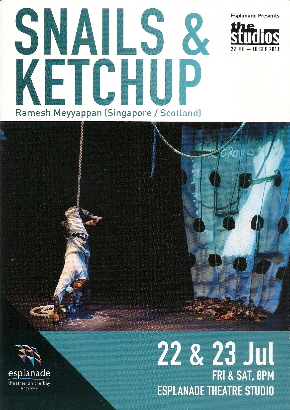
Event: Snails & Ketchup (part of The Studios series by Esplanade)
Run: 22 & 23 July 2011
Venue: Esplanade Theatre Studio
Created & Performed by: Ramesh Meyyappan
Creative/Production team: Produced by Chloe Dear/Iron-Oxide; Directed by Josette Bushell-Mingo, Music by Tze
Inspired by Italo Calvino’s “The Baron in the Trees”, Snails & Ketchup is the darkly comic tale of a dysfunctional family and follows a son taking to the trees to live an arboreal existence, escaping his brutal home environment for the solace of the forest. It is told in the style of physical theatre, where the entire story was told entirely via body expression, with no spoken words. That, I guess, explains the very comprehensive synopsis given, which helped me follow through the story. It was a performance aimed at exploring family relationships, responsibilities and existence, though maybe extreme at points. As I read somewhere, it “reminds us that despite familial love being unconditional, it is sometimes impossible to co-exist with those we hold dear.”
The story tells of how a boy finds solace in snails when faced with an obsessive an indifferent father, who has no compassion; a mother who tries to do her duty and fixes everything with her sewing (and I mean everything); and a sardonic twin sister who cooks with the most perverse kind of ingredients, including the snails which the boys find solace in, and half-cooked at that. Following an incident where his father forces him to eat the half-cooked snails his sister cooks, the boy escapes into the woods where he found his snail friends and the solace he needs, scaling the trees and living in them. Finally he can breathe. But the father comes in search of him, determined to bring him back to the family and in a struggle, tragedy happens, and the boy never returns home again.
Opening with the turning point of the protagonist’s in a convulsive moment (after the force-feeding), followed by a return to the past, Ramesh brings us through the story of father, mother, daughter and son (the protagonist), all by himself, and oh, as the snails too. How does one play 4 different characters and at the same time manage the aerial choreography, considering he needed to switch between roles? And without words/speech, just body expression. It was no mean feat as he does this skillfully with distinct mannerisms established in the beginning when he introduced the 4 characters accordingly. You could easily distinguish the characters, even when they appeared in the same scene and at no point were we lost on which character was on stage or how the story was going. In addition, Tze, with his scoring and live accompaniment, helped us differentiate by rhythm and pace, and also enhanced the mood and tones in the performance. It was a full hour of piano-playing on Tze’s part. As for the acrobatic rope works, he learnt it from scratch for this piece. Well-executed and almost natural, he recalls his instructor was almost hesitant to teach him as he was worried about how to communicate with Ramesh. There were “scares”, but it was obvious the training was a success. In any case, the storytelling was done astutely, even though I felt the story rather dark. There was a disturbing scene of the mother who had sewn up the children’s mouth at childbirth, probably because of post-natal depression, and it was later used against them as a threat when they were fighting (many of us didn’t realise this until it was told in the post-show dialogue with the help of an interpreter).
As a matter of fact, it didn’t occur to me that Ramesh was actually deaf until the end of the performance. I hadn’t known much about him (and somehow missed that detail in the programme), and had come for this performance because Tze, the composer, was a friend of mine. But that didn’t affect the understanding of the show at all. In fact, it was amazing how the music and actions of Ramesh were perfectly synced. Composer and actor communicated through signals, by tapping, and signs of the “feel” of the music like ‘floating’ and the like. The music (for those who relied on it) enhanced the show and the purpose was to help the audience get into the story faster, and at the same time set the pace. It worked. The live score was complementary.
And the way Ramesh interacts with the audience, he “feels” them, to engage them, even though he couldn’t hear their response. As explained in the post-show dialogue, the space (close & intimate space of the Theatre Studio) aided this.
In closing, as I had read the full synopsis before the show, I just followed the story through. Too bad I couldn’t give a perspective of not having known the details of the story, or else I would have been given to a more “twistful” feel of the show. And why “Ketchup”? I was told that I would need to read “Baron in the Trees” to find out.
(“Snails & Ketchup” is a Singapore-Scotland collaborative project commissioned for Unlimited as part of the London 2012 Cultural Olympiad principally funded by the National Lottery through the Olympic Lottery Distributor. It is supported by Singapore International Foundation, Creative Scotland, Esplanade – Theatres on the Bay, the National Arts Council (Singapore) and Made In Scotland.)
Snails & Ketchup will next be staged in Edinburgh at New Town Theatre from 6-28 August.
Into The Woods
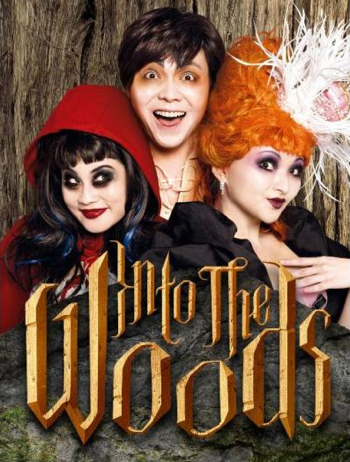
Event: “Into The Woods” by Dream Academy
Venue: Esplanade Theatre
Run: 29th Jul – 7th Aug 2011
Dream Academy’s Delightful Foray
First things first, it is so wonderful to see Emma Yong back on stage once again.
Truly one of the most talented musical theatre actresses we have in theatre today.
I had the pleasure of catching Dream Academy’s ambitious new production of Stephen Sondheim’s acclaimed “Into The Woods” on opening night.
As such, minor glitches and kinks in the show must be forgiven, since they are par for the course on opening night, and hence we shan’t dwell too much on those.
This is the biggie – a grand and elaborate staging of “Into The Woods”, complete with giant tree, intricate costumes, lavish makeup, fake cow and all.
Publicity for this show began as early as March this year, and credit goes to Dream Academy for crafting a sustained marketing campaign on Facebook and the like for almost four months straight.
The stacked cast includes Emma Yong, Sebastian Tan, Adrian Pang, Selena Tan, Lim Kay Siu, Denise Tan, Robin Goh, RJ Rosales, George Chan, and many others.
The musical is directed by Glen Goei, choreographed by George Chan, and musically directed by Elaine Chan.
I wonder if anyone else caught the beautiful irony in the casting – Emma Yong reprising the role of Cinderella (which she has done twice in “Cinderel-LAH!”), and Sebastian Tan reprising the role of Jack (which he once did in “Jack and the Bean Sprout”).
So it was kinda like déjà vu in some sense, seeing Emma Yong being bullied by her step-sisters, and seeing Sebastian Tan trying to sell away his cow for beans.
But good fun nonetheless.
You could probably say that Dream Academy hardly spared any expenses for this production.
The costumes are elaborate, the sets are impressive (the centrepiece being, obviously, the huge tree in the middle of the stage), and the cast is huge.
Sondheim, being known more for his lyrics and complexity of music rather than for hummable melodies, once again blows us away with lyrics and rhymes of impeccable quality.
(“The end justifies the beans”? Wicked!)
Songs that stood out for me were “Agony” and “On the Steps of the Palace” for their high comedic value, and “Your Fault” for its complexity and the intelligence in its dramatic construction.
Music-wise, there weren’t any tunes that seemed to jump out at you in the way a Richard Rodgers tune would, although the “into the woods” refrain did manage to lodge itself in one’s memory.
Credit goes to Denise Tan for once again putting in such an exceptional performance.
In my opinion she was easily the star of the night, although RJ Rosales, Ria Jones and Adrian Pang deserve high praise as well.
I thought the portrayal of the Giant’s wife via the lips on the screen projection seemed a tad out-of-place.
It seemed a rather strange and clumsy way to portray her presence, but then again, I can’t really think of a better way to do it either.
Generally “Into The Woods” was rather pacey, although the story did seem to take a number of rather bizarre and fantastical twists, which made it hard for one to take the story very seriously, nor to be able to be fully vested in the story.
Lastly, is Dream Academy’s “Into The Woods” an entertaining show?
It certainly is.
But one should not expect humour in the mould of the recent “Beauty Kings”.
The humour is much more subtle, and far less in-your-face.
And if you’re keen on Broadway lyrics which blow your mind away, then this is the show you’re looking for.
As I’ve mentioned before, Sondheim musicals don’t come our way very often.
Kudos to Dream Academy for daring to take a show like this on, and for pulling off what is in my opinion a very remarkable piece of musical theatre.
Into the woods, it’s time to go!
Man Singapore Theatre Festival 2011

The Man Singapore Theatre Festival 2011 will take place from 3rd to 21st August at the Drama Centre.
This is the third installment of the Singapore Theatre Festival, which is staged by W!ld Rice.
We at Buttons in the Bread are very grateful to W!ld Rice for their kind offer of a Media Pass to this anticipated event, and we look forward to being able to cover it in the next few weeks.
The festival’s 6 productions are as follows:
I am particularly looking forward to watching “Charged”, the racially-charged play featuring the winner of Best Script (by Chong Tze Chien) at this year’s Life! Theatre Awards.
I unfortunately missed its initial staging last year, so I am very much looking forward to catching the restaging.
“Family Outing” is also an interesting one, as it is the first full-length play by young playwright Joel Tan.
“Cooling Off Day” is, of course, poignant because it tackles what was very likely the biggest event in the Singapore social landscape this year – the 2011 General Elections.
It is unique in the sense that “Cooling Off Day” seems to be a play pieced together via the accounts of actual views of Singaporeans from all walks of life on the General Elections.
Lastly, “The Weight of Silk On Skin” stars the inimitable Ivan Heng in what seems to be yet another solo effort on a script by Huzir Sulaiman, and directed by Claire Wong.
One must applaud Ivan Heng and his team at W!ld Rice for taking the effort to promote new local theatrical works, and to bring these works – some brand new, some previously staged before – to a larger audience.
I think this is beneficial to the state of local theatre.
The Man Singapore Theatre Festival is a theatre festival not to be missed.
Lovers of local theatre, or theatre in general, would be advised to catch at least one, if not a few of these intriguing works.
(All tickets available from SISTIC.)
VISION
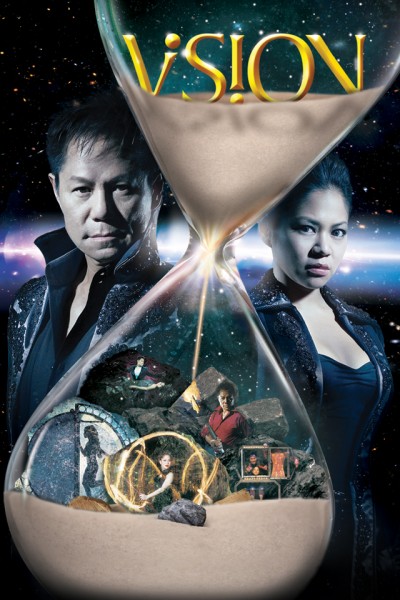
Event: VISION (link)
Run: 15-24 July 2011
Venue: Esplanade Theatre
Cast: Lawrence & Priscilla Khong
Creative/Production team: Produced by Felina Khong; Directed by Samantha Scott-Blackhall & Beatrice Chia-Richmond, Music by Kenn C.
With a tagline “Where Seeing is Just the Beginning”, what we saw was a vision of non-reality, a vision of possibilities or impossibilities. That’s how I would describe the magic. VISION is the latest, if not largest, theatrical magical production since MAGICBOX staged three years ago by the father-daughter team of “The Magic of Lawrence and Priscilla“, which will capture you in the illusions woven before your eyes. Being meant as a magical showcase with a storyline, the story tells of the relationship between a father-daughter pair of magicians. The daughter feels neglected by the father, whom she believes is only concerned about himself and magic. In a bid to test him and win him back, she creates an alternate reality and they are both transported into it. It goes through memories of his and her childhood, and for her, she has a bad memory of believing that her father chose a phone call over her while practising a trick, which resulted in her being injured and scarred. Later, in a bid to make her father forget about magic, she attempts to break its spell on him as a boy. That leads to a lost future for him. Finally, she realised it was a misunderstanding and her memory had failed her. Father-daughter patches up.
Having worked very hard and gone a long way over the years, Lawrence and Priscilla, have the skill to show. As Jeremy commented (he’s the one more familiar with this area, while I just watch), it was good that they performed a variety of illusions catering from personal (close-range) to that for a bigger audience.
My favourite illusion was in “Act 1 Scene 1: A Las Vegas Style Magic Show – Don’t blink your eyes”. In less than a blink, Lawrence and Priscilla swopped places instantaneously by just a wave of the cloth. Other highlights included:
1) the sudden appearance of a Lotus Evora on stage. They had 4 people from the audience to guard the sides of the canopy (which was set up on the spot) and when it was removed, the car was there!
2) The disappearing act into the “alternate reality” – The cylindrical rim where the centre is hollow, but halved by a centre piece, which as the person steps through, disappears (doesn’t appear on the other half-side).
3) The empty container that was suddenly filled with a truckload of people.
4) The “great escape” near the end where they were chained and raised up and given 30 seconds to escape before they were dropped, whereby at due time, they appeared in the audience.
5) The ring trick where he randomly picked 3 ordinary rings from the audience and linked & delinked them by just throwing them into a glass. I could understand if it were “magical” rings, but ordinary ones like wedding bands, etc.?
There were also the usual conjuring and levitation tricks and the newspaper trick. Although I’ve seen some of these tricks many times, whether on TV or stage, it never ceases to amaze me.
The sound design played some part in creating effect too. This was my first time hearing a very “surround” effect in the Esplanade Theatre and of course, keeping us guessing on where they would appear. I think the sound engineering part was done quite well, though some parts were slightly loud. And my, the sets were massive and so varied! Not just the magical props which I heard cost quite a lot especially the box stuff (and there were quite a few of these), but also the theatrical sets (platforms, backdrop, etc.). The Capitol Theatre backdrop was quite magical in the way that I didn’t realise the images were projected onto it. Initially, I thought it was a painted wooden backdrop, until they starting screening the “Slightly Scarlet” trailer followed by various changes to the scene. Haha, maybe I wasn’t looking hard enough.
Unfortunately though, the story was weak. Well, honestly, I wasn’t expecting much. As ideal as it would be to meld magic and drama together, insofar, it might prove less practical in real life (have not really seen a successful one yet). One can either focus on performing magic, or focus on the story. Yes, you can have simple magic tricks in a story, but with magic on this scale, it’s not easy. And as Jeremy said, it felt a bit contrived. We understand the desire to explore the father-daughter relationship story but it didn’t come out strong enough, and the underlying message wasn’t clear. The chicken pox story was a major downer for the whole climax of the show. They could have just kept to the falling story and him rescuing her without adding that in. Maybe a musical-type performance might have worked better because songs could have added depth to the story and characters.
Nevertheless, I guess the magic alone is good enough to warrant a watch. I know I’m asking too much, but it would have been splendid and grand if, with a bow, the main cast did a disappearing act as an encore finale. Ha!

 Buttons In The Bread